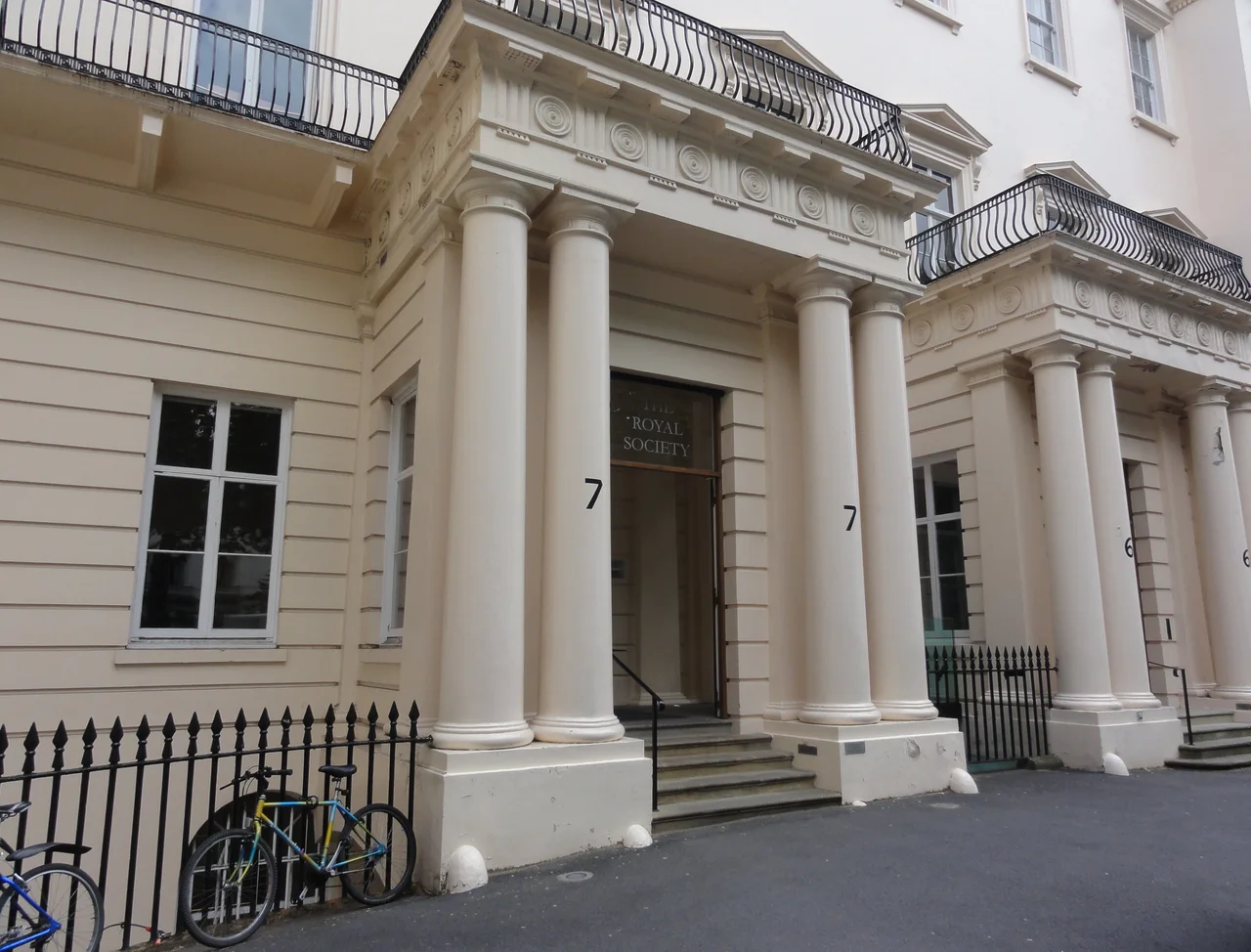

Royal Society
On 28 November 1660, twelve natural philosophers gathered at Gresham College in London and decided to form a society for the promoting of "Physico-Mathematicall Experimentall Learning." Among them were Christopher Wren, Robert Boyle, and John Wilkins. The king approved of the gatherings. A royal charter followed in 1662, then another in 1663. The society they founded became the Royal Society — the oldest continuously existing scientific academy in the world, still operating today from Carlton House Terrace, still electing fellows by secret ballot, still publishing journals that trace their lineage to 1665.
The Invisible College Becomes Visible
Before the Royal Society had a name or a charter, Robert Boyle was writing to friends about "our invisible college" — a network of experimenters sharing ideas across the Republic of Letters. The society grew from these informal exchanges, from meetings at Gresham College in London and Wadham College in Oxford, from the influence of Francis Bacon's vision of organized scientific inquiry in his New Atlantis.
The founding was not without political dimension. The Restoration of Charles II brought the monarchy back to England in 1660, and the king's early patronage of the society gave it legitimacy. Every British monarch since has been the society's patron. The Charter Book, signed continuously since 1663, carries the signatures of kings, queens, and scientists whose work remade the world. All monarchs have signed it — except William and Mary, and Queen Anne.
Newton's Tenure and Its Complications
Isaac Newton served as president of the Royal Society from 1703 until his death in 1727 — nearly a quarter century. Under his presidency, the society's reputation grew substantially, and the number of fellows increased from 110 to roughly 300 by 1739. But Newton was not above using the position for personal advantage.
In a dispute with Gottfried Leibniz over who had invented infinitesimal calculus, Newton appointed an ostensibly impartial committee to adjudicate the matter, then wrote the committee's report himself — and published it under the committee's name. The society declared Newton the priority holder. Leibniz, who had developed his own version of calculus independently, died in 1716 still contesting the decision. The controversy is now generally regarded as having had no clear winner, and both men are credited.
The First Scientific Journal and Peer Review
In 1665, the society launched Philosophical Transactions — the world's first journal exclusively devoted to science. Its founding editor was Henry Oldenburg, the society's first secretary. The process of having submitted papers reviewed by other experts before publication was formalized through this journal, making the Royal Society the origin point of scientific peer review as it is practiced across research worldwide today.
Philosophical Transactions remains the oldest and longest-running scientific journal in the world. It now publishes in two streams — A for mathematics and physical sciences, B for biological sciences — and the society publishes eleven journals in total. In 1945, the first female fellows were elected: Marjory Stephenson and Kathleen Lonsdale. The statutory amendment that made this possible had passed in 1944, with 336 fellows voting in favor and 37 opposed.
Carlton House Terrace
The Royal Society has moved several times since 1660 — from Gresham College to Arundel House to Somerset House to Burlington House and finally, in 1967, to its present home at 6–9 Carlton House Terrace. The building was designed by John Nash and is still owned by the Crown Estates. The society leases it and underwent a £9.8 million renovation between 2001 and 2004.
Today the society disburses over £100 million annually to fund nearly 1,000 research fellowships. It advises the UK government, the European Commission, and the United Nations on scientific matters. Up to 73 new fellows are elected each year from a pool of roughly 800 candidates. The motto on its coat of arms — Nullius in verba, meaning "take nobody's word for it" — remains the guiding principle. Question everything. Verify through experiment. The society has been saying so for 365 years.
From the Air
Located at 51.5061°N, 0.1322°W at Carlton House Terrace in the City of Westminster. The building faces St James's Park, which is easily identifiable from the air. Nearest airports: London City (EGLC, ~7nm east), Heathrow (EGLL, ~14nm west). Buckingham Palace is roughly 0.5 miles southwest; Trafalgar Square is approximately 0.4 miles northeast.
Nearby Stories
- Stevenage 5.7 km away
- Malling Abbey 5.7 km away
- 1952 Farnborough Airshow Crash 7.7 km away
- Ingatestone Hall 8.2 km away
- Hellfire Caves 9.1 km away
- The Carrington Event: The Solar Storm That Could Happen Again 9.8 km away
- Bletchley Park 16 km away
- Castle Hedingham 23 km away