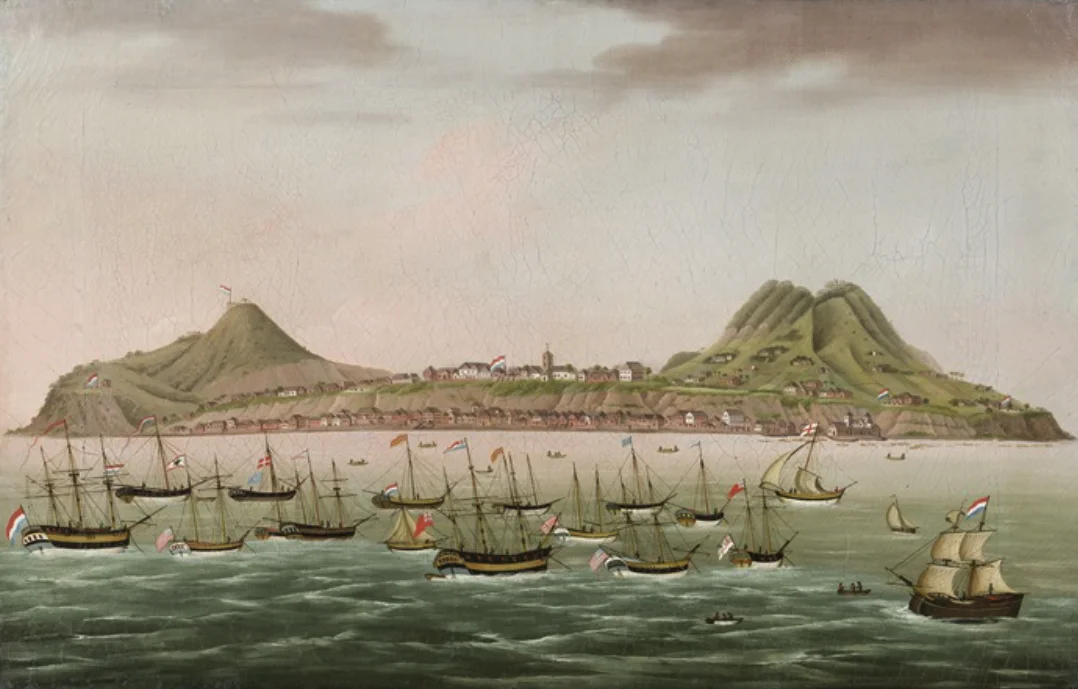

Run Island
Historian John Keay put it plainly: 'As the island of Runnymede is to British constitutional history, so the island of Run is to British imperial history.' The claim sounds absurd until you see the island -- three kilometers long, one kilometer wide, the westernmost speck of the Banda group, barely visible on most maps. Yet in the 17th century, this sliver of volcanic rock in the Banda Sea produced nutmeg worth more than gold by weight, and the fight over who controlled it would reshape two hemispheres.
Christmas Day, 1616
English sailors from the East India Company had been visiting Run since 1603, establishing trade contacts with the islanders and building a small settlement on the islet of Naijalaka off Run's northern tip. But it was on December 25, 1616, that the stakes became existential. Captain Nathaniel Courthope and his first mate Zachary Barnett Duncan arrived to plant the English flag and defend the island against Dutch claims. Courthope signed a contract with the Bandanese inhabitants, who accepted James I of England as their sovereign -- a remarkable act of allegiance born not from affection for England but from fear of what the Dutch East India Company had done to their neighbors. Courthope fortified Run with forts overlooking the eastern approaches. He had 39 European defenders and the loyalty of the islanders. He would need both.
1,540 Days Under Siege
The Dutch were furious. Run's nutmeg threatened their monopoly over the most valuable commodity in global trade, and the English presence -- small as it was -- undermined the fiction that the VOC controlled the Bandas absolutely. They laid siege, blockading the island and cutting off supplies. Courthope lost two ships, one to mutiny and one sunk by the Dutch. For more than four years -- 1,540 days -- Courthope and his defenders held out, sustained by the island's own resources and the resolve of people who knew what Dutch 'protection' meant for neighboring islands. The siege ended in 1620 when Courthope was killed during a Dutch attack. With their captain dead, the English departed Run. The Dutch response to victory was total: they killed or enslaved the adult men of the island, exiled the women and children, and chopped down every nutmeg tree. Only cattle were allowed to remain, providing food for the other Banda islands. For decades afterward, VOC officials visited Run annually, checking that the English had not secretly returned.
Manhattan for a Nutmeg Grove
The English never gave up their claim to Run. The 1654 Treaty of Westminster, ending the First Anglo-Dutch War, stipulated that Run should be returned to England, but the Dutch ignored the provision. It took another war to settle the matter. After the Second Anglo-Dutch War ended in 1667, the Treaty of Breda formalized what had already happened on the ground: England kept Manhattan -- seized by the Duke of York in 1664 and renamed from New Amsterdam to New York -- and the Dutch kept Run. At the time, the trade seemed reasonable. Nutmeg was one of the most sought-after commodities on Earth, a preservative, medicine, and luxury all at once. Manhattan was a fur-trading outpost with uncertain prospects. History, of course, rendered its own verdict on which island proved more valuable.
After the Empires Moved On
The Dutch monopoly on nutmeg held until the Napoleonic Wars, when British forces under Captain Cole captured the Banda Islands in 1810. Seven years later, the British transplanted nutmeg trees to Ceylon, Grenada, Singapore, and other colonies, ending the Bandas' unique position in the spice trade forever. Dutch control of the islands continued until 1949, when the Dutch East Indies became Indonesia. Run today is part of the Banda District within Central Maluku Regency, with a population contributing to the group's total of about 21,000. Education goes up to junior high school level. The nearest real town is Banda Neira, reachable by local boats that follow no fixed schedule. The airport at Bandaneira is one of Indonesia's smallest, used mainly by administrative staff and the occasional diver drawn to the region's spectacular reefs. Nutmeg trees still grow on Run -- descendants of those the Dutch failed to eradicate completely, or perhaps replanted by the islanders who never forgot what the trees were worth.
From the Air
Located at 4.56S, 129.68E, Run is the westernmost island of the Banda group in the Banda Sea. It is 3 km long and 1 km wide, sitting about 8 km west of Pulau Ai and approximately 20 km from Banda Neira. The small islet of Naijalaka lies 0.7 km to the north. From altitude, look for the elongated shape west of the main Banda caldera cluster. The volcanic cone of Gunung Api (650 m) on Banda Api is the best visual reference for locating the group. Nearest airfield is Bandaneira Airport (ICAO: WPAT) on Banda Neira. Nearest major airport is Pattimura (WAPP) in Ambon, approximately 140 km north. Tropical maritime weather; afternoon thunderstorms common.
Nearby Stories
- Five Minutes of Shaking, Then the Sea Rose 60 km away
- Fort Victoria: Ambon's Stone Witness 110 km away
- The Nutmeg Wars of Banda Neira 120 km away
- Maluku: Where the World Went to War Over Seasoning 128 km away
- The Abyss That Isn't a Trench 129 km away
- The Banda Sea: Where Continents Collide 212 km away
- Misool: Port of Kings 261 km away
- One Stove, Three Stones 301 km away