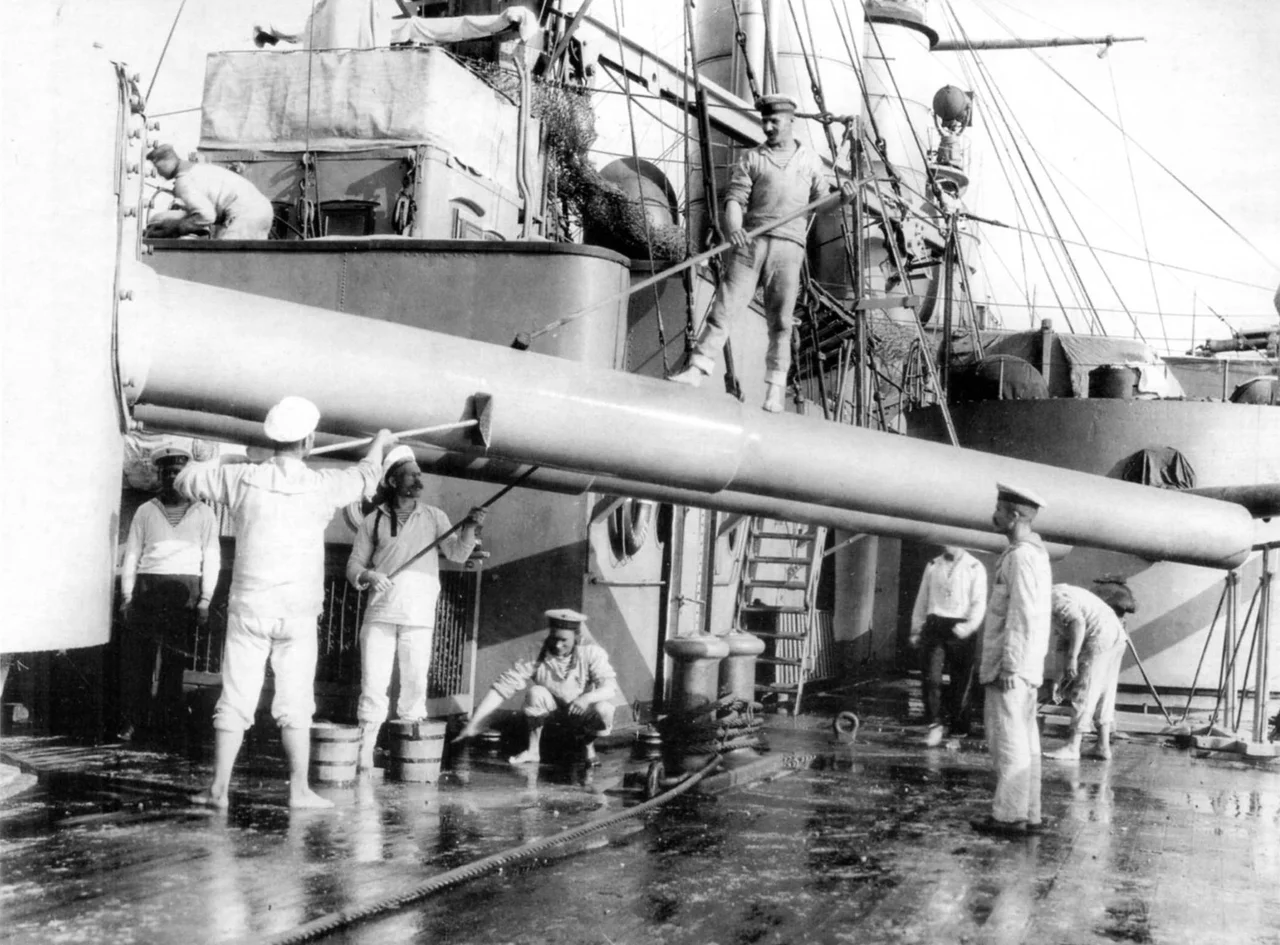

Russian Battleship Rostislav
Somewhere in the shallow water of the Kerch Strait, about 1,200 meters from shore and sinking ever deeper into the silt, lie the remains of a battleship that once made naval history. Rostislav was the first capital ship in the world to burn fuel oil instead of coal, a genuine milestone launched from the Nikolaev shipyard in 1896 for the Black Sea Fleet of Imperial Russia. She was meant to be cheap and compact, but poor design swelled her weight by more than 1,600 tons, and her innovation would nearly destroy her. For a quarter of a century she carried grand dukes, suppressed mutinies, and dueled across the Black Sea, before her own side sank her here in the closing act of the Russian Civil War.
A Grand Duke and a Fatal Innovation
Rostislav sailed into a spotlight. In May 1899 she became the first ship of the Imperial Navy commanded by a member of the House of Romanov, Grand Duke Alexander Mikhailovich, the first of his dynasty to command a warship since Peter the Great. But her pioneering oil-fired boilers proved a curse. Black oil smoke betrayed her position, heat pooled unevenly inside the fireboxes, and for three and a half months the boilers failed one after another, buckling and backfiring. The navy finally gave up on the very innovation that made her famous and converted her back to coal in 1904. Each repair added weight to an already overloaded hull, and by 1907 her armored belt, meant to protect the waterline, had sunk entirely beneath it, a warship slowly drowning in her own excess tonnage.
The Men of the Kambala
The ship's most tragic day came in peacetime. On the night of 11 June 1909, during an anti-submarine exercise, Rostislav rammed the submarine Kambala in the dark and cut her down. Twenty of the submarine's crew went to the bottom, and two divers sent to reach them died in the attempt. An inquiry blamed the submarine's maneuvering and cleared Rostislav's captain, but no verdict could soften the loss: twenty-two men killed in a training accident, the sea closing over them in the strait's black water. It was a grim reminder that the dangers of naval life did not wait for war, and that the sailors who crewed these ships, on the battleship and the submarine alike, paid the price for every mistake at sea.
The Long Sinking
War gave Rostislav a fuller life. In the First World War she became the first Russian ship to shell enemy positions on land, supported amphibious landings along the Caucasus coast, and endured the distinction of being the first Russian naval target hit by a German airstrike, a bomb that struck her aft turret and wounded sixteen sailors without silencing her guns. Then came revolution and collapse. In 1918 her crew fled the advancing German army and abandoned her at Sevastopol. British forces wrecked her engines in 1919 to deny her to the Reds, and the White forces of Baron Wrangel dragged the crippled hull into the shallows of the Kerch Strait as a floating gun battery. There she was scuttled in November 1920. Her superstructure stood above the water for years; in 1930 Soviet salvage crews stripped her guns and cut away part of the hull. What is left still lies in the strait, settling slowly into the mud, a monument to a ship of firsts.
From the Air
The wreck of Rostislav lies at roughly 45.42°N, 36.63°E in the shallow water of the Kerch Strait, near the Crimean shore not far from Cape Fonar and the Yeni Kale Lighthouse. From the air, orient on the strait linking the Black Sea and the Sea of Azov; the wreck itself is submerged and not visible from altitude. Nearest airport is Kerch's airfield, with Anapa-Vityazevo (URKA) across the strait.
Nearby Stories
- Koyashskoye Salt Lake 15 km away
- Temryuk 21 km away
- Akra, Crimea 25 km away
- Kerch Peninsula 27 km away
- Abrau Peninsula 47 km away
- Byriuchyi Island 98 km away
- Henichesk 159 km away
- Battle of the Kalka River 173 km away