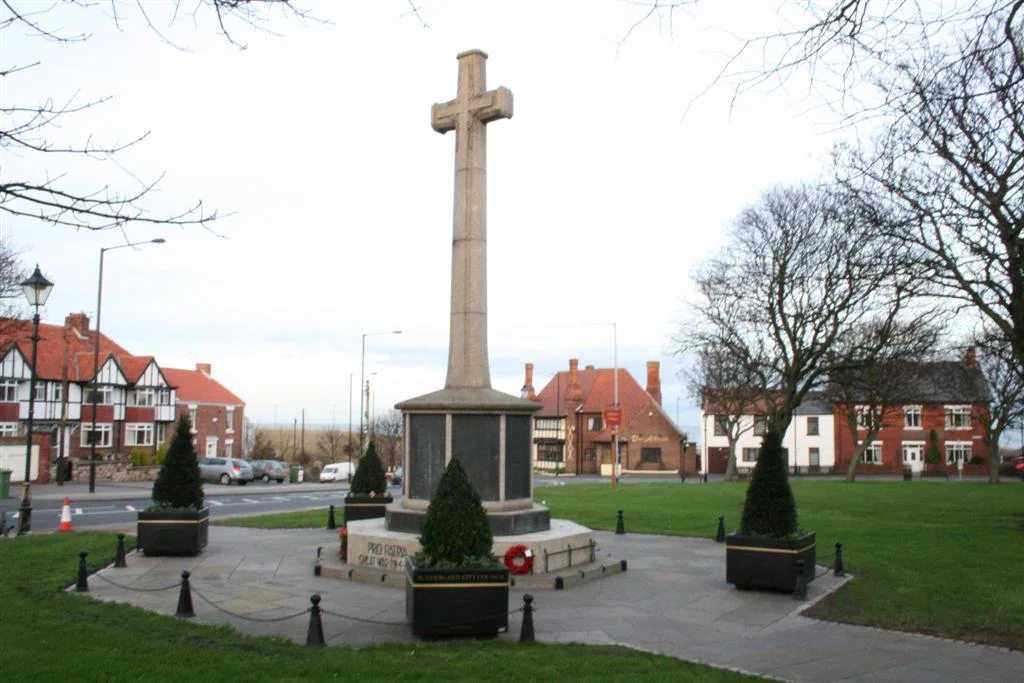

Ryhope
When thieves stole Ryhope's bronze pit pony statue for the second time in October 2021, locals replaced it with a rocking horse. Then more rocking horses. Then teddy bears. The plinth on Stockton Road became, briefly, a viral phenomenon in 2023: a small Durham coast village improvising a memorial to its mining past out of toys, and the internet falling for it. In August 2024 a second pit pony statue, elsewhere in the village, was also stolen. The replacements keep coming. So does the affection for what they represent.
Rough Valley by the Sea
The name comes from the Old English reof hoppas, meaning rough valley, and Ryhope first surfaces in the written record in 930 AD when King Athelstan granted Bishopwearmouth, including the township of Ryhope, to the Bishop of Chester-le-Street. The land had been wrenched back from Vikings who captured it in 918. For most of the next nine centuries this was farming country: 22 villeins recorded in 1183, around 150 people by 1380, common grazing strips radiating from the village green that survived until enclosure in 1860. The beach below the village was said to have been a favourite sea-bathing spot for the Bishop of Durham, which gives some sense of how genteel its coastal reputation once was.
When Coal Arrived
Ryhope sits on the Durham coalfield, and in 1859 a colliery was sunk that would change the village's geography forever. The settlement extended westward toward Tunstall, and Ryhope split into two distinct areas: the old Village around the green, and the newer Colliery section along Tunstall Bank Road. A post-war council estate at Hollycarrside added a third district later. Railway lines threaded in to link Ryhope with Sunderland and Seaham and the other pit villages, and for a century the pit shaped every rhythm of local life. The colliery closed in 1966, the railway stations followed it into disuse, and now only a single freight line and a few names in the street directory mark what was once a community of miners.
The Last Flight of LK797
On the night of 30 March 1944, Pilot Officer Cyril Barton was flying a Handley Page Halifax bomber, registration LK797, home from an RAF Bomber Command raid on Nuremberg when his aircraft was attacked by night fighters over Germany. Three of his crew bailed out, mistakenly believing the order had been given to abandon ship. Barton flew the crippled bomber across the North Sea on three engines, with no navigator, no bomb-aimer, no wireless operator, and brought it down at Ryhope. The aircraft crashed into the village. Barton was killed; his three remaining crew survived. For getting them home he was posthumously awarded the Victoria Cross, the only Halifax pilot to receive one. The village still marks the place.
Tunstall Hills and Pigeon Crees
Walk west from the village green and the land rises into Tunstall Hills, a stretch of magnesian limestone outcrop that became a site of special scientific interest for its uncommon flora: blue moor-grass, common rock-rose, Frog Orchid, Autumn Gentian, Purple Milk-Vetch. The Maiden Paps section preserves geology from the Permian, some 250 million years old, in the cuttings of disused quarries. On a clear day the view runs down the coast almost as far as Whitby. Ryhope also claims one quirky distinction: it is home to the world's first listed pigeon cree, a tiny rooftop loft for racing pigeons that was deemed historically significant enough to warrant statutory protection. Among the Bishop of Durham's bathing beach and Cyril Barton's medal and a stolen statue replaced with toys, the pigeon cree fits right in.
From the Air
Ryhope sits at 54.868 north, 1.370 west on the Durham coast about 2.9 miles south of Sunderland centre and 2.8 miles north of Seaham. Recommended viewing altitude 1500 to 3000 feet. From the air the village shows clearly as the triangular green of the old village set against the rectangular grid of the Colliery section to the west. Tunstall Hills rise to the southwest. Nearby airports: Newcastle International (EGNT) is roughly 18 nautical miles north-northwest; Durham Tees Valley (EGNV) is about 18 nautical miles south-southwest. The A1018 Southern Radial Route runs along the clifftops east of the village. North Sea sea fret is common in spring and early summer.
Nearby Stories
- Seaton Carew 2.7 km away
- HMS Unity (N66) 6 km away
- George Stephenson's Birthplace 6.1 km away
- Raby Castle 9 km away
- Cragside 15 km away
- Whitby Abbey 21 km away
- German submarine U-2367 46 km away
- Alexander L. Kielland (Platform) 277 km away