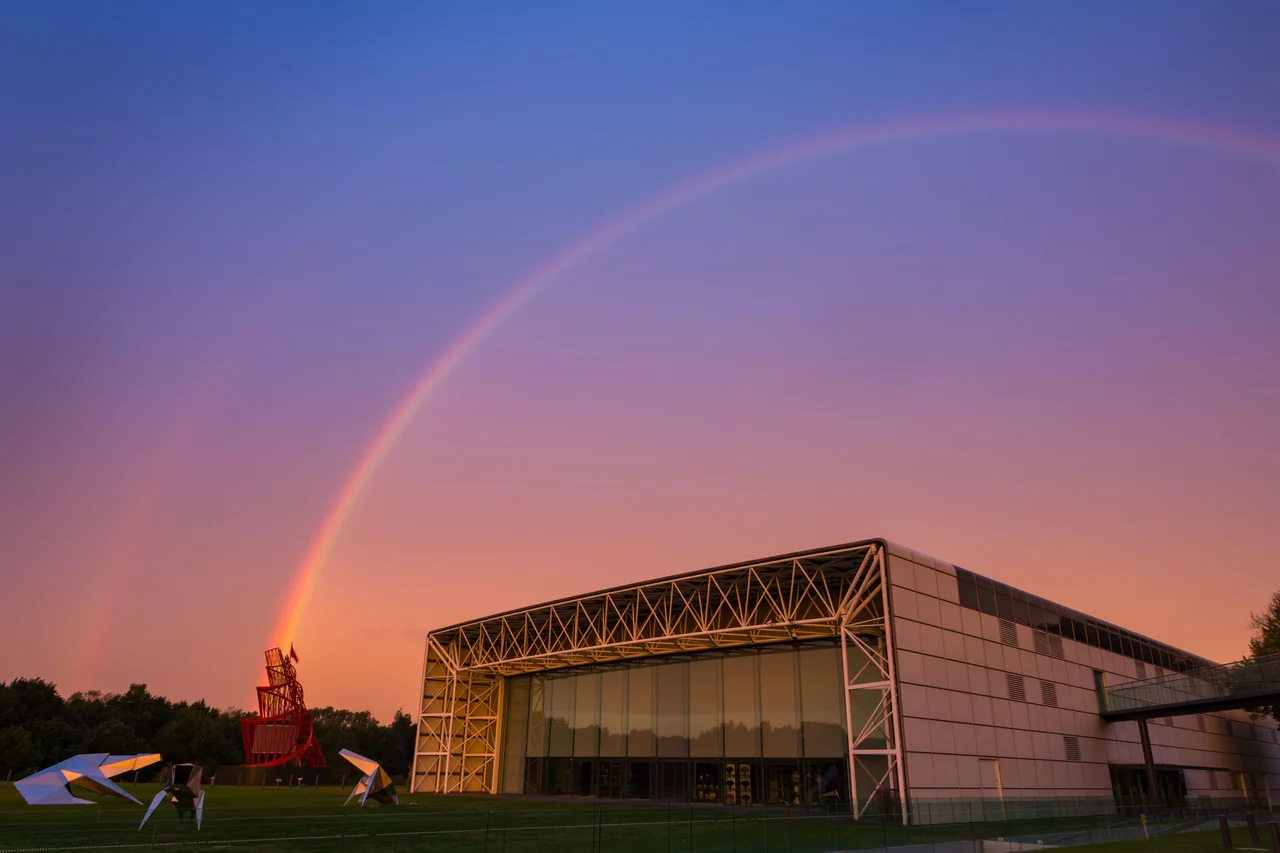

Sainsbury Centre for Visual Arts
In 2023, a single sentence rewrote how a museum sees itself: the Sainsbury Centre became the first museum in the world to formally recognise art as alive. Under new executive director Jago Cooper, the centre adopted an ethos called Living Art Sharing Stories, giving agency to objects in its collection and inviting visitors to build relationships with them rather than simply observe. It was a radical pivot for what had already been a radical building. Forty-five years earlier, Norman Foster had finished a long silver shed on a sloping lawn at the University of East Anglia, and the discipline of high-tech architecture was never quite the same again.
Foster's First Major Move
When Sir Robert and Lady Lisa Sainsbury offered the University of East Anglia their collection in 1973, they chose an architect almost no one outside the trade had heard of. Norman Foster, with his partner Wendy Cheesman, designed the building between 1974 and 1976 and opened it in 1978. It became one of the first major public buildings of Foster's career, the project that began his ascent from talented unknown to Lord Foster of Thames Bank. The critic Chris Abel described its principle as 'a regular structure embracing all functions within a single, flexible enclosure' - a 'universal space' where galleries, studios, restaurant, and reserve collection coexist under one shimmering roof. The cladding made of aluminium panels failed within a decade and had to be replaced in 1988, but the architectural idea proved durable. The Sainsbury Centre is now Grade II* listed, named a Modern Classic by Historic England.
The Crescent and the Lake
By the late 1980s, the collection had outgrown its shed. Foster could have bolted another bay onto the existing building, but instead he looked down. The sloping site allowed him to scoop out an enlarged basement that emerges at a curved glass frontage facing a man-made lake - the architectural firm Anthony Hunt Associates engineering the structure. From the lawn above, the new wing is almost invisible. Approach from the water, however, and a long crescent of glass appears, reflecting sky and reeds. It opened in 1991. The lake itself is one of the campus's strangest features: a body of water excavated between 1973 and 1978 in a 'no money' deal with an aggregate company, who took the gravel and left behind a 7.3-hectare landscaped Broad, an echo of Norfolk's medieval gravel-pit lakes.
Bacon, Moore, Giacometti, Oba
Inside, the collection ranges across more than 5,000 years of human making. The Sainsburys began collecting in the 1930s and donated over 300 pieces to start; the holdings now run to thousands. Henry Moore sculptures sit in the gardens. Inside there are works by Jacob Epstein, Alberto Giacometti, and Francis Bacon, alongside a Fang reliquary head from Gabon, the bronze Head of an Oba from Nigeria, and art from the Pacific, the medieval European mainland, and the ancient Mediterranean. The hanging arrangement deliberately refuses chronology, placing a 5,000-year-old object beside a 20th-century canvas to see what conversation emerges between them.
Cape and Cosmic Cube
In June 2014, Marvel film crews descended on the Norwich campus. The Sainsbury Centre served as fictional Avengers headquarters for scenes in 'Avengers: Age of Ultron' and as a research facility in 'Ant-Man,' both released in 2015. Walking the silver-clad hall today, it is easy to see why a Hollywood location scout might mistake Foster's building for a covert tech compound - the long, repetitive structure, the polished panels, the sense that something complicated is happening just out of view. In fact, what is happening is older and stranger: a Bacon Pope study staring across a quiet room at a Nigerian bronze, and a museum trying to convince you that both are still very much awake.
From the Air
Located at 52.6203 degrees N, 1.2347 degrees E on the western edge of Norwich. From cruising altitude, look for the long silver-grey rectangle of the Sainsbury Centre on the UEA campus, with the curve of the UEA Broad to its south. Best viewing altitude 2,000-4,000 feet AGL. Nearest airport: Norwich International (EGSH) approximately 4 nautical miles north-northeast. RAF Marham (EGYM) lies 25 nm west.
Nearby Stories
- Sheringham 2.7 km away
- Wingfield Castle 4.4 km away
- Castle Acre Castle and Town Walls 6.3 km away
- Brancaster 7.1 km away
- West Stow Anglo-Saxon Village 9.3 km away
- Four Days' Battle 80 km away
- Battle of Lowestoft 80 km away
- SM U-97 110 km away