
Sainsbury's
The sign above the door at 173 Drury Lane in 1869 read "Quality perfect, prices lower." John James Sainsbury was twenty-four years old, his wife Mary Ann was working the counter, and the shop they had just opened sold fresh butter, milk, and eggs to a Covent Garden neighbourhood where most groceries arrived in barrows and bad condition. The promise on the sign was simple, and so was the proposition: bring the dairy clean, light, and tiled into a city that had grown used to grime. It worked. Within a generation the cast-iron J. SAINSBURY signs would arch over shops across London, deliveries would slip discreetly to the back, and the family name would mean something the Victorian high street had not quite invented yet — a brand of trust.
The Drury Lane Promise
Covent Garden in 1869 was the kind of place where you could buy almost anything and trust very little of it. Adulterated butter, watered milk, eggs of indeterminate age — the Public Health Act of 1872 was still three years away, and grocers competed largely on price. John James Sainsbury's innovation was not that he sold cheap food. It was that he sold clean food cheaply. The shop was tiled, the counters were marble, the staff wore white aprons that actually got laundered. Mary Ann worked alongside her husband, and the partnership was less Victorian patriarchy than Victorian sweat equity. The neighbourhood took to it. By the time their first son was born in 1872 above the shop, the Sainsburys were already eyeing a second branch.
How a Family Becomes a Chain
John James was relentless about uniformity. The shops should look alike, smell alike, treat the customer alike. By 1903, when groceries — packaged tea, sugar, biscuits — joined the dairy lines, there were branches across south London. He preferred a parade location to a corner shop, reasoning that a wider frontage meant a longer chilled display, and chilling mattered before refrigeration. By his death in 1928 there were more than 128 Sainsbury's. His son John Benjamin had been working alongside him since 1915. The grandsons Alan and Robert came in next, and then in 1956 came Croydon, where the first self-service branch opened. Customers picked their own tins from the shelves, and the cashier rang a total at the end. The high-street grocer had been quietly rewired.
Good Food Costs Less
The 1960s slogan — "good food costs less at Sainsbury's" — was a quiet boast that the family meant literally. Own-brand goods were pioneered here: products that matched national brands in quality but undercut them in price, all under that orange J Sainsbury logo. When the company finally went public on 12 July 1973, applications closed within a minute. Four hundred and ninety-five million pounds had been offered for fourteen and a half million pounds' worth of shares. For most of the twentieth century, Sainsbury's was Britain's largest grocer. Then, in 1995, Tesco overtook them, and the company that had defined how Britain bought its food spent the next three decades learning how to be number two.
Holborn and the Modern Era
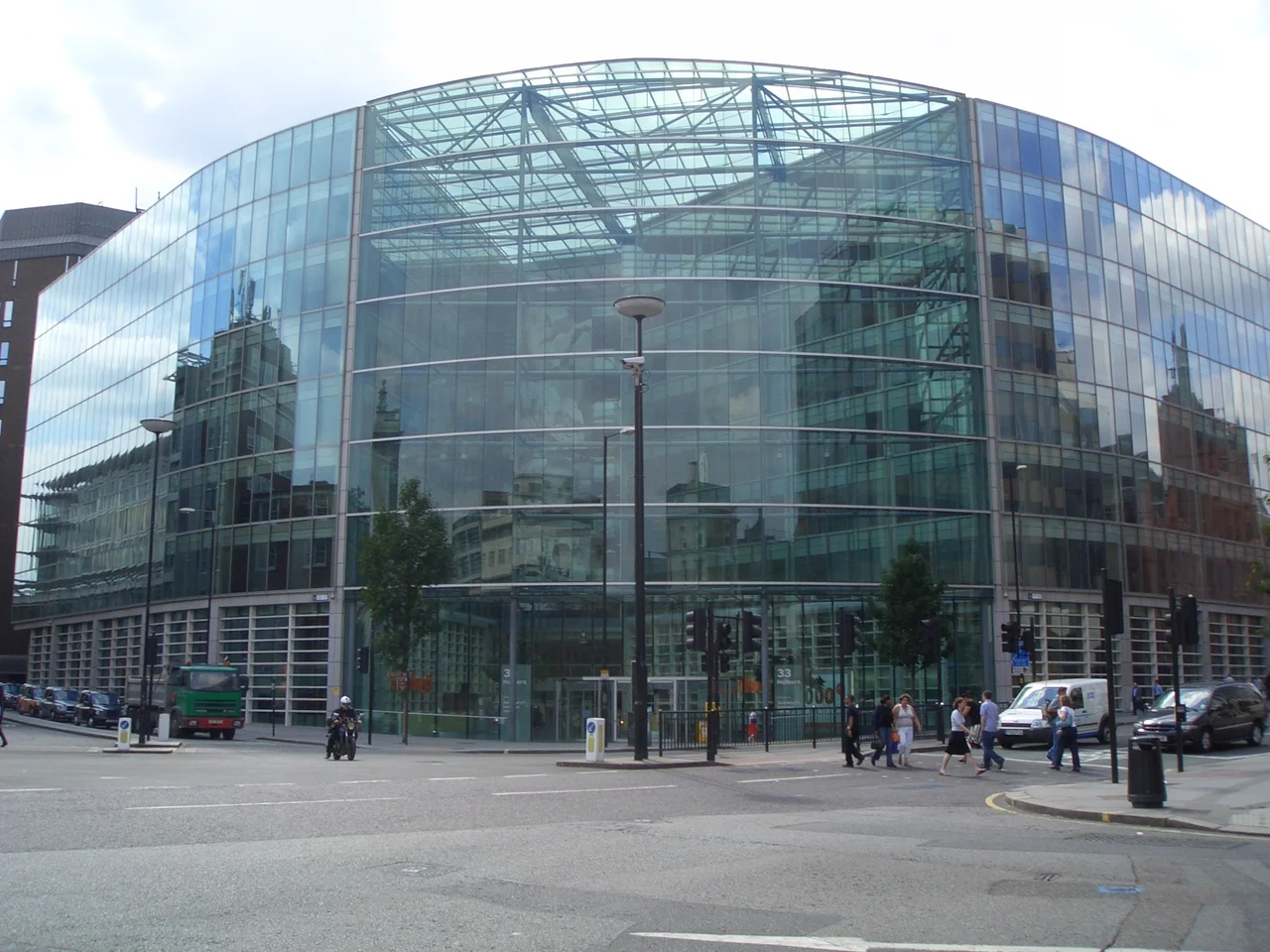
The headquarters at Holborn — a Foster and Partners building originally meant for Andersen Consulting — became home in 2001, a Norman Foster glass-and-steel marker that the chain had moved from Stamford House in Southwark to the centre of legal and commercial London. The empire diversified: a bank in 1997, the Argos acquisition in 2016 for 1.4 billion pounds, Habitat in 2019. The Qatar Investment Authority became the largest shareholder. Through all of it the original logo, refined but recognisable, kept its place above six hundred supermarkets and a thousand-plus Local convenience stores. Every Sainsbury's shopper today is, in a small way, still buying from a Drury Lane dairy that promised quality perfect, prices lower.
What the Sign Still Says
Walk into any Sainsbury's in 2026 — Crayford with its hundred-thousand square feet, the Lincoln superstore, a tiny Local tucked into a Holborn side street — and the lineage is still legible. The orange remains. The own-brand still undercuts the names beside it. The dairy and the bakery still sit near the entrance, the freshest things closest to the door, exactly as John James arranged them at Drury Lane. A company founded by a tailor's son and a butcher's daughter became Britain's largest grocer and then, for thirty years, its quietly determined runner-up. The marble counters are gone, but the proposition that built them has proven remarkably hard to improve.
From the Air
Sainsbury's headquarters sits at 33 Holborn (51.5172 N, 0.1083 W) in central London. From cruise altitude the Holborn-Strand-Aldwych axis is visible as a tight cluster between the Thames and the British Museum, with St Paul's Cathedral about a mile east. Nearest airports: London City (EGLC) eight miles east, Heathrow (EGLL) fifteen miles west, Biggin Hill (EGKB) thirteen miles south-east. The Drury Lane site of the original 1869 shop lies a few hundred metres south-west of the modern headquarters; Covent Garden's market hall is the easiest visual landmark.
Nearby Stories
- Stevenage 5.7 km away
- Malling Abbey 5.7 km away
- 1952 Farnborough Airshow Crash 7.7 km away
- Ingatestone Hall 8.2 km away
- Hellfire Caves 9.1 km away
- The Carrington Event: The Solar Storm That Could Happen Again 9.8 km away
- Bletchley Park 16 km away
- Castle Hedingham 23 km away