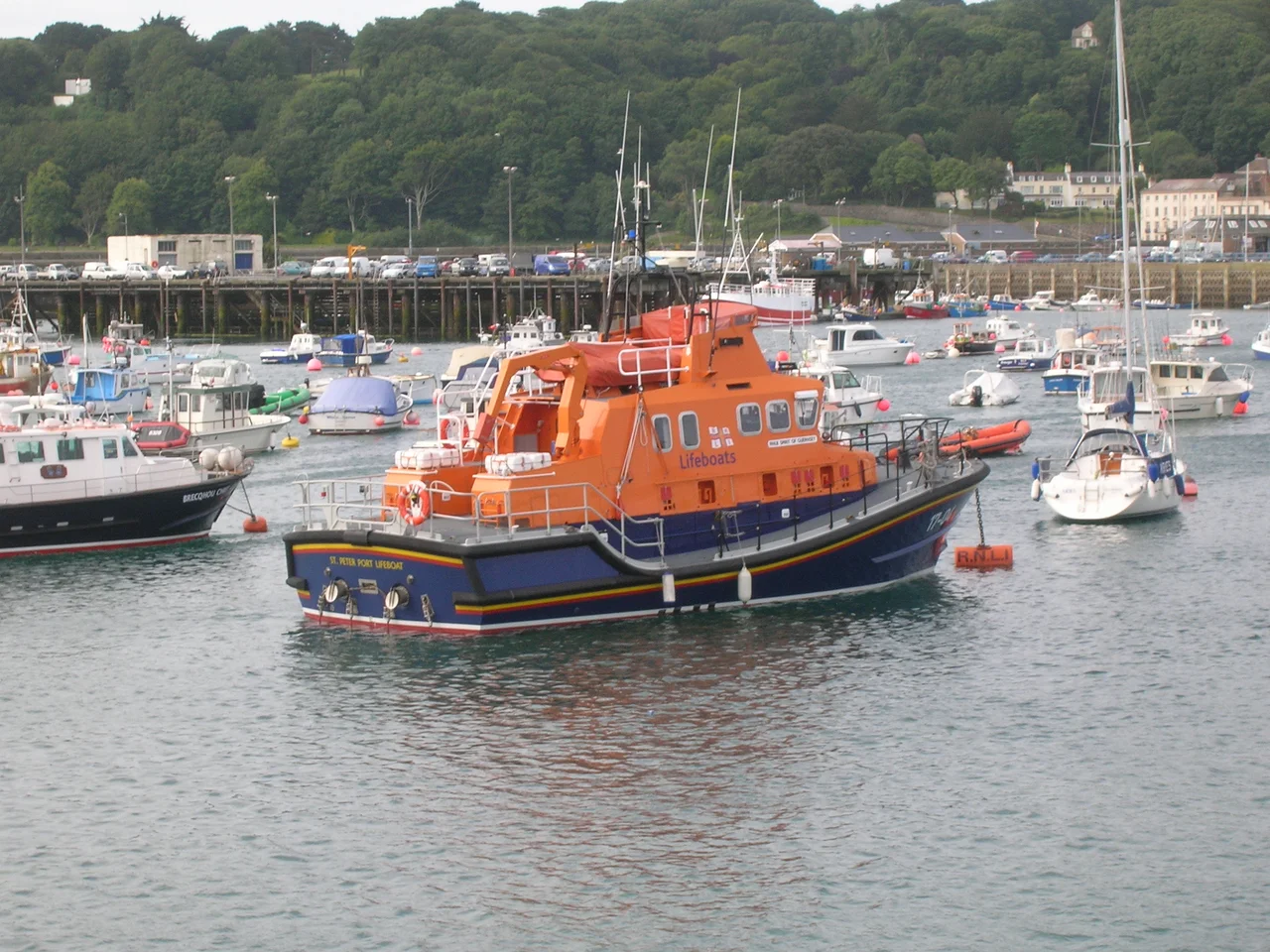

Saint Peter Port Lifeboat Station
In 1803 the twelve members of the St Peter Port Douzaine, the local parish council, sat down to do something about the bodies washing up on Guernsey's rocks. They put 170 pounds toward a lifeboat from the famous builder Henry Greathead in South Shields, parked it at St Sampson, and that was the beginning. The boat rotted away. The reasoning that built it did not. More than two centuries and 1,500 launches later, the same impulse, that someone out there in the Channel might be drowning and someone here ought to do something about it, is what gets the all-weather lifeboat Spirit of Guernsey out of her shed at Saint Peter Port.
The Wreck That Started a Movement
Greathead's first lifeboat did not last. After it rotted, the wreck of the schooner Boadicea reopened the wound. A public subscription run by Mr Gustavus Carrington and Captain Richard Peake raised 115 pounds, 19 shillings, and 10 pence in seven days. A new 28-foot self-righting boat, named simply Rescue, arrived on 20 July. With no carriage to launch her, the islanders parked her in Stonelake's yard in St Sampson and rowed her out as required. The Royal National Lifeboat Institution took over the station in 1861 and supplied a 30-foot, six-oared replacement the following year, eventually named the Louisa Hall after a thousand-pound bequest from a Guernsey woman whose name now floats permanently in the station's records.
Victor Hugo's Lifejacket
Victor Hugo, in exile on Guernsey, did what artists in exile do: he thought about everything. In 1870, as a gesture to the Harbour Master Captain Abraham Martin, he presented his own design of a lifejacket and belt. Whether sailors actually wore it is unrecorded. That an exiled novelist designed a lifejacket for the Guernsey lifeboat is the kind of detail this island specializes in. The station moved to its current site at St Julian's Emplacement in 1946 after a brief and unsuccessful experiment with a station at La Lande, near what is now Beaucette Marina, where the RNLI built a boathouse for 334 pounds and discovered nobody could keep a crew there. The boat came back to Saint Peter Port and stayed.
Two Gold Medals and One That Cost a Life
Two RNLI Gold Medals, fourteen Silvers, and fifteen Bronzes sit in the records of the St Peter Port station, more honors than most lifeboat stations in the country can claim. Coxswain Hubert Ernest Petit took home gold in 1963; Michael John Scales took the second in 1982. The Norwegian Lifeboat Society and the Greek Ministry of Merchant Marine added their own decorations after Channel Islands crews pulled foreign sailors from the sea. Behind every medal is a service, and behind every service is weather most boats run from. The new inshore lifeboat that arrived in 2024 carries a name that lands harder than any award: Harold Hobbs, the volunteer RNLI crewman killed by German forces while serving on a Guernsey lifeboat in 1940. The crew that put to sea that day did not all come home. The boat that bears his name remembers what the medals do not say outright, that this work has always been dangerous, and people have always done it anyway.
1,500 Calls and Counting
In 2020 the RNLI logged its 1,500th call-out from Guernsey. By that point the station had saved over 600 lives and brought 2,000 people safely back to shore. The current all-weather boat, the 17-04 Spirit of Guernsey, has been on station since 1997 and ranges across the Channel Islands hazard zone: the Hanois reef, the Casquets, the Paternosters off Jersey. Modern operations run through the Joint Emergency Services Control Centre, coordinating with French and English coastguards, the Royal Navy, and the small spotter aircraft of Channel Islands Air Search. In October 2025 the RNLI announced that over the next three years all three Channel Islands stations would receive new all-weather lifeboats. The boats change. The crews keep their pagers on their belts. When the maroons go up over Saint Peter Port, the volunteers walk away from dinners and meetings and children's bedtimes, the way they have since 1803.
From the Air
The Saint Peter Port Lifeboat Station sits at 49.458 N, 2.530 W on the harbor front of Saint Peter Port, the capital of Guernsey. From altitude the station is visible at the north end of St Julian's Emplacement, between Castle Cornet on the breakwater to the southeast and the Albert Pier marina to the west. Best viewed from 1,000 to 2,500 feet for the harbor context. Operational range typically extends north to the Casquets near Alderney, west to Les Hanois, and south toward Jersey. Nearest airport: Guernsey (EGJB), about 4 nautical miles southwest. Diversions: Alderney (EGJA) and Jersey (EGJJ). The Channel Islands sit in a busy maritime crossroads; expect commercial shipping, fishing fleets, and a long swell from the open Atlantic.
Nearby Stories
- Pallot Steam, Motor & General Museum 29 km away
- HMS Affray 29 km away
- Operation Donnerkeil 29 km away
- German Submarine U-672 35 km away
- Action of 18 June 1793 60 km away
- Mont Saint-Michel: The Abbey That Becomes an Island Twice a Day 78 km away
- Basilica of Sainte-Therese, Lisieux 209 km away
- 1941 Santander Fire 642 km away