
Sainte Luce Reserve
Ninety-eight out of every hundred land snails crunching underfoot in this forest exist nowhere else on Earth. That statistic captures something essential about Sainte Luce: it is a place defined by its endemics, by the species that evolved here in isolation and have nowhere else to go. The reserve is barely a kilometer long and averages 300 meters across - a green ribbon you could walk the width of in five minutes - yet it shelters five kinds of lemur, two hundred species of tree, and a tangle of life found in this corner of the island and nowhere beyond it. It is also one of the last intact fragments of a coastal rainforest that once ran for miles along Madagascar's southeastern shore.
The Forest on White Sand
Walk inland from the beach and the ground stays improbably pale - this is rainforest growing on white sand, a strange marriage of jungle and dune. Screwpines, the spiky Pandanus that gives the canopy its ragged silhouette, dominate the overstory. Tucked among them are enclaves of rare ebony, the dense black-hearted Diospyros prized for centuries, and along the waterways, river mangroves thread their roots through brackish mud. The whole reserve is a mosaic, each patch of habitat hosting its own specialists. It belongs to the greater Sainte Luce forest, which stretches roughly fifteen kilometers up the coast - though that forest is now broken into fragments, separated by cleared land and, crucially, by rivers.
Lemurs Found Nowhere Else
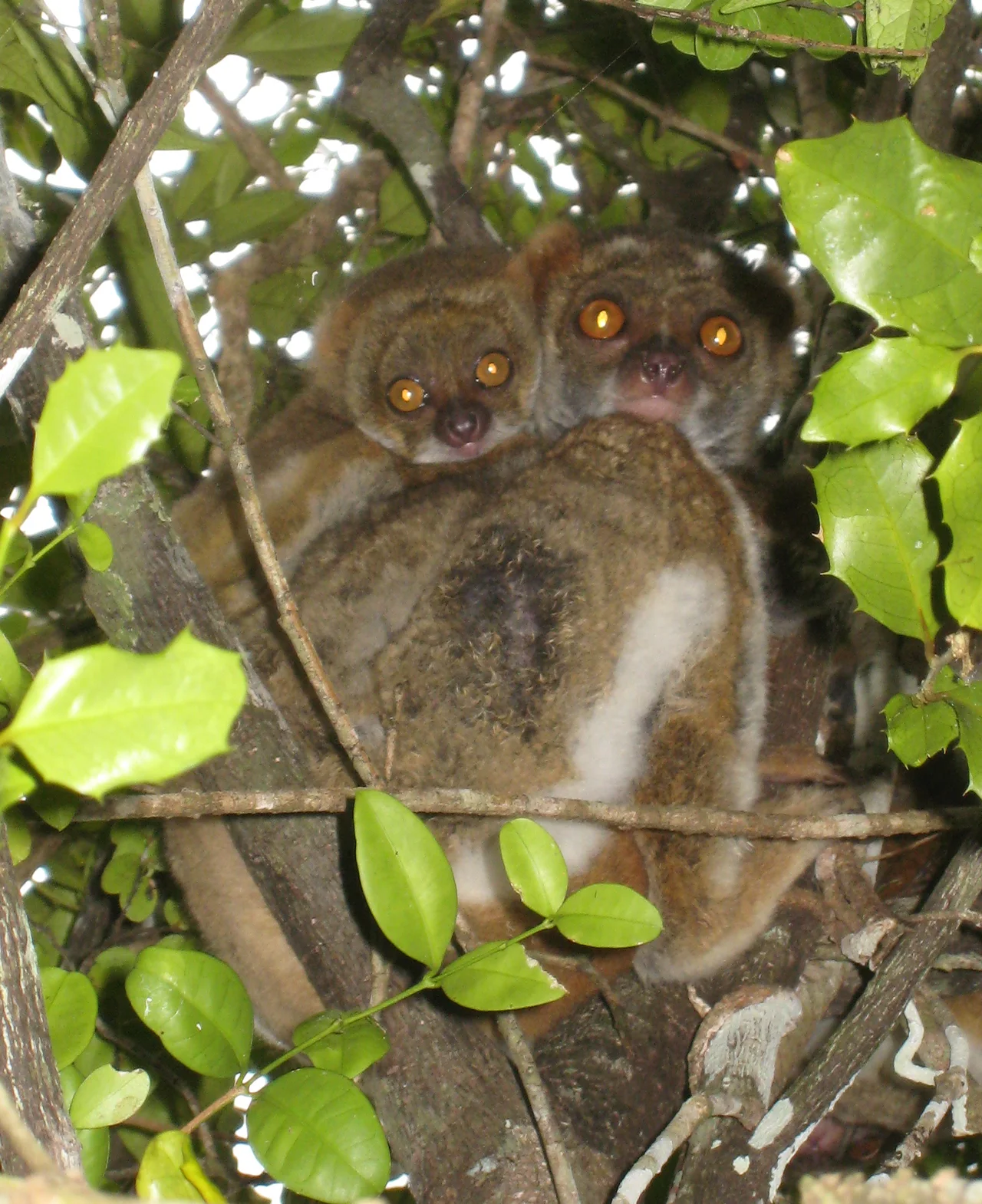
The collared brown lemur, first recorded here in 1990, lives only in this region of Madagascar - a russet-coated primate with the male's namesake collar of pale fur. By night, the forest belongs to others: the fat-tailed dwarf lemur, which can store fat in its tail and enter torpor through the dry season, and the southern woolly lemur, a wide-eyed leaper. Then there is the Sainte Luce mouse lemur. Because rivers cut this reserve off from the neighboring forests, researchers suspect the tiny nocturnal primate here may be an entirely separate, still-unnamed species - evolution quietly diverging in a forest the size of a few city blocks. It is the kind of discovery Madagascar keeps offering: new life, hiding in plain sight.
The Palm and the Mine
Some losses are easier to count. The endangered palm Dypsis saintelucei survives at only four sites in all of Madagascar, and fewer than three hundred mature trees remain. They are felled for the materials to build lobster traps that supply nearby hotels - a small, immediate economy pressing against a species' last stand. A larger threat looms over the whole coast. The sands here are rich in ilmenite, the ore that yields titanium dioxide for white paint and plastics, and the multinational mining operation that already works the dunes north of here has set its sights on Sainte Luce. The community has pushed back, declaring its opposition to plans that would tear up the forest and the fishing grounds it depends on.
A Reserve Run on Hope
Since 2010, the Filana Association has managed Sainte Luce as a private reserve - a small nonprofit running on a shoestring and the energy of volunteers. They come to track lemurs, monitor nesting sea turtles, gather seeds, plant trees, and work alongside the surrounding villages. Slash-and-burn farming, known here as tavy, gnaws at the forest edges, and the pressures are relentless. But the reserve is also genuinely idyllic - white sand, warm sea, a canopy alive with calls - and that beauty is part of its defense. As a member of the Lemur Conservation Network, Sainte Luce stakes a claim that this last ribbon of littoral forest, and everything that lives only here, is worth keeping.
From the Air
Sainte Luce Reserve sits at 24.80 degrees south, 47.16 degrees east, on Madagascar's southeastern coast roughly 35 km northeast of Fort Dauphin (Tolagnaro). From the air, look for the thin green band of littoral forest pinned between the Indian Ocean's white-sand beaches and the inland mangroves and lakes; the pale sandy substrate makes the forest patches stand out against darker interior vegetation. The nearest airport is Tolagnaro Airport (ICAO: FMSD) to the southwest. A low approach of 1,500-3,000 feet best reveals the fragmented forest mosaic and the coastal dunes; the eastern coast is prone to afternoon cloud buildup and cyclone-season storms between November and April, so morning light offers the clearest viewing.
Nearby Stories
- Andohahela National Park 15 km away
- Anosy 73 km away
- Canal des Pangalanes 201 km away
- Andringitra National Park 272 km away
- Moramanga 591 km away
- Inhaca Island 1388 km away
- Ponta d'Ouro 1451 km away
- French Western Australia 6456 km away