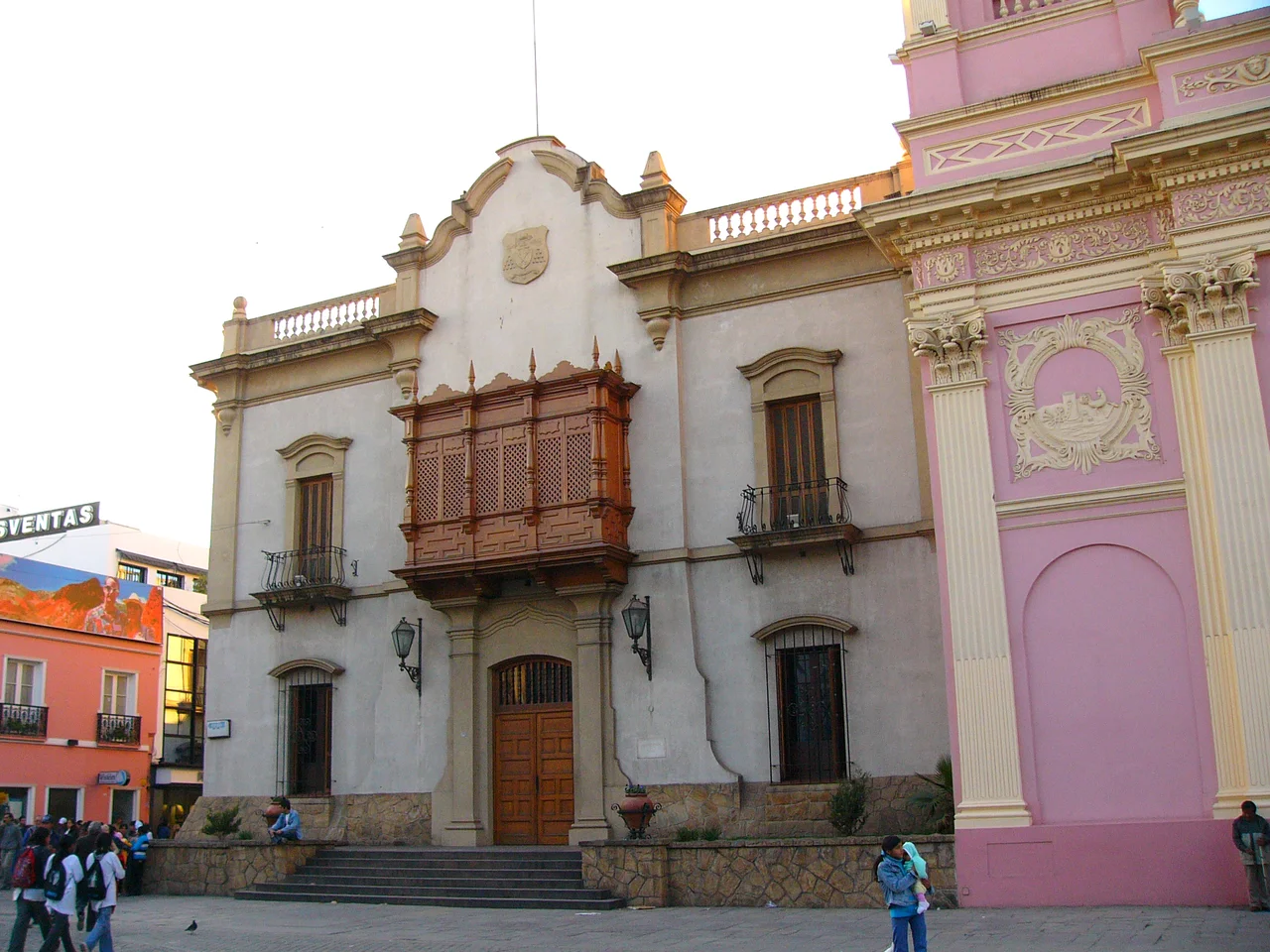

Salta Cathedral
Every September, more than half a million pilgrims fill the streets of Salta, and they are all walking toward the same pink building. Salta Cathedral anchors the city's colonial center with a facade of rose and white and an interior of dazzling gilt, but the crowds do not come for the architecture. They come for two images held inside: a crucified Christ called the Lord of Miracles and an image of the Virgin known as Our Lady of the Miracle. Their story reaches back more than three centuries, to the day the ground tore open beneath the city.
The Earthquake and the Promise
In 1692 a powerful earthquake battered Salta. Amid the damage, according to the tradition handed down ever since, the image of the Virgin was found fallen but unbroken in the ruined church, undamaged where everything around it had failed. Terrified residents carried both sacred images out into the open and begged for the shaking to stop. When it did, they vowed to honor the Lord and Virgin of the Miracle every year in thanks. That vow became the Fiesta del Milagro, today the largest religious gathering in Argentina and among the greatest annual Catholic assemblies on the continent, a promise the city has kept for more than three hundred years.
A Church Rebuilt From Rubble
The cathedral that stands today is itself a child of catastrophe. After an earlier earthquake destroyed the previous building, work on a new one began in 1856, the architect Felipe Bertrés guiding its design. Services resumed in 1858 under Archbishop José Eusebio Colombres, and the project reached completion in 1882. In a region where the earth has repeatedly shaken its buildings down, the survival of this one is part of its meaning. The faithful see in its endurance an echo of the very miracle it was built to honor.
Crowns From a Pope
Rome itself recognized the devotion that grew here. In 1899 Pope Leo XIII granted a decree of pontifical coronation for both enshrined images, an honor reserved for objects of profound veneration, carried out through the local bishop Matías Linares y Sanzetenea. The bishop performed the public coronation in 1902, setting crowns upon the Christ and the Virgin before the assembled city. The shrine in its present form was inaugurated in 1918, and in 1941 the Argentine government declared the cathedral a national monument, binding its religious weight to the nation's official heritage.
Where the City Gathers
Most days the cathedral is simply Salta's heart, its rose facade glowing at dusk above the plaza, its twin bell towers and great dome rising over the colonial arcades of the old town. Inside, light falls through stained glass onto an altar heavy with gold. But step here in mid-September and the building becomes the focus of a tide of humanity, the images borne out among hundreds of thousands of pilgrims in a procession that has wound through these same streets, in unbroken continuity, since the year the earth shook and the city believed it had been spared.
From the Air
Salta Cathedral stands at about 24.79 degrees south, 65.41 degrees west, on the main plaza in the historic center of Salta at roughly 1,187 meters (3,894 feet) elevation. From the air it is a strong visual landmark: look for a rose-and-white facade with twin bell towers and a prominent dome, set in the dense grid of the colonial center within the green Lerma Valley at the foot of the Andes. The Museum of High Altitude Archaeology and the colonial Cabildo sit on the same square. Nearest airport is Martín Miguel de Güemes International (ICAO: SASA), about 7 km southwest at 1,246 meters elevation. The valley setting offers generally clear conditions and good visibility, best appreciated at lower altitudes.
Nearby Stories
- Cachi 28 km away
- 1844 Salta Earthquake 35 km away
- 1692 Salta Earthquake 38 km away
- Santa Rosa de Tastil 43 km away
- San Antonio de los Cobres 48 km away
- Colomé 51 km away
- Quebrada de Las Flechas 84 km away
- Ledesma S.A.A.I. 91 km away