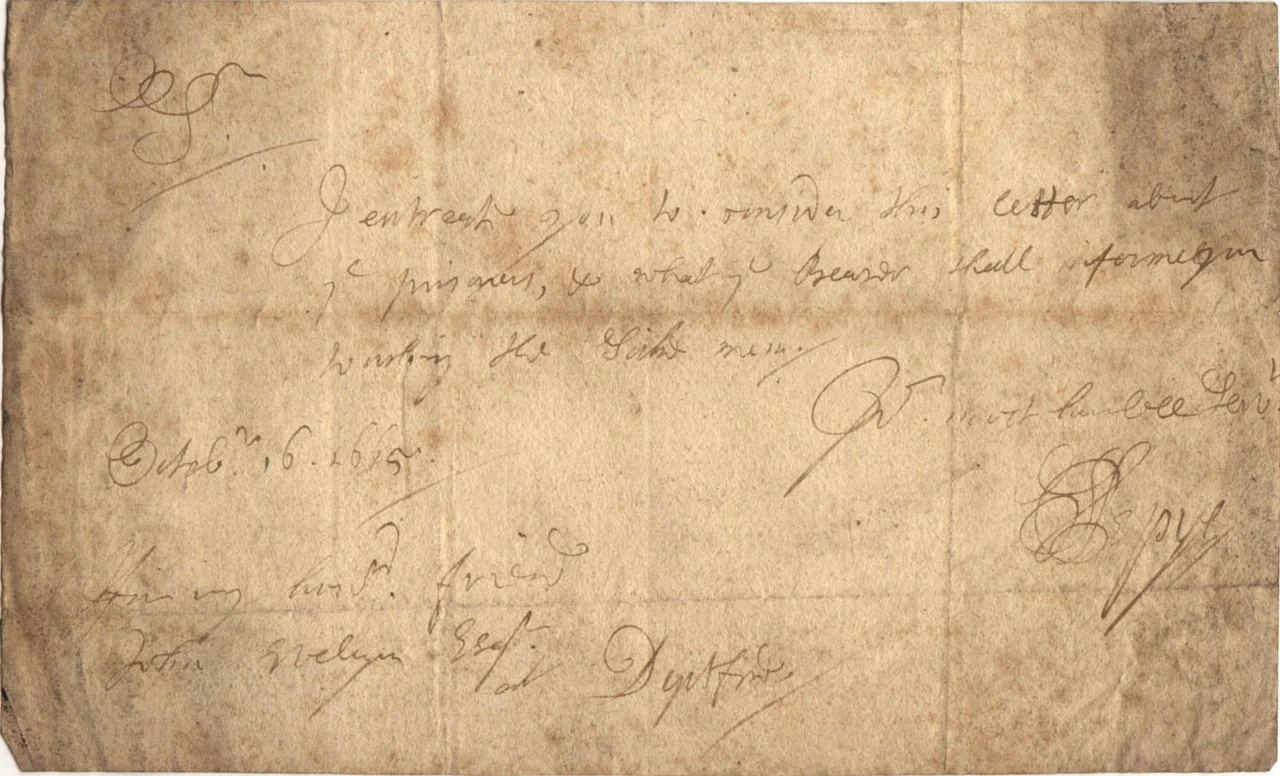

Samuel Pepys
On a September night in 1666, with London burning to the south of him and the wind blowing the flames toward Seething Lane, Samuel Pepys went into the garden and buried his Parmesan cheese. He also buried his wine. The diary records this without irony, alongside the gold he sent by cart to Bethnal Green, the wife he dispatched to Woolwich, and the documents he stuffed into trunks by moonlight. Pepys was thirty-three years old, secretary to the Navy Board, and the most reliable witness modern historians have to what it was like to be a Londoner during the Stuart Restoration. He saw the king come home, the plague kill his neighbours, the fire eat his city, and a Dutch fleet sail up the Medway and tow away the Royal Charles. He wrote all of it down in shorthand, in a million and a quarter words, between 1660 and 1669. Then his eyes began to fail, and he stopped.
Salisbury Court
He was born on 23 February 1633 in Salisbury Court off Fleet Street, the son of John Pepys, a London tailor, and Margaret Kite, a Whitechapel butcher's daughter. He was the fifth of eleven children, and most of his siblings died young. He went to St Paul's School and watched, at sixteen, the execution of Charles I. At Cambridge he took his BA at Magdalene College in 1654, and at twenty-two he married a fourteen-year-old Huguenot girl named Elisabeth de Saint-Michel. The marriage would last fourteen years, end at her death from typhus, and supply the diary with some of its most painful and self-incriminating pages. Pepys was a small man with a watchful eye and a temper for music, theatre, and the company of women. He played the lute, the viol, and the flageolet. He sang in coffee houses. He was, by his own catalogue, frequently unfaithful, and the modern reader does not always like him for it.
A Diary in Shorthand
On 1 January 1660 he began the diary. He used Shelton's tachygraphy, a shorthand system, and slipped into clumsy schoolboy French, Spanish, and Italian whenever the subject matter became too dangerous to entrust to English even in cipher. He recorded what he ate. He recorded the time he got up. He recorded the cat that woke him at one in the morning. He recorded the new watch with an alarm, and his pride in it. He also recorded the coronation of Charles II, the bringing back of the king from the Netherlands aboard Edward Montagu's fleet, the Anglo-Dutch wars, and his own corrupt rise from a salary of fifty pounds to a fortune of seven thousand five hundred. He did not intend his contemporaries to read it. He did, however, catalogue it carefully in his library and bequeath it to Magdalene College, where it remains to this day, in six original bound manuscripts, in the Pepys Library.
Plague Year
In 1665 plague returned to London. By summer it was killing more than seven thousand a week. Pepys was not, on paper, in danger — he lived comfortably on Seething Lane, did not mix with the poor, did not have to remain in town. He sent Elisabeth to Woolwich. He chewed tobacco against infection, and worried that wig-makers were using hair from corpses. "I have never lived so merrily," he wrote on the last day of December, "(besides that I never got so much) as I have done this plague time." He had quadrupled his fortune that year. He had also looked into the open pits at St Olave's churchyard, where three hundred parishioners had been buried, and confessed to Elisabeth on her return that the sight had shaken him. The diary holds these two truths together — the merriness and the shaken man — and asks the reader to hold them too.
Fire
At about three in the morning on 2 September 1666, Jane the maid woke Pepys to tell him she could see fires in the City. He looked, judged it not serious, went back to bed. By dawn three hundred houses were gone. He took a boat down to the Tower, then to Whitehall, and became the first person to inform Charles II that London was burning. The king sent him to Lord Mayor Bloodworth with an order to pull down houses in the fire's path. Pepys found the Mayor exhausted and weeping: "Lord! what can I do? I am spent. People will not obey me." Over the next four days Pepys arranged the removal of his goods by cart, watched the cathedral he had attended as a schoolboy collapse, and yes, dug a hole in the garden for the Parmesan and the wine. His house, his office, and his diary all survived. St Paul's, his father's house, and the schoolroom where he had learned his Latin did not.
The Navy and the End
After the diary closed in May 1669, Pepys lived another thirty-four years. He never went blind. He served as Secretary of the Admiralty under Charles II and James II, professionalised the Royal Navy, was imprisoned twice in the Tower on charges that came to nothing, sat as President of the Royal Society and signed the imprimatur on Newton's Principia Mathematica. He retired in 1689 after the Glorious Revolution and moved to William Hewer's house in Clapham, where he died on 26 May 1703. He is buried beside Elisabeth in St Olave's Church, Hart Street, a few minutes' walk from Seething Lane. The diary, in shorthand, sat largely unread until John Smith deciphered it between 1819 and 1822. He worked for three years without realising the key was on a shelf above the manuscripts in the same library.
From the Air
Pepys's London life centred on Seething Lane (51.5108 N, 0.0796 W) just north of the Tower of London. His birthplace at Salisbury Court lies near Fleet Street about a mile west, and his burial at St Olave's Hart Street is steps from Seething Lane. From the air the Tower of London, Tower Bridge, and the City form an unmistakable cluster on the north bank of the Thames. Nearest airports: London City (EGLC) four miles east, Biggin Hill (EGKB) twelve miles south-east, Heathrow (EGLL) eighteen miles west. Best viewed at lower altitudes on clear days; the Pepys Library at Magdalene College, Cambridge sits about fifty miles north.
Nearby Stories
- Stevenage 5.7 km away
- Malling Abbey 5.7 km away
- 1952 Farnborough Airshow Crash 7.7 km away
- Ingatestone Hall 8.2 km away
- Hellfire Caves 9.1 km away
- The Carrington Event: The Solar Storm That Could Happen Again 9.8 km away
- Bletchley Park 16 km away
- Castle Hedingham 23 km away