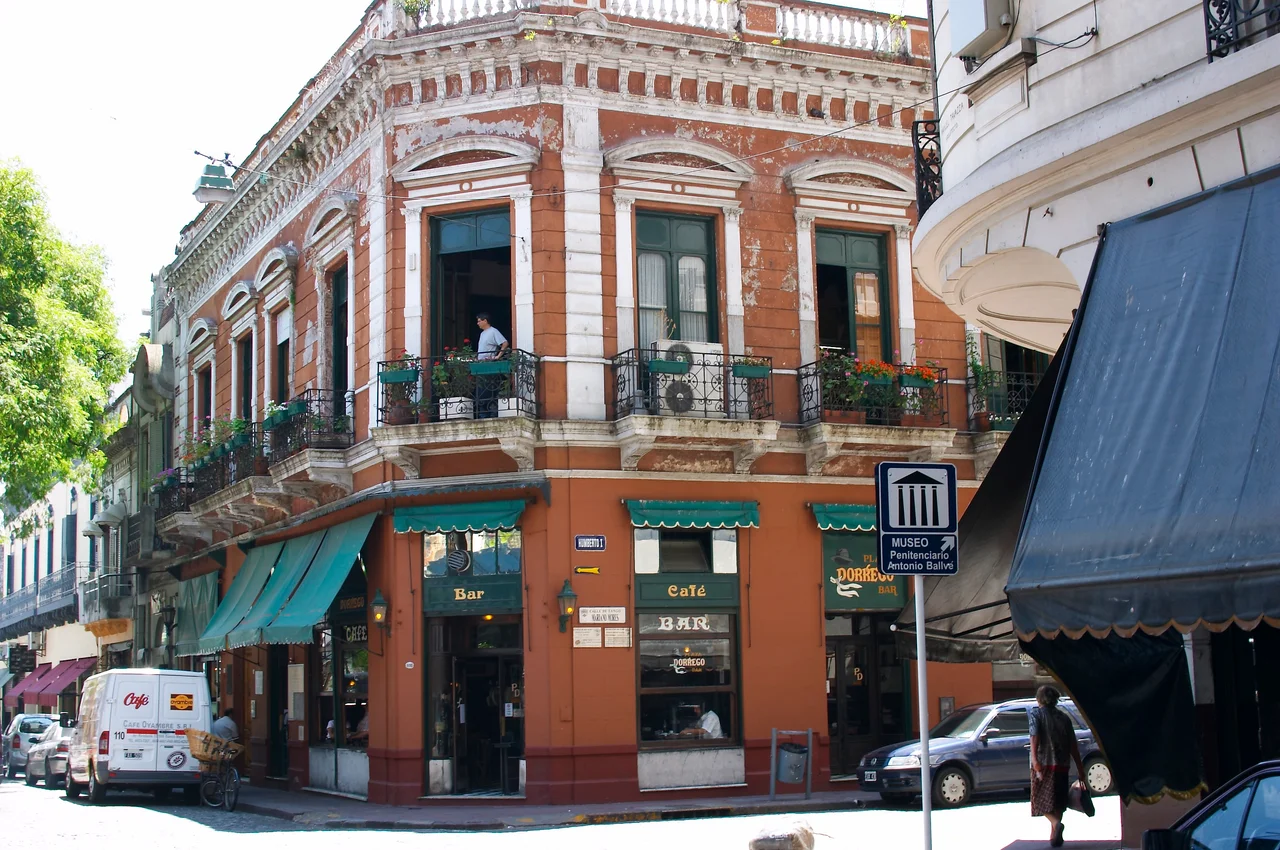

San Telmo, Buenos Aires
On Sunday mornings the cobblestones of Defensa Street disappear under a tide of strangers. They come for the antiques fair that spills out of Plaza Dorrego and runs for thirteen blocks - silver thimbles and seltzer bottles, cracked soda siphons, gramophone horns, the discarded treasure of a century of porteño households. A couple dances tango on a worn patch of pavement while a hat fills slowly with coins. This is San Telmo, the oldest barrio in Buenos Aires, and it has been improvising on the same streets for more than three hundred years.
Ovens, Bricks, and the People Who Worked Them
Before it was bohemian, San Telmo was industrial - the city's first industrial quarter, in fact. In the seventeenth century the area was known as San Pedro Heights, a rise of land just south of the city proper, separated from it by a ravine. Here stood Buenos Aires' first windmill, its earliest brick kilns, and the warehouses where the colony's wool, hides, and leather were prepared for export. Those exports were the region's chief source of wealth well into the 1870s. The work drew the first residents to settle these blocks: dockworkers, brickmakers, and Africans both enslaved and free, whose labor built the literal bricks of the early city. In 1708 the district was formally folded into Buenos Aires under a name that left no doubt about its purpose - the Ovens and Storehouses of San Pedro.
A Saint for the Sailors
The neighborhood's poverty kept catching the attention of those who hoped to save it. The Jesuits founded a charitable mission here that the poor simply called the Residence, until the order's suppression closed it in 1767. To fill the void, the Parish of San Pedro González Telmo was established in 1806, named for the patron saint of seafarers - the name that locals shortened to San Telmo and that the whole barrio now carries. Yet the new parish failed to replace what was lost. Through Argentine independence in 1816 and the harsh rule of Governor Juan Manuel de Rosas, who planted a feared political dungeon and a barracks here, the district languished. Public works were scarce for thirty years. San Telmo was waiting, though it could not have known for what.
Fever and Flight
Recovery finally came after Rosas fell in 1852. Gas mains, sewers, running water, cobblestones, and the city's main wholesale market arrived together, and prosperous families began building handsome houses in the western half of the barrio. Then, in 1871, yellow fever struck. The epidemic ultimately claimed more than ten thousand lives across the city, and physicians like Florentino Ameghino fought to keep it from spreading north. The wealthy did not wait to see who would win. They fled toward what became Barrio Norte, abandoning hundreds of properties almost overnight. Their grand homes did not stay empty for long. As waves of European immigrants poured into Argentina between 1875 and 1930, the mansions were carved into conventillos - crowded tenements - and San Telmo became the most multicultural corner of the city, home to British, Galician, Italian, and Russian families. Argentina's first Russian Orthodox church was consecrated nearby in 1901.
The Old Grocery Store and the New Galleries
The departing immigrants left behind cheap rooms and faded grandeur - exactly what artists tend to love. By the 1950s painters and musicians had moved in, the Buenos Aires Museum of Modern Art opened in 1956, and a tongue-in-cheek artisans' guild proclaimed itself the Republic of San Telmo in 1960. The decisive moment for tango came in 1969, when the renowned singer Edmundo Rivero bought an abandoned colonial grocery and reopened it as El Viejo Almacén, the Old Grocery Store, which became one of the city's most famous tango halls. Restorations followed through the 1980s, and the barrio that immigrants had once filled became a destination again. By 2008 a newspaper could count roughly thirty galleries and art spaces and declare a San Telmo art district reborn. The nineteenth-century facades and the cobblestones endured through every reinvention, which is why walking here still feels like walking through layered time.
From the Air
San Telmo sits at 34.62°S, 58.37°W, in the southeast of central Buenos Aires near the Río de la Plata waterfront and the old port. From the air the barrio reads as a dense, low-rise grid south of the Plaza de Mayo, distinct from the high-rise towers of the modern center. The nearest field is Aeroparque Jorge Newbery (ICAO SABE), the in-city airport on the river roughly 8 km north; the international gateway Ministro Pistarini (ICAO SAEZ, Ezeiza) lies about 30 km southwest. Best viewed at low altitude on a clear day, when the gridded rooftops and the broad brown sheet of the Río de la Plata frame the city's historic core.
Nearby Stories
- Ezeiza Massacre 1.9 km away
- Luján, Buenos Aires 5.1 km away
- Curutchet House 13 km away
- Colonia del Sacramento 17 km away
- Martín García Island 28 km away
- Atucha Nuclear Power Plant 37 km away
- Lobos 43 km away
- Cry of Asencio 87 km away