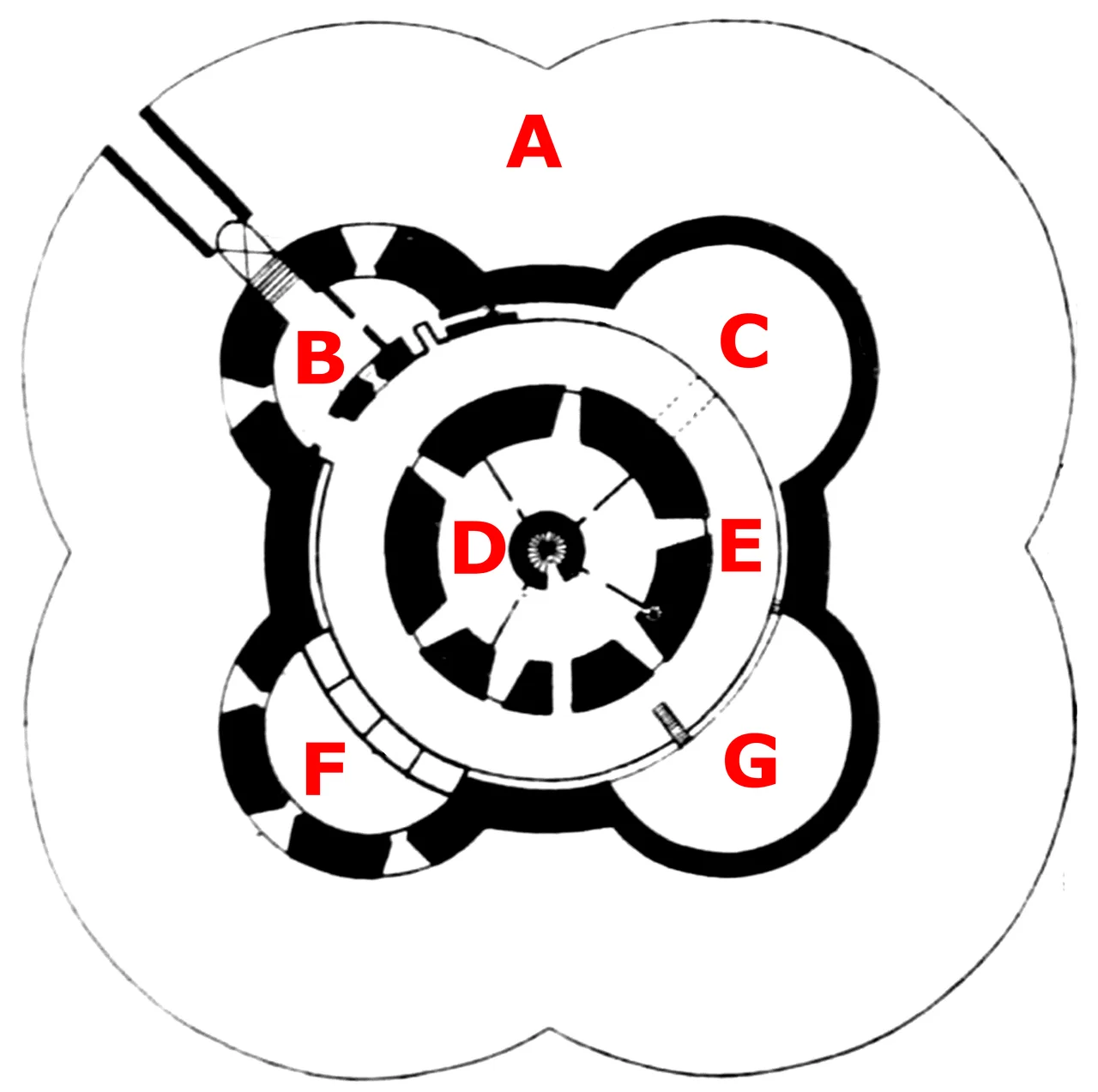

Sandown Castle, Kent
Sandown Castle was lost slowly, then quickly. The sea did most of the work over three centuries, gnawing at the shingle beach and the foundations. Then in 1863 the War Office decided the place was no longer worth maintaining and blew up the upper levels with explosives. Two more waves of demolition - 1882 and 1893 - destroyed most of the surviving stonework. By the time the town of Deal bought what was left in the late 19th century for 35 pounds, Sandown was already more idea than castle. The remaining masonry was encased in concrete in the 1980s as part of the local sea wall, where it still works, in its diminished way, to hold back the waves that the cannon were once supposed to repel.
The Northern Castle of the Downs
Sandown was the northernmost of the three castles Henry VIII built along the east Kent shingle in 1539 and 1540 to protect the Downs anchorage. Deal Castle stood in the middle, Walmer to the south, and Sandown to the north, with a 2.5-mile defensive ditch and earthwork bank connecting all three. The trio went up together in eight feverish months, sharing materials, designers, and workforce. Sandown was a near-twin of Walmer - smaller than Deal, with a tall central keep about 83 feet across, flanked by four rounded bastions called lunettes, surrounded by a moat and a curtain wall. The total area was about 0.59 acres. The walls were 15 feet thick. Three tiers of artillery offered 39 firing positions on the upper levels, with another 31 gunloops in the basement for handguns at close range. The historian John Hale considered Sandown a transitional design between older medieval fortification and the newer Italian star forts that were starting to emerge in southern Europe.
The Same Builders, the Same Hurry
The team that built Sandown overlapped with those at Deal and Walmer: Richard Benese as surveyor, William Clement as master carpenter, Christopher Dickenson as master mason. Construction began in April 1539 and was finished by the autumn of 1540. The three castles together cost the Crown 27,092 pounds, most of it paid from the proceeds of the Dissolution of the Monasteries. Sandown was completed late in 1540, around the same time Anne of Cleves dined inside Deal Castle. The cannon were mounted, the garrisons installed - eight soldiers, sixteen gunners, and two porters at each castle, under a captain. The invasion threat that had triggered the building work passed. France and the Holy Roman Empire never attacked. The castles waited.
The Royalist Stand of 1648
The castles did see action in 1648, during the Second English Civil War. In May of that year a Royalist insurrection swept across Kent. The Parliamentarian navy was based in the Downs. The naval commander William Batten - forced out of his post as Commander of the Fleet the previous year - encouraged elements of the navy to switch to King Charles I. Sandown declared for the King shortly before its sister castles at Walmer and Deal followed. With the coastal forts and the navy now in Royalist hands, Parliament feared foreign forces could be landed along the Kent coast. Colonel Nathaniel Rich was sent to retake them. Walmer surrendered on 12 July. Deal held on through July and into August, surrendering on 20 August. Artillery assaults then began on Sandown, the last to hold out, which surrendered shortly after.
The Long Erosion
After the Restoration in 1660 the castle continued in military use. A 1616 survey had already noted repairs needed costing 437 pounds. A 1634 survey escalated that to 1,243 pounds. By 1641 a comprehensive report on all three Downs castles asked for 8,000 pounds - including 3,000 specifically for sea defences. The Channel was already winning. Through the 18th and 19th centuries the sea kept advancing on Sandown's shingle foundations. The moat filled with beach material. The outer walls cracked. By 1863 the War Office decided Sandown was past saving and ordered demolition with explosives. The upper levels came down then. The second demolition campaign in 1882 took more. The third in 1893 destroyed most of what was left. The town of Deal bought the remains for 35 pounds to incorporate them into its sea defences.
Concrete and Memory
What is left of Sandown Castle today sits inside a concrete sea wall. The 1980s encasement work preserved the surviving fragments of Tudor masonry, but they are no longer recognisable as a castle from the beach. You have to know what you are looking at - or look at the interpretive panels, or follow a guide - to understand that the unremarkable stretch of concrete on the North Deal seafront contains the remnants of a six-bastioned artillery fort that Anne of Cleves dined in, that Charles I's supporters held against Parliament in 1648, that Pitt the Younger's navy patrolled past during the Napoleonic Wars. Sandown's life was busy. Its death was slow. Stand on the seafront at Sandown today and the Downs anchorage still lies offshore, the Goodwin Sands still shelter the water from the worst of the weather, and the chalk seabed still gives anchors poor hold. The castle that was built to dominate all that is barely there. The sea has won.
From the Air
The ruins of Sandown Castle sit at 51.2384 degrees N, 1.4022 degrees E on the North Deal seafront, about half a mile north of Deal Castle (still standing) along the same shingle beach. Only fragmentary masonry remains, encased in modern concrete sea defences - it is difficult to see from the air as a castle. Best identified by reference to its still-standing sister castles: Deal Castle is the unmistakable six-petalled fort 0.5 nm south; Walmer Castle (also intact) is another mile beyond that. The Goodwin Sands lie offshore. Nearest airfield: Manston (decommissioned) 9 nm north. Best viewed at low altitude approaching the Kent coast from the Channel.
Nearby Stories
- Ringlestone Inn 3.4 km away
- Cliffs Pavilion 3.5 km away
- Citadel of Calais 6.5 km away
- 2021 English Channel Disaster 11 km away
- Stag Inn, Hastings 15 km away
- Dungeness Lighthouse 19 km away
- Clacton Pier 32 km away
- Four Days' Battle 54 km away