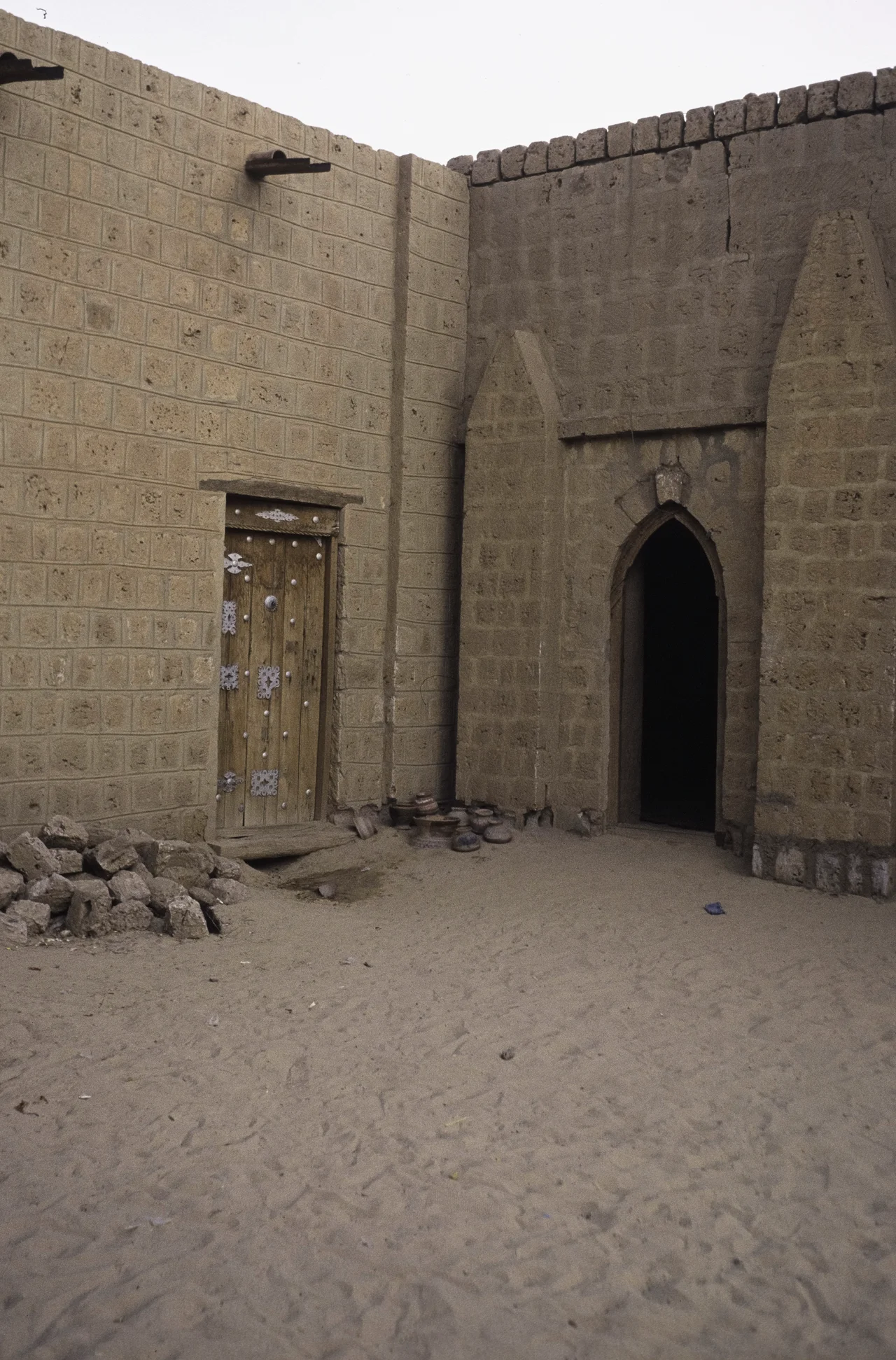

Sankoré Madrasah
There is no campus, no gate, no central hall. The Sankoré Madrasah was a university the way a forest is a library: not a single institution but a dense community of scholars, each teaching his own students in the shade of the mosque, around courtyards measured to match the dimensions of the Kaaba in Mecca. In the sixteenth century, men came from Egypt and Syria to study here, in a desert town on the far southern edge of the Sahara. What drew them was not buildings. It was knowledge, and the people who guarded it.
A Mosque in the Quarter of Nobles
Sankoré rose in the fourteenth or fifteenth century in the Berber and Arab quarter of Timbuktu, funded, by tradition, by a wealthy Tuareg woman of the Aghlal tribe. The name itself carries the neighborhood's character: French translators of the old chronicles rendered Sankoré as 'neighborhood of the nobles.' Like its sister mosque Djinguereber, it was built in the Sudano-Sahelian style of packed earth, and modern scholars have set aside the old myth that an Andalusian architect designed it. In the late sixteenth century, the chief judge of Timbuktu, Imam al-Aqib ibn Mahmud, tore down the sanctuary and rebuilt it to the exact proportions of the Kaaba, binding this distant African mosque to the spiritual center of Islam.
How a Town Became a Mind
Timbuktu grew rich as a hinge of trans-Saharan trade, and into that wealth flowed something rarer than gold. In the fifteenth century the learned Aqit clan migrated to the town, carrying a deep tradition of Islamic law. Scholars and holy men followed from Egypt, Libya, Algeria, and Morocco. They brought books, and books became the city's most coveted commodity. When the traveler Leo Africanus visited in 1526, he marveled that manuscripts brought across the desert 'are sold for more money than any other merchandise.' Around Sankoré gathered a class of scholars so respected that Songhai kings showered them with gifts during Ramadan. Some assembled private libraries of more than 1,600 volumes.
Four Degrees and a Turban
Learning at Sankoré followed a path. By the sixteenth century the town held as many as 180 Qur'anic schools teaching basic literacy to thousands of children, while a smaller circle of a few hundred pursued higher study. Students climbed through four levels, receiving a turban at each as a symbol of attainment. The early stages demanded mastery of Arabic and the Qur'an; later ones opened into grammar, mathematics, astronomy, history, and law. At the summit a student attached himself to a sheikh, completed original research, and might join a 'circle of knowledge,' a fellowship not unlike a body of tenured professors. From these ranks came the judges and counselors who advised the rulers of the Sahel.
Ahmad Baba and the Cost of Conquest
The greatest of Sankoré's scholars was Ahmad Baba, its final chancellor, author of more than forty books spanning subjects as varied as law and his pointed critique of unjust enslavement. His life measures both the height and the heartbreak of Timbuktu's golden age. When a Moroccan army crossed the desert and conquered the city in 1591, Ahmad Baba was among the first to protest. For it, he was imprisoned and exiled to Morocco, and his library of 1,600 books, one of the richest of his time, was scattered and lost. The golden age dimmed with him. Yet his name endures, attached today to the modern institute in Timbuktu that safeguards what survives of the city's manuscripts.
From the Air
The Sankoré Madrasah stands at 16.78°N, 3.01°W in the northeastern part of old Timbuktu, Mali, distinguished by its earthen minaret and a courtyard built to the proportions of the Kaaba. The nearest airport is Timbuktu (ICAO: GATB), about 6 km to the north. From the air, Sankoré reads as one of three pyramidal mud minarets punctuating the tan grid of the old town, with Djinguereber to the southwest. Clear-sky visibility is best in the dry season; expect significant haze during harmattan winds.
Nearby Stories
- Essakane 13 km away
- Liptako 18 km away
- Tondidarou 86 km away
- Hand of Fatima (rock formation) 159 km away
- Lake Débo 184 km away
- Hombori 187 km away
- Festival au Désert 332 km away
- Oualata 374 km away