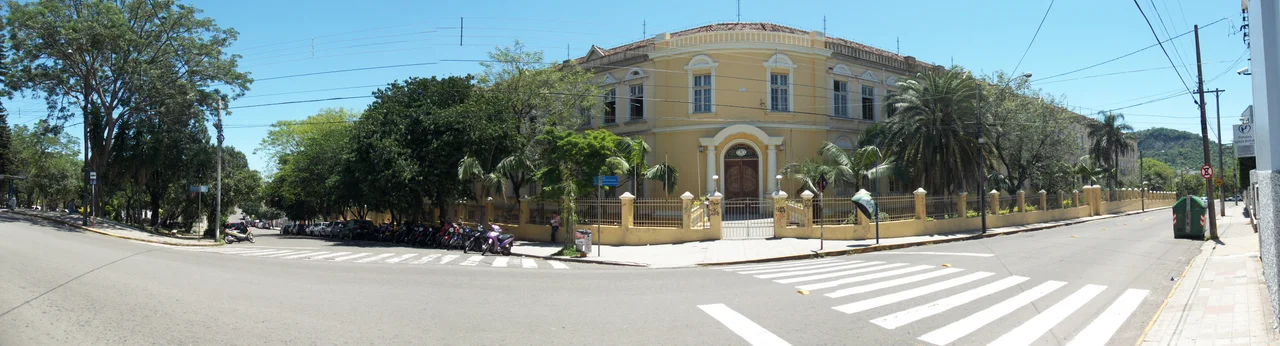

Santa Maria, Rio Grande do Sul
They call it the heart of Rio Grande, and the name is more than affection. Santa Maria sits almost exactly at the geographic center of Rio Grande do Sul, Brazil's deep-south state, a crossroads where the highways of the gaucho frontier meet. Nearly 284,000 people live here, but on any given day the city feels younger than that number suggests, its streets filled with students from one of the country's great federal universities. It is a place of contradictions worn comfortably: scholars and soldiers, dinosaur bones and tank factories, all rooted in the same rolling plains.
A Camp That Became a City
Santa Maria began as a surveyors' camp. In 1797, a commission set out to draw the contested border between Spanish and Portuguese South America, and they pitched their tents on this spot, naming it the Acampamento de Santa Maria. The first peoples of the land were the Minuano and the Tape, who lived on the plains and in the hills before the European frontier closed in around them. In 1828, German mercenaries hired to fight in the Cisplatine War marched through; when the war ended, many simply stayed, and a wave of German settlement followed, later joined by Italians. Their descendants still give the city much of its character. Santa Maria became a town in 1857 and never looked back.
The University City
The thing that defines Santa Maria today is learning. The Federal University of Santa Maria, founded in 1960 by Jose Mariano da Rocha Filho, was one of the first federal universities planted outside a Brazilian state capital, and it transformed a railroad town into a city of campuses, hospitals, and research. Locals call their home the Cidade Universitaria, the University City, and the nickname fits. Tens of thousands of young people arrive each year to study, lending the place a restless, hopeful energy and a steady churn of new ideas. The Franciscan University, older still, traces its roots to 1951. Knowledge is the city's true industry.
The Night of January 27
Santa Maria carries a wound that the wider world came to know in a single terrible night. In the early hours of 27 January 2013, a fire broke out in the Kiss nightclub during a band's performance, ignited when pyrotechnics caught the acoustic foam on the ceiling. The club was packed, and there was no usable emergency exit. Two hundred and forty-two people died, most of them students in their teens and twenties, out for an ordinary night with friends. The grief reshaped the city and pushed Brazil to rewrite its fire-safety laws. Santa Maria has refused to let the dead become a statistic, and the memory of those young lives remains woven into the conscience of the place.
Faith, Fossils, and the Frontier
There is a softer rhythm here too. Each year the Romaria da Medianeira draws hundreds of thousands of pilgrims to honor Our Lady, one of the great Catholic festivals of southern Brazil. Because of its strategic position, the city also hosts a large military presence, including the Santa Maria air force base, and a tank factory that earned it the nickname Armored Capital. And beneath all of it lie the dinosaurs: Santa Maria is the birthplace of Brazilian paleontology, sitting atop some twenty Triassic fossil sites. Few cities ask you to hold so much at once, the sacred and the scholarly, the grieving and the ancient, all in the heart of Rio Grande.
From the Air
Santa Maria sits at roughly 29.68 degrees south, 53.81 degrees west, in the geographic center of Rio Grande do Sul. The city occupies a basin ringed by low hills and ridges, with the Morro das Antenas and Cerrito heights rising nearby. Its own airport, Santa Maria (ICAO: SBSM), lies about 12 km east in the Camobi neighborhood and shares facilities with the ALA4 air force base, so expect military traffic. Porto Alegre (ICAO: SBPA), the state capital, is about 286 km to the east-southeast. From 3,000 to 5,000 feet above ground the city reveals its role as a transport hub, with highways BR-287 and BR-158 radiating outward across the plains and rail lines threading through. The surrounding farmland is open and gently rolling; clear, low-humidity days in autumn and winter give the cleanest views over central Rio Grande do Sul.
Nearby Stories
- Battle of Ituzaingó 55 km away
- Ruins of São Miguel das Missões 90 km away
- Santa Cruz do Sul 98 km away
- Santo Ângelo 121 km away
- São Lourenço Mártir Archaeological Site 130 km away
- Passo Fundo 158 km away
- Bagé 162 km away
- 2009 Brasil de Pelotas Bus Disaster 182 km away