
São João del-Rei
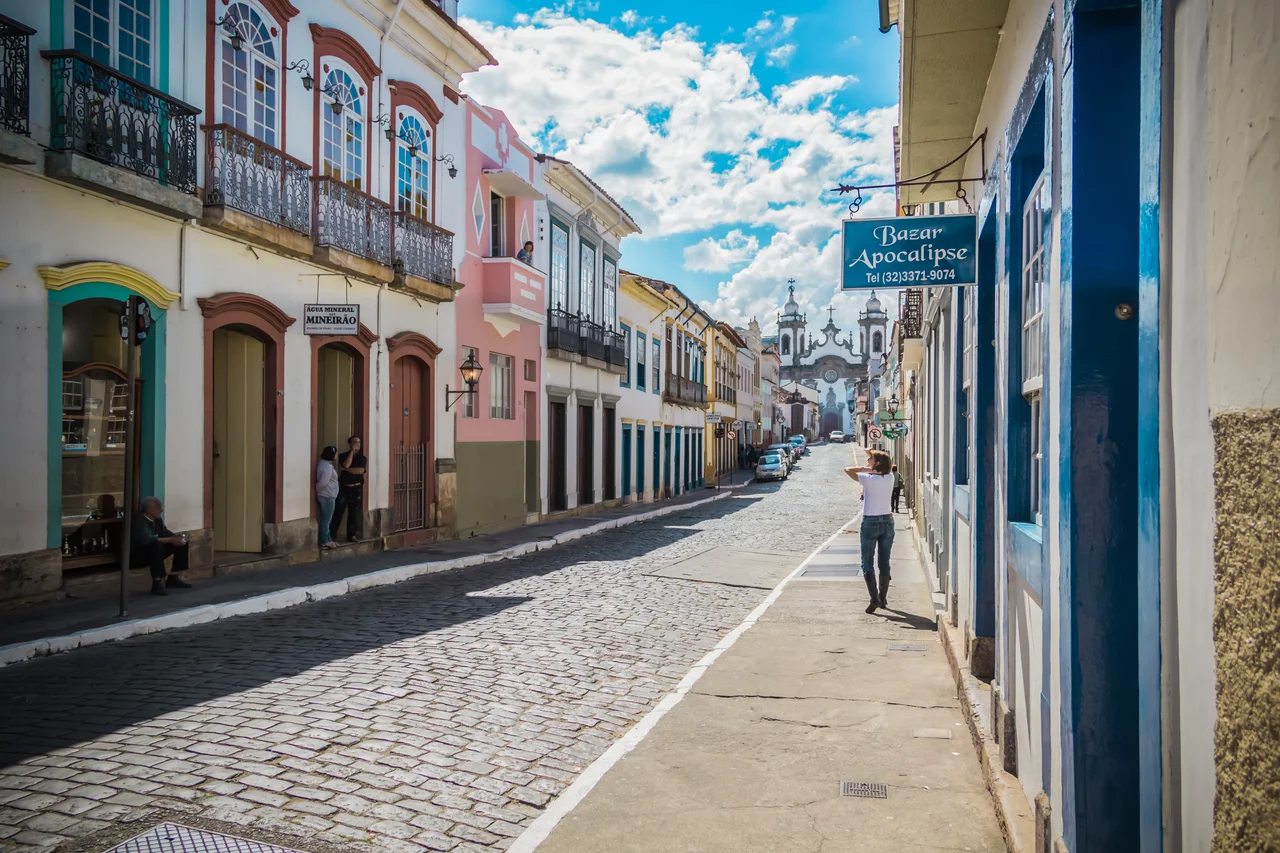
The whistle arrives before the train does. It carries across the valley of the Rio das Mortes, through streets laid out when Portugal still ruled Brazil, and announces that a wood-burning locomotive built in the nineteenth century is about to pull into São João del-Rei on a schedule that has barely changed in over a hundred years. The tourist railway runs twelve kilometers to Tiradentes, across a narrow gauge track that once hauled gold and now hauls people who want to see what gold hauling looked like. Founded in 1713 in homage to King John V of Portugal, São João del-Rei is a Minas Gerais city where colonial architecture is not a theme but a continuing fact.
A Staging Post That Struck Rich
The bandeirantes founded São João del-Rei as a waypoint, not a destination. Tomé Portes del-Rei is remembered as the city's founder, and his small village in southern Minas Gerais existed to serve a longer journey: the Estrada Real, the Royal Road connecting the Atlantic coast at Paraty to the gold fields at Ouro Preto, Mariana, and Conselheiro Lafaiete. Mule trains stopped here, changed crews here, paused before the last mountain leagues. Then surveyors found gold in the ground beneath the town itself, and what had been a staging post became a destination in its own right. The population that filled the valley needed churches. Minas Gerais gold paid for them. What the city became in the eighteenth century is what it largely remains today.
The Churches of the Gold Century
The Cathedral Basilica of Our Lady of the Pillar went up starting in 1721, a minor basilica that still serves as the seat of the local Roman Catholic diocese. Our Lady of Rosário was already there by 1720. Our Lady of Carmo followed in 1733, Our Lady of Mercês e Bonfim in 1769, and São Francisco de Assis in 1774. That last one is the jewel. Its curving twin-tower facade, its stone carving attributed to the circle of Aleijadinho, its interior polychrome wood - this is baroque not as imported style but as local invention, made by Afro-Brazilian and mestizo craftsmen working in gilded cedar. The churches stand close together. You can walk the route on foot in an afternoon, and during Holy Week the whole town becomes the procession route, with tapis de serragem - sawdust carpets dyed into elaborate religious images - laid across the cobblestones for the faithful to tread and ruin.
Where the Whistle Still Blows
The Estrada de Ferro Oeste de Minas was built as a narrow-gauge railway to serve mining operations, and it was characterized from the start by woodburning steam locomotives. São João del-Rei was its anchor - a major roundhouse, a substantial yard, and the engineering infrastructure of a working railroad. When the gauge became obsolete and the traffic dried up, most such facilities were scrapped. This one was preserved. Brazil's largest railway museum occupies the station and its surroundings, and a tourist railway still operates between São João del-Rei and Tiradentes, using period locomotives on the original track. The ride is twelve kilometers and takes about forty minutes each way. Passengers lean out to watch the countryside slide past at the speed of nineteenth-century transportation, and the locomotive, stoked by hand with cordwood, answers with the real smell of real coal smoke and real steam.
The Writers and the Cardinal
The town has produced its share of people worth remembering. Tiradentes, the leader of the failed 1789 Inconfidência Mineira independence conspiracy, was born nearby and became a national martyr after his execution. Bárbara Heliodora, a poet connected to the same rebellion, lived here. Otto Lara Resende grew up in the town and became one of Brazil's significant twentieth-century chroniclers. Tancredo Neves - the president-elect who died in 1985 before taking office, a figure whose funeral the country watched with genuine grief - was a son of São João del-Rei. Francisca de Paula de Jesus, known as Nhá Chica, was an Afro-Brazilian laywoman whose piety led to her beatification in 2013. Lucas Moreira Neves rose from local seminary student to Catholic cardinal. For a town of roughly 90,000 people, the list is improbably long.
University Town, Festival Town
The Federal University of São João del-Rei anchors the modern economy, and students from across Minas Gerais fill the historic center with a demographic that colonial cities often lose. But the religious calendar still shapes the year. Holy Week draws the greatest visitor surge, as does the Feast of Our Lady of the Pillar, and the city's baroque music tradition - orchestras that still play the sacred compositions of José Maria Xavier, an eighteenth-century priest-composer born here - gives those festivals an acoustic depth that feels medieval and is not. Tiradentes is twelve kilometers away, smaller and more self-consciously preserved. Ouro Preto, Mariana, and Congonhas are within easy driving. The whole region functions as a colonial Brazil that never stopped being colonial Brazil, and São João del-Rei, with its railway and its seven churches, sits at the living heart of it.
From the Air
São João del-Rei sits at 21.14 degrees south, 44.26 degrees west, roughly 200 km southwest of Belo Horizonte in the Minas Gerais highlands. The city is at about 900 m elevation, surrounded by the rolling hills of the Mantiqueira foothills. Recommended viewing altitude 3,000-5,000 ft AGL. The twin-tower silhouette of São Francisco de Assis and the cathedral's pillared facade anchor the historic center on a bend of the Córrego do Lenheiro. Nearest airport is Tiradentes Aerodrome (QIQ), a small strip; for commercial service, Belo Horizonte Confins (SBCF) is about 250 km northwest. Expect afternoon thunderstorms in the wet season (November to March).
Nearby Stories
- Santos Dumont, Minas Gerais 4.5 km away
- Our Lady of the Rosary Church, Lavras 37 km away
- Ibitipoca State Park 38 km away
- Inconfidência Mineira 58 km away
- Crucilandia 64 km away
- Ubá 68 km away
- Três Corações 69 km away
- São Gonçalo do Pará 106 km away