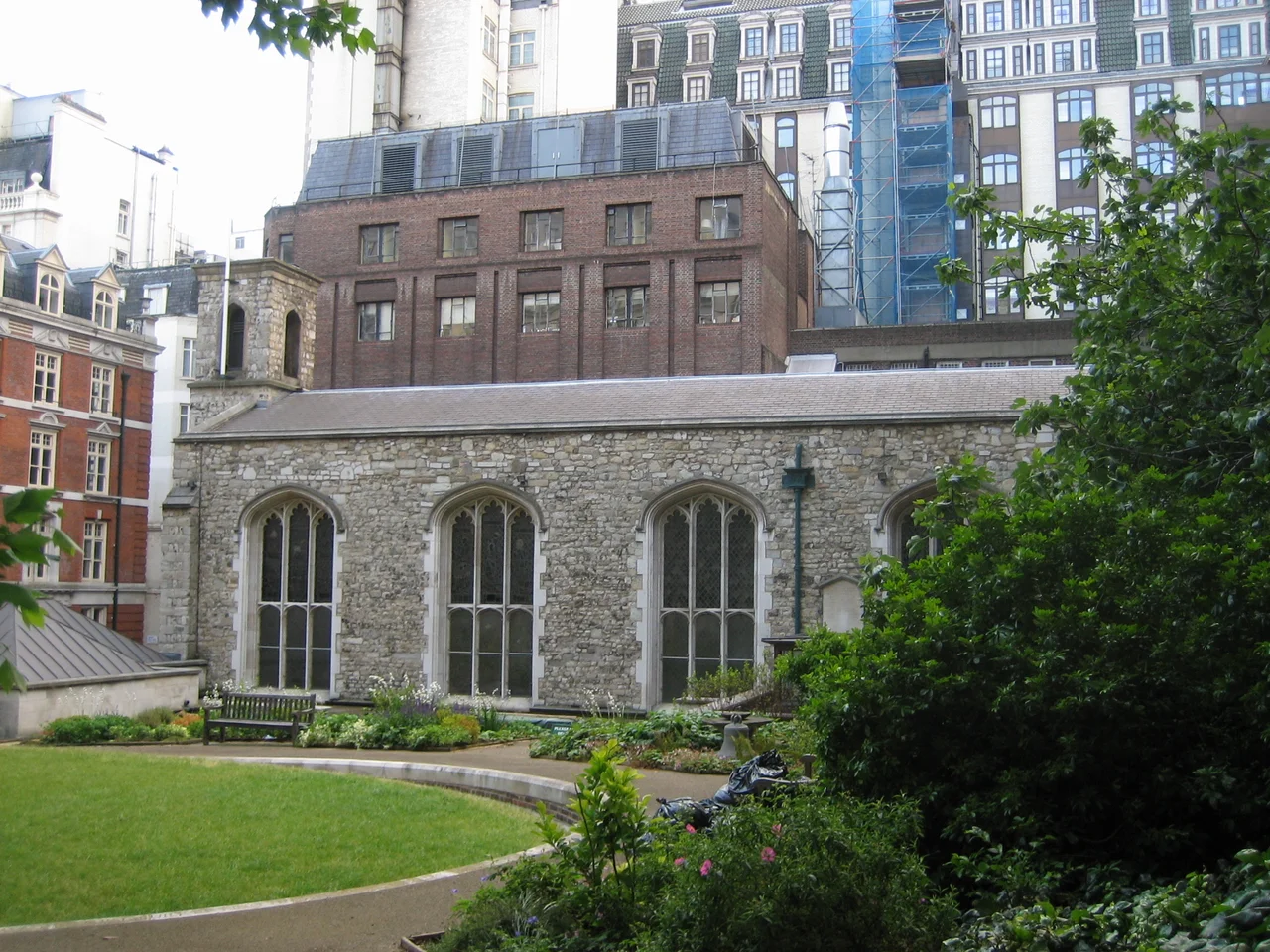

Savoy Palace
When the rebels reached the Savoy Palace in June 1381, they did not simply burn it. They demolished it. What could not be smashed was thrown into the Thames. Jewellery was pulverised with hammers. One rioter who tried to keep a silver goblet for himself was killed by his fellows for theft, because this was not a robbery. The Peasants' Revolt under Wat Tyler had come to destroy John of Gaunt, the richest man in England after the king, whose hated poll tax had set the country alight. Gaunt was not at home. The palace was. It was the grandest nobleman's townhouse in medieval London, famous for its tapestries, its jewels, its tableware, and the prisoner-king John II of France who had died here. By the end of the day on which the rebels arrived, it was rubble. The name Savoy stayed.
Land Between the Strand and the River
In medieval London, the most desirable address for a noble was not within the city walls but along the Strand, the great ceremonial road between the City and Westminster. A house on the Strand could have a Thames water frontage, the highway of choice for travel and trade, and it was far enough from the city to escape the stink, the smoke, the constant fire risk, and the social tumult downstream and downwind to the east. In 1246, King Henry III granted a parcel of this prime ground to Peter, Count of Savoy, who was the uncle of his queen, Eleanor of Provence. Peter, made Feudal Baron of the Honour of Richmond, built a palace on the site. When he died in 1268, he willed the property to the monks of the Great St Bernard Hospice high in the Swiss Alps, who promptly sold it back to Queen Eleanor for three hundred marks.
Chaucer Begins to Write
In 1285, Eleanor passed the Savoy to her second son, Edmund, Earl of Lancaster. His descendants, the Dukes of Lancaster, lived there throughout the next century. By the fourteenth century, when the Strand had been paved as far as the Savoy itself, the palace belonged to John of Gaunt, a younger son of Edward III who had inherited the Lancaster title and lands through marriage. Gaunt was the nation's power broker, second only to the king in wealth and influence. The Savoy was his London base, magnificent enough to be famous across England for its art collection and ornaments. Geoffrey Chaucer began writing The Canterbury Tales while working at the Savoy Palace as a clerk to Gaunt's household. The opening lines of one of the foundation texts of English literature were drafted in a building that no longer exists, on a site now occupied by a hotel and a theatre.
An Honourable Captivity
King John II of France had been captured at the Battle of Poitiers in 1356 and held in England as a hostage for ransom. His captivity was described as honourable, which meant comfortable. He kept his court, his servants, his finances, and his dignity. He was treated as a king, not a prisoner. In 1364, after a brief release that ended when his designated substitute hostage escaped, John II returned voluntarily to England to honour the terms of the treaty. He died at the Savoy after an illness, in a noble bed in a noble palace, technically still a prisoner. Around the palace itself the law operated differently: a special jurisdiction called the Liberty of the Savoy, separate from the rest of the county of Middlesex, where Gaunt's officers held authority. This medieval enclave outlived the palace by centuries.
The Peasants' Revolt
John of Gaunt was not a popular man in London. He had supported the religious reformer John Wycliffe at a time when reformers were heretics. He had tried to replace the elected Lord Mayor with a royally appointed captain. London rioters attacked his palace once already, in 1377, before doing it properly in 1381. The trigger that summer was the poll tax, which fell hardest on the poorest. Rural rebels marched on London under Wat Tyler and Jack Straw. They believed Gaunt had introduced the tax, and they came for his house. The systematic demolition of the Savoy was meant as political theatre as much as destruction. Tapestries burned. The jewel collection was pounded into dust. What could not be ruined went into the Thames. The palace was never rebuilt. The site lay derelict for over a century.
Hospital, Barracks, Bridge Approach
Henry VII founded the Savoy Hospital here for the poor and needy, endowed in his will. His son Henry VIII formally established it as a body corporate in 1512. The hospital ran fitfully for two centuries, suppressed by Edward VI in 1553 and refounded by Mary three years later. By the late seventeenth century, nobility had moved out and tradespeople had moved in: glove-makers, printers, leather-sellers. In 1695 Christopher Wren built a military prison on part of the site. By the eighteenth century the complex served as barracks, and in 1776 most of it burned. Sir William Chambers drew up plans for a vast new Foot Guards barracks accommodating three thousand men, but the scheme was finally dropped in 1804. Between 1816 and 1820, almost everything remaining was demolished to make way for the approach road to the new Waterloo Bridge. Only the Savoy Chapel survives. The names persist: Savoy Hotel, Savoy Theatre, Savoy Street. Of the medieval palace itself, nothing visible remains.
From the Air
Coordinates 51.511°N, 0.120°W between the Strand and the Thames Embankment in central London, just west of Waterloo Bridge. From altitude the site lies between the river and the curve of the Strand, with the distinctive courtyard of the Savoy Hotel and the small Savoy Chapel marking the spot. Somerset House is the large block just to the east. The Thames runs immediately south. Nearest airport: London City (EGLC) about 9 km east, London Heathrow (EGLL) 22 km west.
Nearby Stories
- Stevenage 5.7 km away
- Malling Abbey 5.7 km away
- 1952 Farnborough Airshow Crash 7.7 km away
- Ingatestone Hall 8.2 km away
- Hellfire Caves 9.1 km away
- The Carrington Event: The Solar Storm That Could Happen Again 9.8 km away
- Bletchley Park 16 km away
- Castle Hedingham 23 km away