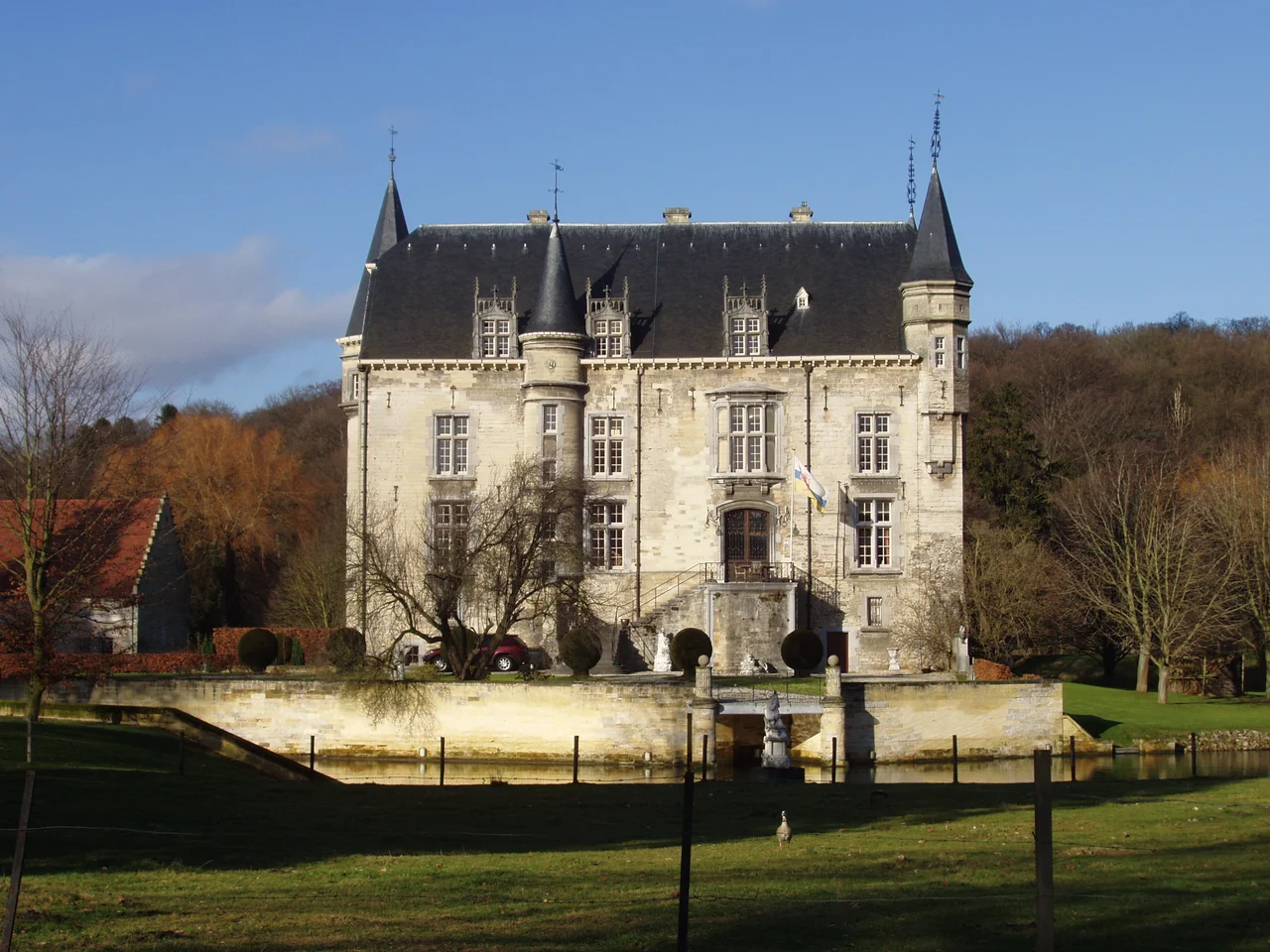

Schaloen Castle
In 2013, the most expensive house on the Dutch property market was a turreted marlstone castle in a meadow by the Geul river, asking price never officially confirmed because the rich Chinese buyer rumoured to be interested apparently never closed. Schaloen had passed through eight centuries of owners by then — knights, Spanish-era counts, a Hohenzollern princess, the De Villers Masbourg d'Eclaye family in Brussels, a contractor named Woudenberg, and then the Bot family who bought it in 1986 and turned the stables and outbuildings into a hotel. The castle itself, with its arkel turrets and bay windows added by the architect of Amsterdam's Rijksmuseum, sat polished, photographed, and waiting for the next owner of one of South Limburg's longest-occupied addresses.
Marl and Water
Schaloen is built of mergel — the soft yellow-grey marlstone the entire region quarried from the Sint-Pietersberg and the surrounding hills. The castle sits in the wet meadow of the Geul, with a wide canal fed by the Molenbeek, a Geul branch that was the river's main channel in the sixteenth century. The driveway approaches through a watermill, the marlstone Schaloensmolen of 1699, originally a ban mill where local farmers were obliged to grind their grain. Then a gatehouse from 1718, then a courtyard, then the castle itself across its bridge. The rectangular keep dates from the twelfth century in its oldest stones. A 1550 map by Jacob van Deventer shows it already roughly in its current shape, marked Sloenes — a residential tower flanked by two wings, surrounded by water on every side.
Burned and Rebuilt, Burned and Rebuilt
Schaloen has burned more than once. In 1575, during the Eighty Years' War, the castle was almost completely destroyed by fire. A Latin inscription inside records that Johan Reinier Hoen van Cartils and his wife Johanna Maria van der Merwijck saved and rebuilt the ruin, completing the work in 1656. Different colours of marl in the walls today still mark the layers of patched reconstruction. Restorations followed in 1721 and 1738. A tithe barn was added in 1721 — it is now the hotel. In 1894, the De Villers Masbourg d'Eclaye family commissioned a complete makeover from Pierre Cuypers, the architect of the Rijksmuseum and Amsterdam Centraal Station. Cuypers added the attached west tower and a stair tower, raised the arkel turrets, regularised the facades, fitted a bay window to the front and a balcony to the rear. The castle that visitors photograph today is mostly his.
American Damage
After eight centuries of fortified life, the worst damage to Schaloen came not from siege or fire but from billeting. American soldiers were quartered in the castle at the end of the Second World War, and by 1946 the interior was wrecked. The Bot family later restored it. The municipality of Valkenburg-Houthem took ownership in 1968 after the De Villers Masbourgs, who had lived in Brussels since 1934, finally sold their long-distance inheritance. The town then sold to a contractor in 1977. The Bots bought in 1986. The story of Schaloen since the war has been the slow, expensive work of putting a castle back together — restoring walls, reroofing the gatehouse, converting outbuildings into hotel apartments, and waiting for the wedding parties whose receptions help pay the bills.
The Lords' Long List
Eight hundred years of owners makes for a long inscription. The earliest records, from 1381, name two co-owners: the knight Jan van Hulsberg and Geraerdt Mulaerdt. After 1397 the whole castle passed to Reinier II van Hulsberg, and the Van Hulsberg family held it through five generations. Some served as mayors of Maastricht in the sixteenth century, from both the Liège and Brabant sides of that divided town. When the male line failed, Schaloen passed by marriage to the Hoen van Cartils, who held the title of count after Gerard Ernest Hoen van Cartils married Anna Agnes van Renesse van Elderen. Then through another marriage to Felicitas of Hohenzollern, princess of Hohenzollern-Hechingen. Then to the De Villers Masbourgs by another marriage. The castle has the rare quality of having been continuously possessed but, since the early nineteenth century, almost never lived in. It is a building whose owners have always been somewhere else.
Three Statues at the Foot of the Hill
Walk down the lane from Schaloen toward the Geul and you reach the Calvary group called locally the Three Statues — a small wayside crucifixion shrine founded in 1739 by Gerard Ernest Hoen van Cartils, then lord of the castle. The same lord commissioned the watermill, built a stone safe up on the Schaelsberg above, and generally treated the surrounding landscape as a kind of personal estate to be improved with monuments. Today the statues sit at the edge of the Oud-Valkenburgerweg, the old road from Valkenburg to Schin op Geul, and walkers on the Geul valley footpaths pass them without always knowing whose family vanity built them. Like the castle behind, they are mergel — the same soft stone, weathered the same yellow, slowly returning to landscape.
From the Air
Located at 50.86°N, 5.85°E in the Geul valley near Oud-Valkenburg, eastern South Limburg. Recommended viewing altitude: 2,500-4,000 feet for the moat, gardens and surrounding hilly meadows. Nearest airports: Maastricht-Aachen (EHBK, 18 km west) and Liège (EBLG, 35 km southwest). The Geul river threads east-west through the valley below; the towns of Valkenburg (2 km west) and Schin op Geul provide clear landmarks.
Nearby Stories
- Siege of Julich (1621-1622) 4.6 km away
- Wessem-Nederweert Canal 6.7 km away
- Monchengladbach 9 km away
- County of Duras 10 km away
- SCK CEN 15 km away
- Belgium 56 km away
- Marcinelle Mining Disaster 100 km away
- Marmoutier Abbey 228 km away