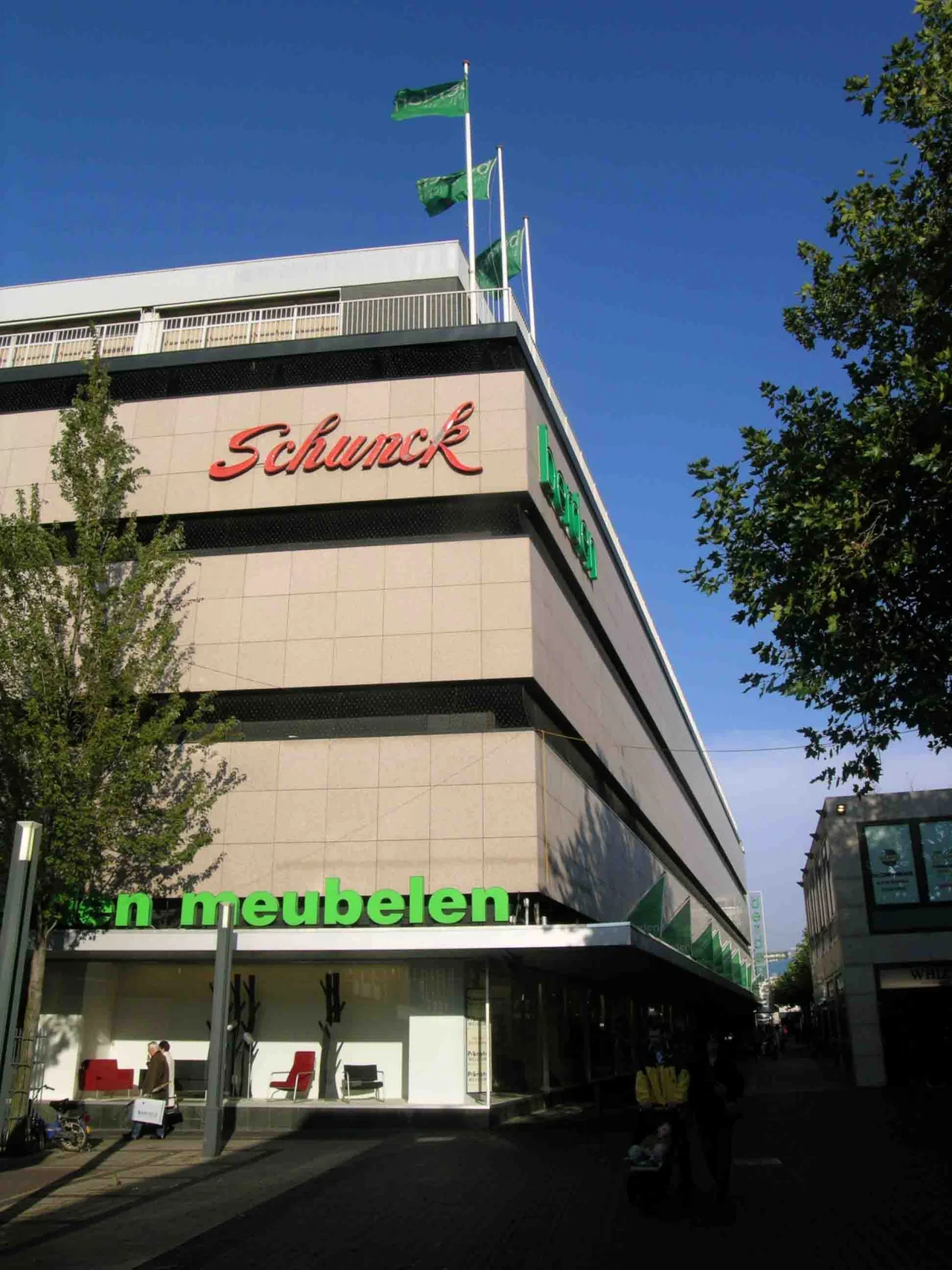

Schunck
In August 1874 a German weaver named Arnold Schunck walked into a small Dutch town with three handlooms, a wife and a one-year-old son. Heerlen had 5,000 people, no railway and not yet a single coal mine. Anna Schunck-Kuppers sold cloth on one side of their one-room shop in the Willemstraat and packets of medicinal herbs on the other. Arnold, more artisan than businessman, wove. Within sixty years their descendants would commission a glass-walled department store that ended up on a list of the thousand most important buildings of the twentieth century. The story of Schunck is the story of how four generations of a single family, born in a Belgian weaving village, helped invent modern Heerlen.
Wanderbursche
Arnold Schunck was born in 1842 in Eupen-Kettenis, in the German-speaking sliver of what is now Belgium, into a family of weavers whose name appears in the parish records as early as 1776. As a young master weaver he set out on his obligatory Wanderbursche journey, the travelling apprenticeship that took him on foot from Silesia to Hamburg to Berlin, looking for work in the new mechanised weaving factories. The factory owners had little respect for the wandering craftsmen and turned him away. He came home to handweaving. When his father died in 1865 of dust lungs - the weavers' affliction - Arnold and his brothers walked away from the family mill in favour of their younger brother, taking only one loom each as inheritance. With his brother Ludwig he tried a dye works in a vacant copper mill at Hauset, but the textile giants of Eupen and Aachen undercut them. In 1874, with samples of unsellable cloth and his wife Anna's idea of selling herbs, he tried his luck in Heerlen.
Cloth for the Miners
Arnold Schunck arrived just as the regional ground was about to shift under his feet. There had been some prospecting for coal at the Valkenburgerweg that very March. He may have heard the rumours. The mines themselves would not really get going until after his death in 1905, but the rising tide of population - sturdy clothing for sturdy men, miners' overalls, work shirts - would carry the business he founded. Anna ran the shop while Arnold cleaned wool at a brook in nearby Schandelen. By 1882 they had outgrown the Willemstraat and moved to a bigger building they bought from the pharmacist Knittel at the Kerkplein, the Church Square, right next to the market. They rebuilt it in 1893-94 using concrete and 2-by-3-metre shopping windows, a sensation for the town. As Heerlen grew with the State Mines after 1901, so did the firm. By 1903 it had become a general partnership - the Firma Schunck - so the children working in the shop could share in the profits, and so the convents of two daughters who became nuns would not inherit the business.
Peter and the Glass Palace
Arnold's son Peter Schunck, born in Hauset in 1873, is the figure who looms largest in the family's memory and Heerlen's. He took over the firm in 1905 with sixty employees. By 1960, the year he died, there were six hundred. Peter survived two world wars and the catastrophic interwar currency collapse that nearly wiped Schunck out when its cash holdings, held in German marks, became almost worthless. By the early 1930s the firm was profitable again, and Peter was buying up the houses around the dirty corner of Bongerd and Kerkplein. When a storm blew over the fence concealing the lot in 1932, the city told him to build or be expropriated. He chose to build. He sent the young Heerlen architect Frits Peutz to study department stores across Europe, fell hardest for Henri Sauvage's Magasins Decre in Nantes, and commissioned a Bauhaus-style structure of steel and concrete wrapped in a free-standing glass curtain on three sides. The Modehuis Schunck opened on 31 May 1935. The Minister of Finance called it the act of a madman, putting up such a building during the Great Depression. Peter Schunck's reply was that depression was precisely when labour was cheap and a stimulus was needed - a piece of Keynesianism delivered a year before Keynes published the General Theory.
Pierre, and What Was Hidden
When the Germans invaded in May 1940, Peter's son Pierre Schunck made a quieter and braver kind of decision. Pierre had taken up the family's old craft of weaving as a young man. During the occupation he worked in the Dutch resistance, sheltering people whose lives depended on not being found. The Glaspaleis itself, with its many floors and storerooms, was part of a family enterprise that during those years was doing more than selling cloth. Pierre survived the war and lived until 1993. The Schunck story is often told as commerce and architecture, which it is. But it is also a story about what a family business can be in a country under occupation, when ordinary acts of shelter become acts of moral courage. The Wikipedia entry for Pierre notes simply that he 'worked in the Dutch resistance.' Heerlen knows what those five words mean.
From Bankruptcy to Cultural Centre
The good times did not last forever. In the 1970s, expansion into businesses outside the core - the kind of diversification Peter had pruned away after the First World War - almost cost the family the company. The firm eventually closed and the Glaspaleis fell into dilapidation. Then in the 1990s the International Union of Architects placed it on its list of the thousand most important buildings of the twentieth century, one of just thirteen Dutch entries. The city bought it, restored it, and renamed it SCHUNCK - a multidisciplinary cultural centre for contemporary art, architecture, music, dance and the public library. The weaver from Kettenis who in 1874 hauled three handlooms over thirty-five kilometres of dirt road to a town that had not yet found its mines became, posthumously, the patron of Heerlen's reinvention. His grandchildren built the building. His name is on it still.
From the Air
The Glaspaleis stands in the centre of Heerlen at roughly 50.888 N, 5.979 E, immediately beside the Romanesque Pancratius church and the Bongerd square. The building is hard to miss from low altitude - it is the rectangular glass-clad block beside the church tower. Heerlen is in the southeast tip of the Netherlands, north of Aachen. Nearest airport: Maastricht-Aachen (EHBK) 25 km west.
Nearby Stories
- Novaesium 4.6 km away
- RAF Bruggen 5.5 km away
- Battle of Lauffeld 6.7 km away
- Toyota Gazoo Racing Europe 13 km away
- Wire of Death 16 km away
- Belgium 81 km away
- Marcinelle Mining Disaster 124 km away
- Zwingenberg Castle 215 km away