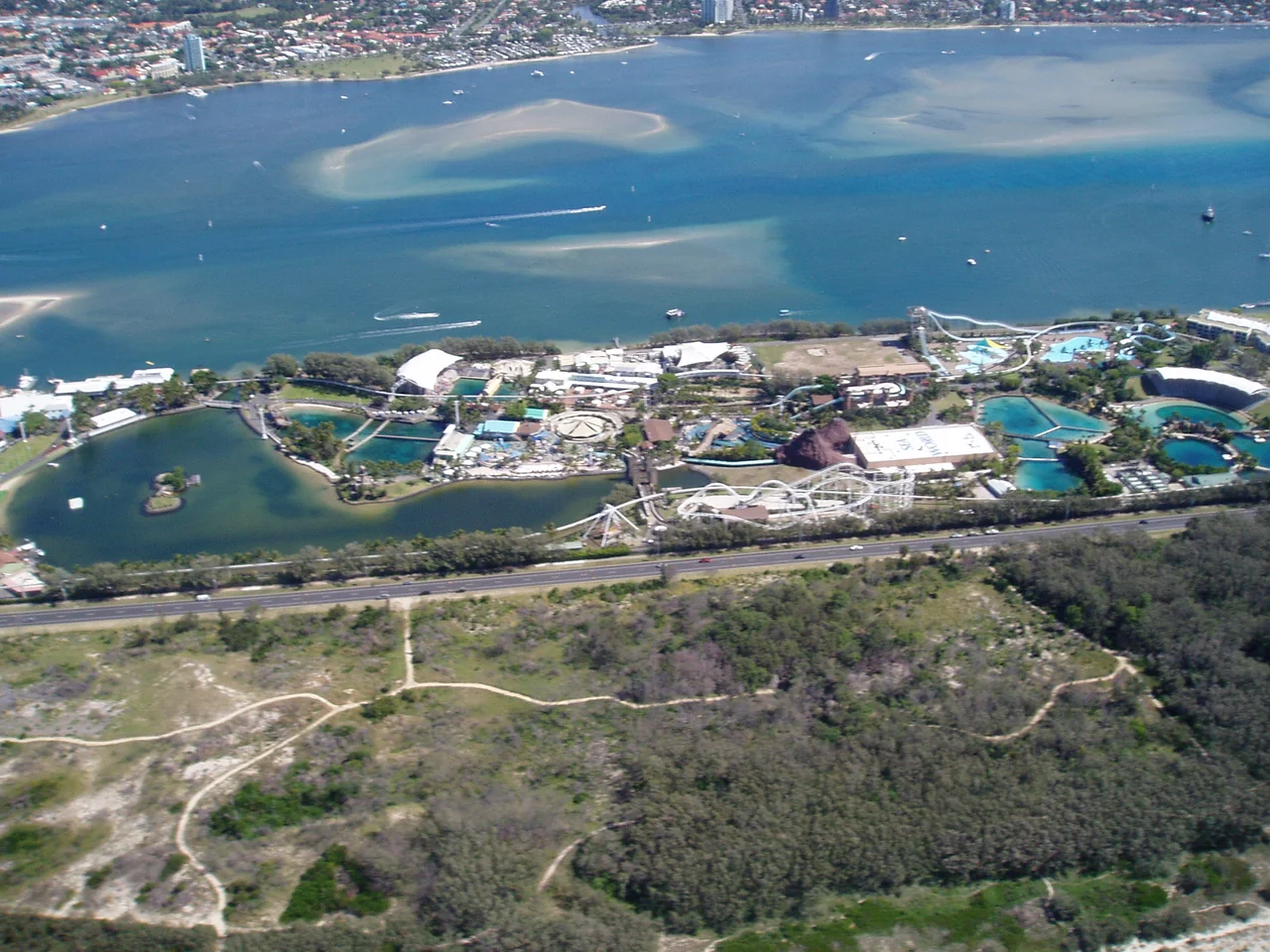

Sea World (Australia)
It began as a water-ski show. Before the dolphins, the roller coasters and the polar bears, the founder Keith Williams ran the Surfers Paradise Ski Gardens, where the headline act was waterskiers performing aqua ballet and stunts. In 1971 the operation moved onto a dredged lake on the Spit, and a year later it took the name Sea World, adding dolphins, marine displays and a replica of Cook's Endeavour. Half a century on, the park that opened on 30 October 1971 has become one of the Gold Coast's defining attractions — and, beyond the rides, one of the hardest-working marine-rescue teams in the country.
Rides, Reinvented Again and Again
Few theme parks rebuild themselves as relentlessly as Sea World. The first attraction, in 1975, was a two-thirds-scale steam-train replica the park designed and built itself. Then came the rides in waves: the Viking's Revenge flume in 1978, the park's first roller coaster in 1981, the Corkscrew in 1982. Whole zones have been themed, re-themed and demolished — Cartoon Network to Sesame Street to Nickelodeon, a Bermuda Triangle ride replaced by the Storm Coaster, dinosaurs arriving and leaving. The New Atlantis precinct, delayed by the pandemic, finally opened in December 2022 with Leviathan, a wooden coaster billed as the first new wooden coaster in Australia in 37 years. The constant churn is the point: there is always a reason to come back.
The Monorail's Long Goodbye
In 1986 Sea World opened something genuinely novel: Australia's first monorail, gliding between three stations and giving visitors a bird's-eye loop of the park. For decades it was a Gold Coast icon, as much a part of the skyline as the rides beneath it. But icons age, and by the 2020s the monorail's running costs and safety concerns had caught up with it. In 2024 the system was dismantled and formally retired, the carriages scrapped. For a generation of visitors it was the first thing they remembered about the place — the gentle hum, the long view over the lake — and its quiet end marked the close of a chapter.
Penguins, Polar Bears and Rays
The marine side is where Sea World earns its name. The park keeps Australia's only polar bear exhibit, Polar Bear Shores, opened in 2000 with bears from overseas zoos and viewing platforms above and below the waterline. Penguin Encounter recreates a slice of the Antarctic in a chilled pool with underwater windows. Ray Reef puts visitors face to face with more than a hundred rays, and Seal Harbour, opened in 2013, houses sea lions and fur seals. The dolphin breeding program has produced births on site, with a nursery pool where young dolphins grow up under their mothers' watch. Throughout, the park leans on its conservation message — that these animals are ambassadors for the wild populations few visitors will ever see.
The Rescue Boat Nobody Sees
Behind the rides runs an operation most visitors never witness. Since the park opened in 1971 its marine team has responded to strandings and entanglements up and down the coast, and in 1988 this work was formalised as the not-for-profit Sea World Foundation. Over the years the rescue crews have attended many hundreds of incidents involving dolphins, whales, turtles, seabirds and sea snakes, pioneering rescue techniques and equipment along the way. In the winter months, when humpback whales migrate past the Gold Coast, the same expertise underpins the park's whale-watching cruises. A seabird aviary cares for injured pelicans and others, some so badly hurt — often by discarded fishing line — that they will never fly free again.
Tragedy in the Air
Sea World's story carries real loss, and it should be told plainly. Twice, helicopter joy-flights linked to the park have ended in disaster. On 3 March 1991 a LongRanger climbed almost vertically, fell backwards, and crashed on a beach on South Stradbroke Island, killing all seven people aboard; investigators found the aircraft was sound and could never fully explain the loss of control. Then on 2 January 2023, two helicopters operated by the separate company Sea World Helicopters collided in the air near the resort. Four people died — Vanessa Tadros, the British couple Ron and Diane Hughes, and the pilot Ashley Jenkinson — and others were gravely hurt. The second helicopter, badly damaged, managed an emergency landing. These were holidaymakers and crew at the start of an ordinary summer day, and the park's place in the Gold Coast's memory now holds their loss alongside its joy.
From the Air
Sea World occupies the Spit at 27.956°S, 153.426°E, on the narrow sand peninsula between the Broadwater and the open Pacific at the northern end of the Gold Coast beachfront. From the air the park's lake, ride structures and the resort stand out at the tip of the peninsula, with the Surfers Paradise skyline just to the south. Best viewed from 1,500–3,000 ft. Note that this airspace has a history of low-level helicopter operations; give working helipads a wide berth. Gold Coast Airport (YBCG / OOL) at Coolangatta lies about 22 km south; Brisbane Airport (YBBN / BNE) is roughly 70 km north. Sea breezes and summer storms can build quickly over the Broadwater.
Nearby Stories
- Tweed Regional Gallery 7.7 km away
- Purga Aboriginal Cemetery 19 km away
- North Stradbroke Island 21 km away
- Deebing Creek Mission 43 km away
- Bald Rock National Park 105 km away
- HMS Porpoise (1799) 636 km away
- Wreck Reefs 665 km away
- SS Elingamite: Gold, Fog, and a Captain Wrongly Blamed 1833 km away