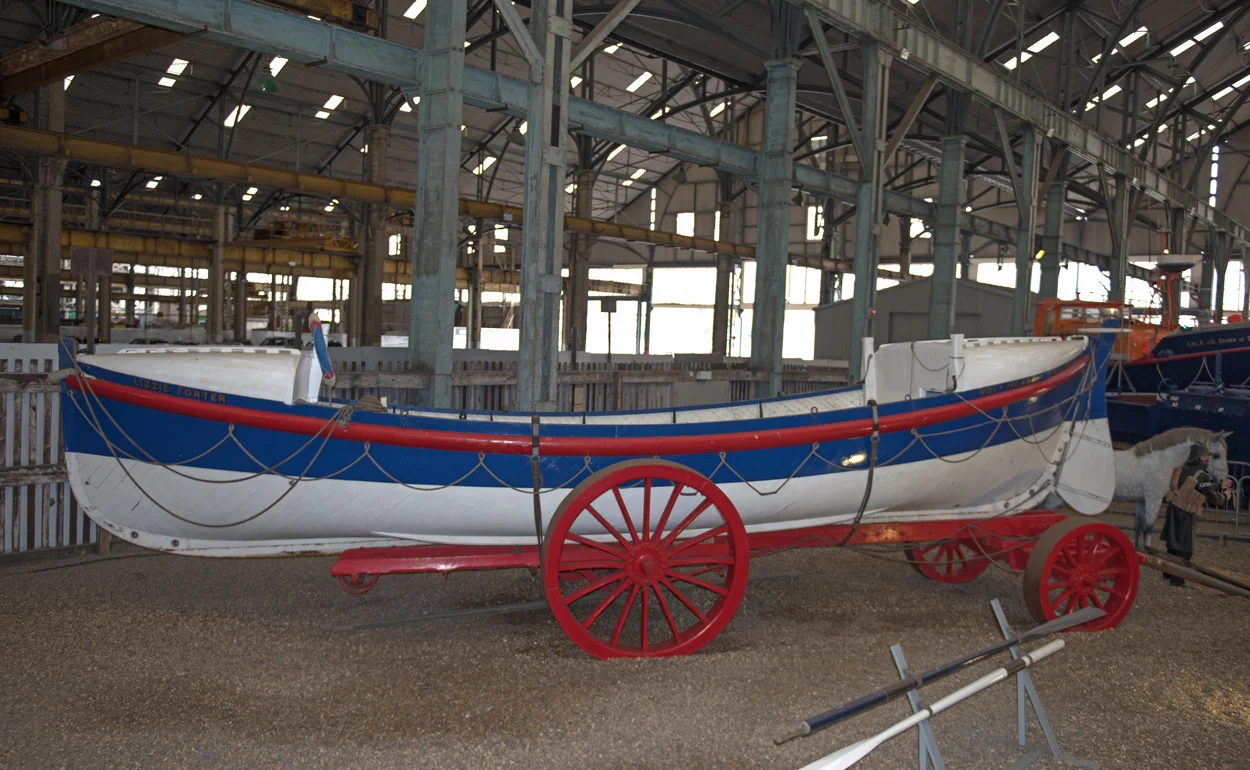

Seahouses Lifeboat Station
The Seahouses inshore lifeboat is called Grace Darling, and the name is not a tribute to a hero from somewhere else. It is a quiet acknowledgement that her brother William was in the North Sunderland crew that did try to reach the Forfarshire wreck on the morning of 7 September 1838, that they failed, that they were forced to shelter for two days at Longstone Lighthouse because the weather would not let them go home, and that the station has spent the 188 years since trying to be a little faster, a little better-equipped, a little more ready than they were that morning.
Two Villages, One Station
Seahouses began as the harbour for the inland village of North Sunderland, and for most of its existence the lifeboat station carried the older name. The first lifeboat arrived in 1832, placed there by the Crewe Trustees - the same charitable foundation that ran the Bamburgh boat. Mr E. Robson of South Shields supplied the original boat, displayed alongside two others at Newcastle Quay before being installed in a new stone-built boathouse. There are no records of any rescues by this first boat. In 1838 it was transferred elsewhere, and North Sunderland received a replacement: a 27-foot lifeboat designed by Captain John Foulerton RN, built by Shore, previously stationed on Holy Island. It was this boat that was meant to launch to the Forfarshire.
The Morning of 7 September 1838
The Forfarshire paddlesteamer went onto the Farne Island rocks before dawn and broke in two. On Longstone, Grace Darling spotted the survivors at first light and set out with her father in their own coble. At North Sunderland, the coxswain made a judgement call that has been argued about ever since: he chose not to launch the regular lifeboat, deciding a smaller coble could navigate the rocks better. The coble had a crew of seven, one of whom was William Darling - Grace's brother. They reached the wreck after the Darlings had completed the rescue, found no one left to save, and could not return home because the weather had worsened. They spent two days sheltering in a disused outbuilding at Farne Island Lighthouse, the keepers' rooms being full of survivors. The Royal National Lifeboat Institution took over the station in 1852, and continued to call it North Sunderland - the village name - rather than Seahouses - the harbour name.
From Oars to Petrol Engines
In 1851 the original Foulerton boat was replaced with a 30-foot self-righting lifeboat from Forrestt of Limehouse, modelled on the James Beeching design that had won a competition organised by Algernon Percy, the 4th Duke of Northumberland, who was president of the RNIPLS. Sail-and-oar boats continued to serve until 1936, when North Sunderland received its first motor lifeboat - a non-self-righting boat with a 35 horsepower petrol engine giving seven and a half knots. She cost £3,447, funded by three separate legacies, and was given a composite name: W.R.A., standing for William and James, Ridge Matthews, and Abigail Gardiner. Each name was inscribed on a plaque inside the boat. Helen Percy, Duchess of Northumberland, performed the naming ceremony on 5 September 1936.
Modern Service
In 1999 the station was formally renamed Seahouses Lifeboat Station - the harbour name finally winning out over the village name, almost 170 years after the boat first arrived. The current all-weather lifeboat is a Shannon-class boat called John and Elizabeth Allan (ON 1343), formally named in March 2023. The inshore lifeboat is Grace Darling (D-828), named when its predecessor of the same name was retired in January 2021 - the second inshore boat at Seahouses to carry that name. Both lifeboats and their crews continue to serve the same waters where the Forfarshire went down: the Farnes, the long sand beaches, the reefs that stretch out from Bamburgh and Beadnell. The coxswain Robert Charles Dawson Douglas received the British Empire Medal in 1992; the honorary secretary Robert Heslop Reay was decorated in 1991. The station's awards run back through almost two centuries of cold dark mornings when somebody had to go out.
From the Air
55.58N, 1.65W at Seahouses harbour, Northumberland, 20 mi southeast of Berwick-upon-Tweed and 3 mi south of Bamburgh. From altitude, the harbour is a small pier and breakwater jutting east into the North Sea, with the Farne Islands visible 2-3 mi offshore. The boathouse is at the inner harbour. Nearest ICAO: Newcastle (EGNT) 45 mi south. Best viewed at 1,500-2,500 ft AGL. The waters between Seahouses and the Farnes are where most of the historic Farne wrecks occurred and where modern callouts still concentrate.
Nearby Stories
- St Abbs Lifeboat Station 1.2 km away
- Etal Castle 1.6 km away
- Warkworth Castle 3.4 km away
- Otterburn Training Area 12 km away
- Eyemouth Disaster 28 km away
- German submarine U-2367 79 km away
- Saltburn Pier 117 km away
- Alexander L. Kielland (Platform) 265 km away