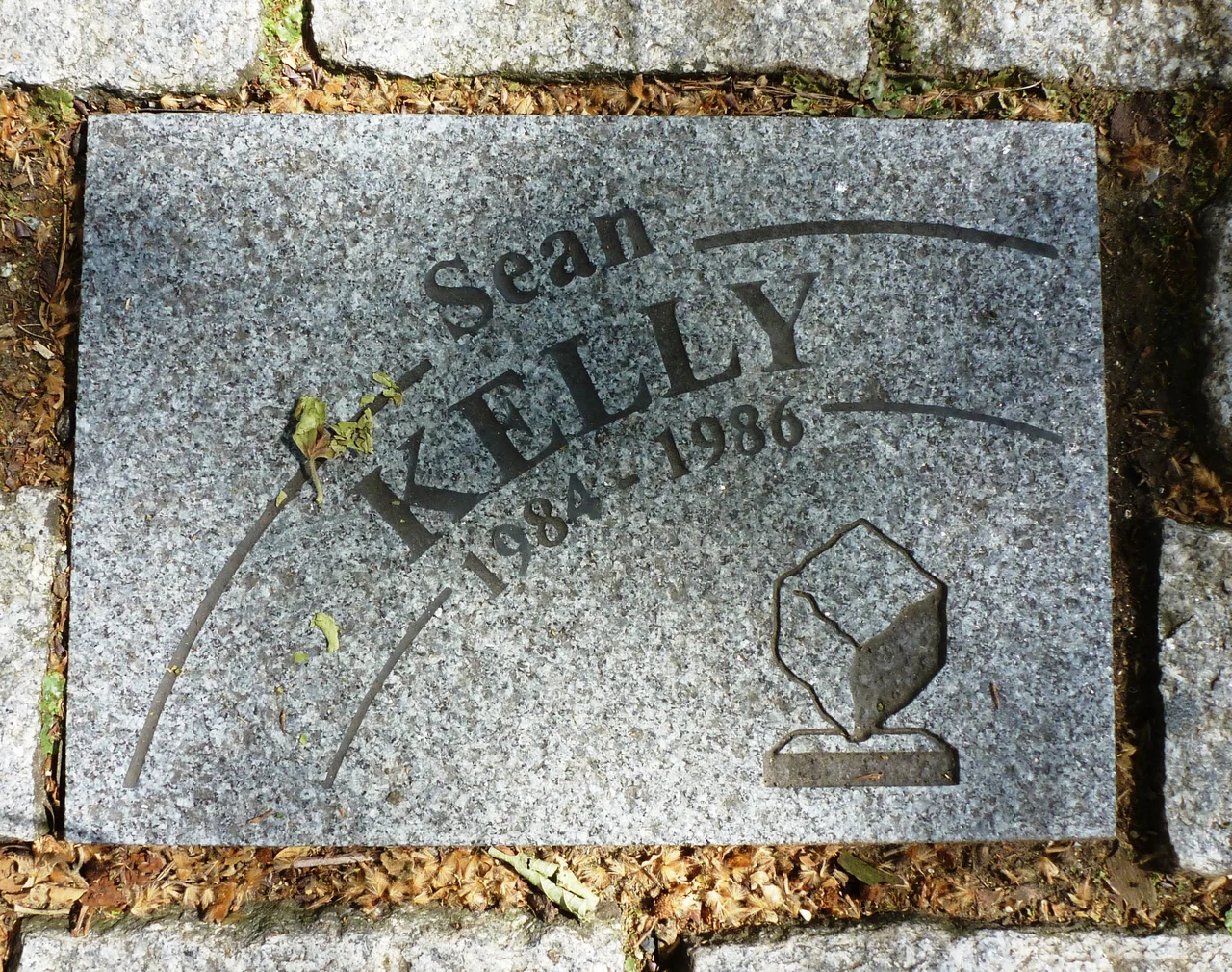

Sean Kelly (cyclist)
On a December morning in 1976, a private jet from Dole Airport landed at Dublin. Inside were three Frenchmen: a directeur sportif from Besançon named Jean de Gribaldy, his pilot acting as interpreter, and a young amateur cyclist who could identify their target. They hired a taxi to Carrick-on-Suir, found the farm at Curraghduff, and learned that Sean Kelly was out somewhere on a tractor. They drove the Dungarvan road until they met a tractor coming the other way, flagged it down, and called out the name. The young man answered: yes, I am Sean Kelly. The signing happened around the family kitchen table later that day - £6,000 a year, take it or leave it. Within eight years Kelly would be the number-one ranked cyclist in the world, and would hold that ranking for a record five consecutive seasons. He had left school at thirteen to milk cows. He spoke almost no French.
Curraghduff
John James Kelly was born on 24 May 1956 at Belleville Maternity Home in Waterford City, the second son of Jack and Nellie Kelly, who farmed at Curraghduff in County Waterford a few kilometres south of Carrick-on-Suir. He was called Sean - the Irish form of John - to avoid being confused with his father at home. He went to Crehana National School, cycling there and back the mile and a half with his older brother Joe. He was painfully shy in class, convinced he was outclassed by the brighter children, and he retreated into near-silence. When Jack went to hospital with an ulcer in 1969, the thirteen-year-old Sean left school to help on the farm. He was sixteen when he took his first paying job - as a bricklayer. In September 1969, a delegation from the newly-formed Carrick Wheelers cycling club visited Joe's secondary school looking for recruits. Joe joined and began winning. As had always been the household pattern, Sean followed him.
First Race, First Banned, First Contract
Sean's first race was on 4 August 1970 at Kennedy Terrace in Carrickbeg - an eight-mile handicap that he won by more than three minutes after starting ahead of his brother. He won the National Junior Road Championships in 1972 and again in 1973. By 1975 he was racking up senior wins at seventeen. In September of that year he went to South Africa with Pat and Kieran McQuaid for the Rapport Toer stage race, ostensibly to prepare for the 1976 Olympics, but under the apartheid sporting ban he and the McQuaids were forced to race under false names for a fake British team. The Irish Cycling Federation suspended them for six months when they came home; the International Olympic Committee then barred them from the 1976 Montreal Games. The whole disaster could have ended his career. Instead, blocked from the Olympics, he wrote to a small French amateur team, V.C. Metz, and went to Lorraine for the summer. He won eighteen of twenty-five races, including the Piccolo Giro di Lombardia - and Jean de Gribaldy boarded that jet in December.
King of the Classics
Kelly turned professional in 1977 and rode his first Tour de France in 1978, winning a stage. For years he was tagged as a sprinter who couldn't win stage races. De Gribaldy refused to believe it. He pushed Kelly to lose weight, to climb better, to ride for the whole of a race. The breakthrough year was 1983: Kelly won Paris-Nice for the first time and the Giro di Lombardia in October by less than half a wheel from Greg LeMond. The following spring he went wild. Paris-Nice again. Then Paris-Roubaix - cobbled, freezing, mud on his face on the front page of L'Equipe under the headline Insatiable Kelly! Then Liege-Bastogne-Liege. In 1984 he won 33 races. He took Paris-Nice seven years running - 1982 through 1988 - a record no one has matched. He won Paris-Roubaix twice (1984, 1986), Liege-Bastogne-Liege twice (1984, 1989), the Giro di Lombardia three times (1983, 1985, 1991), and Milan-San Remo (1986, 1992). Nine Monument wins in total - the highest tier of one-day races. From March 1984 he was the inaugural FICP world number one. He held the ranking until 1989.
The 1988 Vuelta
The doubt that hung over Kelly was whether he could win a Grand Tour - three weeks of racing where the climbers usually take it. In April 1988 he flew to Tenerife for the start of the Vuelta a España and immediately lost time when his team-mate Thomas Wegmüller fell out with dysentery. On the Spanish mainland Kelly chipped away with sprint bonuses, regaining a minute in four days. He stayed within striking distance through the mountains thanks to climbing help from his Scottish team-mate Robert Millar. With one day's racing left he was 21 seconds behind the Spaniard Anselmo Fuerte. Then came the time trial on the second-to-last day. 'I put it in a big gear,' Kelly said later, 'and gave it everything.' He took the yellow jersey by almost two minutes. The next day he won his only Grand Tour and the points classification with it. When he came home to Carrick-on-Suir, the town held a parade for its bricklayer's son.
The Comeragh 100
In August 1991, Kelly walked away from the Tour of Galicia mid-race. His brother Joe - the one whose footsteps he had always followed, the one who had drawn him into cycling that day at the school - had been killed in the Comeragh 100, a charity ride near Carrick-on-Suir. Sean came home for the funeral. He had to keep racing - the season was on - but the loss never quite left his career. He came back to win his fourth Nissan Classic by four seconds, then won the Giro di Lombardia at season's end. He retired in 1994 after one last race in Carrick: 1,200 cyclists turned out, including Eddy Merckx, Bernard Hinault, Stephen Roche, and Laurent Fignon. Mary Robinson, President of Ireland, attended the civic reception the day before. Kelly won the race in a sprint against Roche. Across a career that ran from Merckx to Indurain, he had collected 193 professional victories. Today the Sean Kelly Sports Centre stands in Carrick-on-Suir, and Carrick-Wheelers's biggest alumnus - Sam Bennett, the 2020 Tour de France green jersey - learned to ride on the same county roads.
From the Air
The Curraghduff farm and Carrick-on-Suir, where Sean Kelly grew up and trained, sit at 52.35°N, 7.41°W on the border of County Waterford and County Tipperary, on the River Suir. From the air, look for the river curving between the Comeragh Mountains to the south and the green Suir valley to the north. The N24 road runs through Carrick. Nearest airports: Waterford (EIWF) about 25 km east, Cork (EICK) about 95 km west-south-west, Shannon (EINN) about 130 km north-west. The roads south of Carrick, climbing into the Comeraghs, are still favourite training ground for Irish professional cyclists.
Nearby Stories
- Young Ireland rebellion 3.7 km away
- Clonmult Ambush 4.2 km away
- Dunbrody Abbey 5 km away
- Old Parish 5.8 km away
- Doon, County Limerick 12 km away
- Mitchelstown Castle 13 km away
- County Carlow 18 km away
- Ramsey Island 117 km away