
The Letter E and the End of Empire
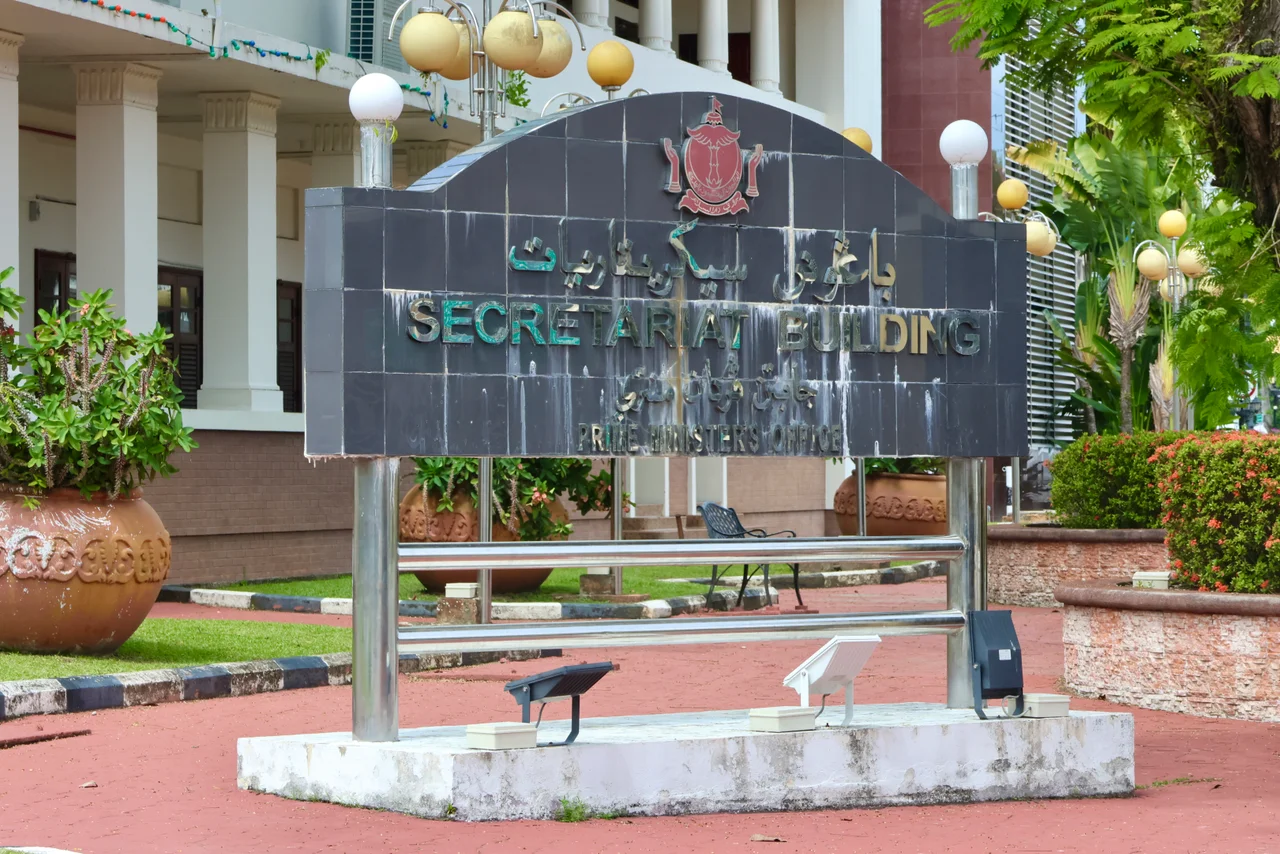
Seen from above, the Secretariat Building in Bandar Seri Begawan resolves into a capital letter E. The shape is not accidental. When Sultan Omar Ali Saifuddien III laid the foundation stone on 19 November 1952, Brunei was a British protectorate, and the building's architects at Booty and Edwards designed the floor plan as a tribute to Queen Elizabeth II, who would be crowned the following year. The brick-red roofs and white walls rose in the colonial style of the era, symmetrical and orderly, and when the building was completed in August 1953 it was considered the most modern structure in the country. Seventy years later, the E remains legible from the air, a relic of a political relationship that the building itself has long outlived.
Colonial Concrete, Bruneian Carvings
The Secretariat Building's architectural identity lives in the tension between its British bones and its Bruneian skin. The colonnaded front verandah, the three pylon entrances, and the symmetrical massing all speak the language of British colonial administration: clean lines, practical layouts, authority expressed through order rather than ornament. But the parapets facing Taman Sir Omar Ali Saifuddien tell a different story. There, relief sculptures by the Italian artist Rudolfo Nolli depict customary Bruneian life -- farming, metalworking, fabric weaving -- summarizing the livelihoods of the people this foreign-designed building was meant to govern. The double timber doors with black glass allow ventilation where windows are absent, a concession to equatorial heat that no amount of colonial formality could override. White stucco, light brickwork, and five pillars frame the passages between the pylons, mixing what the building's designers called minimalist Egyptian features with traditional British government architecture. The result is a building that belongs wholly to no single tradition.
The Seat of Power Shifts
When the building opened on 1 July 1954, the Jabatan Adat Istiadat Negara -- the department of royal customs and ceremonies -- took up residence in its General Office, an early signal that Bruneian traditions would find a home even within colonial infrastructure. After the 1959 promulgation of the Brunei Constitution, which established the country's first written framework of government, the Secretariat Building became the administrative hub of an increasingly self-governing state. Queen Elizabeth II's birthday was still honored with a ceremonial procession in front of the building as late as 8 June 1968, but the direction of history was clear. When Brunei attained full independence on 1 January 1984, the colonial trappings fell away while the building remained. The Ministry of Communications was among the first independent-era institutions to set up shop inside, before eventually relocating to the Old Airport area in Berakas.
An Old Building, Still Working
Unlike many colonial-era structures across Southeast Asia, the Secretariat Building was never abandoned, never converted into a museum, never left to decay behind a heritage plaque. It kept working. Government departments have cycled through its offices for seven decades, each leaving and being replaced without altering the fundamental character of the place. Radio Television Brunei relocated its headquarters to the building as recently as June 2020, proving that the structure still functions as usable office space. The facade has changed remarkably little since 1953. The original brick-red roofs remain. The white body endures. The fair-faced external accent walls still catch the equatorial light at the angles the architects intended. The building is now protected under the Antiquities and Treasure Trove Act, but its preservation owes less to legal protection than to the simple fact that Brunei never stopped needing the space.
Reading the E from Above
The road that passes the Secretariat Building is called Jalan Elizabeth II, another echo of the queen whose initial the building wears. From ground level, the E is invisible -- you see columns, verandahs, Nolli's carvings, the comings and goings of government workers. It takes altitude to read the architect's tribute. From a few thousand feet, the three prongs of the E extend clearly, the center one slightly longer than the two flanking wings, the whole composition facing Taman Sir Omar Ali Saifuddien and the waterfront beyond. The park itself is named for the sultan who commissioned the building, the same man who laid its foundation stone and who would later become known as the 'Architect of Modern Brunei' for his role in transforming oil revenue into national infrastructure. He built an E for Elizabeth, but he filled it with the machinery of a sovereignty that would eventually answer to no one but Brunei itself.
From the Air
Located at 4.891°N, 114.942°E on Jalan Elizabeth II in central Bandar Seri Begawan. The distinctive E-shaped floor plan is visible from 2,000-4,000 feet, with the three prongs of the E extending toward Taman Sir Omar Ali Saifuddien. Brick-red roofs contrast with the white body, making the building identifiable from altitude. Adjacent to the Omar Ali Saifuddien Mosque and the Royal Regalia Museum. Brunei International Airport (WBSB) is approximately 9 km to the northeast.
Nearby Stories
- From Residency to Memory 28 km away
- Twenty Years on the Seattle Run 30 km away
- The Abode of Peace on Borrowed Coastline 31 km away
- USS Salute: The Minesweeper That Found the Last Mine 33 km away
- The Ants of Borneo 50 km away
- Sabah State Railway 55 km away
- Starcevich Monument 74 km away
- Luconia Shoals 209 km away