.jpg)
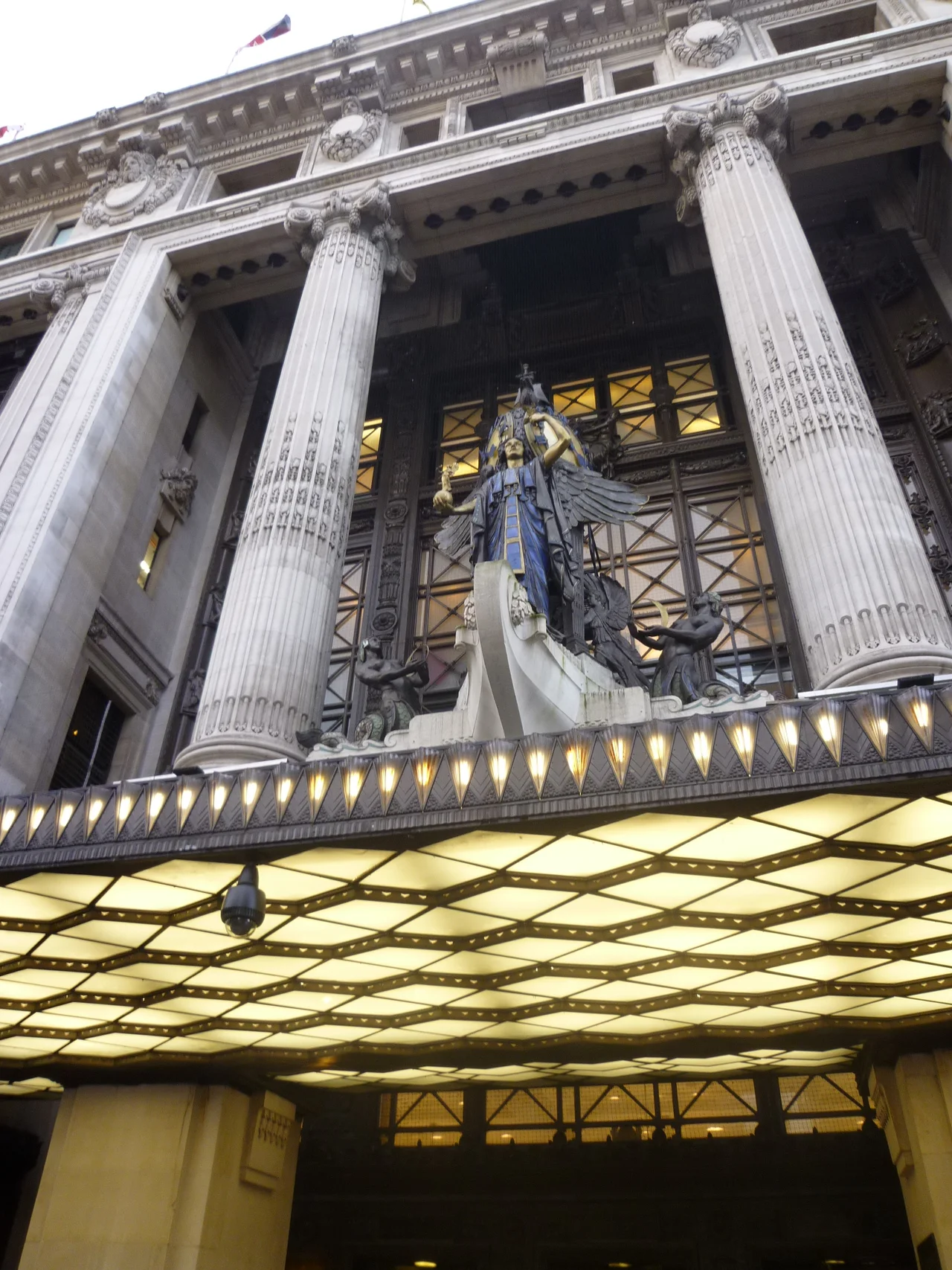
Selfridges flagship store
To reach Selfridges in the early years, you dialled 1. Just the number one. Harry Gordon Selfridge had persuaded the General Post Office to give him the simplest phone number anyone could imagine, and customers picked up their receivers and asked the operator for number 1 to be connected to his store's switchboard. The audacity of the gesture was the whole point. Selfridges opened on 15 March 1909 employing 1,400 staff in a Beaux-Arts palace designed by the Chicago architect Daniel Burnham, on what had been considered an unfashionable end of Oxford Street. Selfridge had assembled the site by quietly buying up a block of Georgian buildings bounded by Somerset, Wigmore, Orchard, and Duke Streets. By the time the building opened, the unfashionable end of Oxford Street had been replanted as the most ambitious department store London had ever seen.
Shopping as Leisure
Selfridge believed that shopping was a form of entertainment, and he built a store designed to extend visits rather than rush customers through. The original 1909 building had five storeys above ground, three basement levels, and a roof terrace, with 100 departments planned. Facilities added across the years included a library, reading and writing rooms, and a silence room where women could rest without conversation. The store opened at a moment when shopping was changing fundamentally for British women. Increasingly able to leave the house without a chaperone, they needed places to spend time, encounter goods, and conduct social life beyond the home. Department stores like Selfridges met that need, becoming venues where the new independence of female public life could be practiced and displayed.
The Architects of the Frontispiece
Daniel Burnham, who had designed Chicago's Flatiron and Marshall Field's, drew the master plan. The Beaux-Arts frontispiece on Oxford Street, with its giant Ionic columns rising the full height of the facade, was designed by the American architect Francis Swales, who had trained at the École Nationale Supérieure des Beaux-Arts in Paris. British architects R. Frank Atkinson and Thomas Smith Tait assisted. Swales drew heavily on John Burnet's 1904 extension to the British Museum, and the resemblance is visible to anyone who walks from one building to the other. The store was built in phases. The first phase covered the nine and a half bays nearest the Duke Street corner, on a site 250 feet wide on Oxford Street and 175 feet deep along Duke Street. The full building was not completed until 1928. The use of steel-frame construction with spandrel panels allowed enormous glass panes at the main entrance.
Rooftop Cocktails and a Gun Club
The roof terrace was the place Londoners went after shopping. Terraced gardens, cafes, and a mini golf course covered the roof, with views across central London. There was also, improbably, an all-girl gun club. Fashion shows were staged up there, and strolling on the roof became a recognised London leisure activity. Down at street level the windows were dressed by the most ambitious display teams in the city, treated as theatre rather than commerce. Selfridge himself worked the floor relentlessly, greeting customers, observing patterns, intervening in displays. He retired in 1941. In 1951 the store was sold to the Liverpool-based Lewis's chain, which was itself taken over in 1965 by Charles Clore's Sears Group. In 2003 the chain was acquired by Canada's Galen Weston for 598 million pounds. The store was named the world's best department store in 2010 and again in 2012.
Eisenhower in the Basement
During the Second World War, from 1942 after the United States entered the conflict, one of the deepest sub-basements at Selfridges was given over to the United States Army. The reason was practical: the building had one of the few secure telex lines in London, it was safe from German bombing thanks to multiple basement levels of reinforced concrete, and it was directly across Grosvenor Square from the United States Embassy. General Dwight D. Eisenhower, commander of SHAEF, initially used the space. Later it housed fifty soldiers from the 805th Signal Service Company of the US Army Signal Corps, operating the SIGSALY encrypted voice system that allowed Roosevelt and Churchill to speak securely across the Atlantic. Rumours of a tunnel from Selfridges to the embassy persist, with interrogation cells hewn into the resulting space, although the documentary evidence is patchier than the legends.
Bombs, Bombs, Bombs
The store suffered serious damage during the London Blitz that began on 7 September 1940 and continued through fifty-seven nights, and again in 1941 and 1944. On the night of 17/18 September 1940, a combined Luftwaffe force of 268 Heinkel He 111 and Dornier Do 17 bombers attacked the West End. The bomb that fell on Selfridges on 17 April 1941 destroyed only the Palm Court Restaurant, venue for the rich and famous. Of the four major pre-war Oxford Street retailers, only Selfridges, House of Fraser, and John Lewis still trade today; Bourne & Hollingsworth and Peter Robinson are gone. The store survived two IRA attacks in the 1970s, a bomb outside on 28 August 1975 that injured seven, and a firebomb inside on 29 January 1977 that injured one and started a serious blaze. Galen Weston's family bought 388-396 Oxford Street next door in 2011, and Renzo Piano was commissioned in 2012 to design an extension. The store still spans 540,000 square feet of selling space, second only to Harrods in the United Kingdom.
From the Air
Coordinates 51.514°N, 0.153°W on Oxford Street in Marylebone, central London. From altitude the long block of the Selfridges building runs along the north side of Oxford Street, with the green of Hyde Park visible to the south-west. Look for the distinctive long facade along Oxford Street between Duke Street and Orchard Street. Marble Arch sits just to the west at the corner of Hyde Park. Nearest airport: London Heathrow (EGLL) about 20 km west, London City (EGLC) 11 km east.
Nearby Stories
- Stevenage 5.7 km away
- Malling Abbey 5.7 km away
- 1952 Farnborough Airshow Crash 7.7 km away
- Ingatestone Hall 8.2 km away
- Hellfire Caves 9.1 km away
- The Carrington Event: The Solar Storm That Could Happen Again 9.8 km away
- Bletchley Park 16 km away
- Castle Hedingham 23 km away