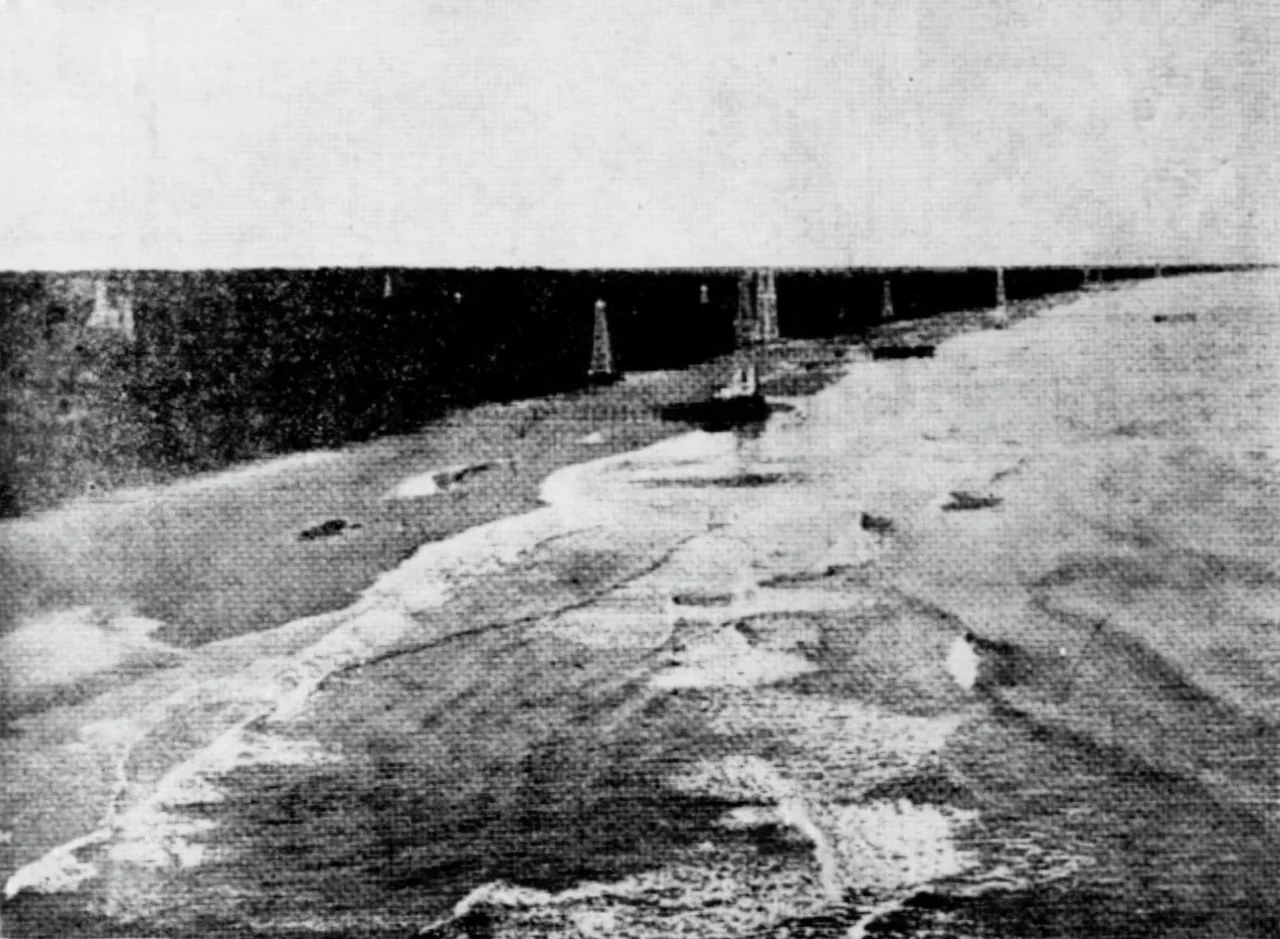

Seria Oil Field
Well S-1 produced exactly 5,320 barrels of oil before it was shut down. Drilled on the Seria coastline using the cable-tool method, it reached a depth of 978 feet and first struck oil on April 5, 1929. The well had been ceremonially inaugurated the previous July by the wife of the British Resident, Patrick McKerron, though at that point it was only producing gas. Those 5,320 barrels were enough. They proved that the geological fold running beneath the coast of northwest Borneo -- the Seria anticline -- held commercial quantities of petroleum, and they set in motion a transformation that would turn a sleepy sultanate into one of the wealthiest nations on Earth per capita.
The Sky Hook and the Nodding Donkeys
By the early 1950s, the Seria field had become the greatest oilfield in the British Commonwealth. Pumpjacks -- the rhythmically bobbing machines that petroleum workers call nodding donkeys -- dotted the landscape, pulling crude from beneath the coastal plain. But the ambitions of the British Malayan Petroleum Company extended beyond the shore. In September 1952, engineers unveiled the Seria Sky Hook: a mile-long aerial cable railway connecting the beach to an artificial steel island offshore in the South China Sea. From this platform, crews drilled into previously unreachable reserves beneath the seabed. Repurposed World War II landing craft ferried cargo from deep-sea ships to the field. By 1956, daily production peaked at 115,000 barrels, and BSP announced the drilling of its 500th well in November 1958.
Burned Twice, Rebuilt Twice
The Japanese understood what the Seria field was worth. The Kawaguchi Detachment invaded Borneo in December 1941, just nine days after Pearl Harbor, and the oil installations were a primary target. British forces destroyed the field rather than let it fall into enemy hands. When Australian forces liberated Seria on June 29, 1945, they found 14 of the 21 remaining wells ablaze -- set on fire by the retreating Japanese. Australian servicemen worked to cap the burning wells and stop the flow of oil. By November 1945, production had resumed, but the original town was gone, completely destroyed by the war. Fire returned in August 1954, this time by accident. A blaze destroyed three storage buildings, and less than two weeks later lightning ignited a second fire that consumed two more buildings and over 100 refrigerators, threatening a paint store holding thousands of gallons before firefighters and volunteers contained it.
Revolt and the Sultan's Calculus
On December 8, 1962, rebels from the Brunei People's Party seized the Seria oil field. Senior BSP officers, including Managing Director Patrick Linton, were taken hostage. The incident cut deeper than a security breach -- it struck at the economic foundation of the sultanate and influenced Sultan Omar Ali Saifuddien III's entire approach to British withdrawal. The Sultan became cautious about losing Gurkha security forces, wary of the vulnerability the revolt had exposed. British forces from the 1/2nd Battalion Gurkha Rifles recaptured Seria within days, and the Sultan subsequently approved a permanent British garrison to protect the oil installations. The field expanded the following year with the South West Ampa gas field in July 1963, pushing Brunei's petroleum frontier further offshore.
A Billion Barrels and Counting
The scale of what the Seria anticline has yielded is staggering. Over one billion barrels of oil have flowed from this single geological structure since 1929. By 1970, offshore sources provided 60 percent of the 129,000 barrels produced daily, with the Seria land field contributing the rest. Output climbed to 250,000 barrels per day by 1979 before the government began managing production for sustainability. The Seria Crude Oil Terminal, opened by Sultan Hassanal Bolkiah in June 1972, formalized the export infrastructure. A refinery expanded from 2,000 to 10,000 barrels per day by the early 1980s. Since 1990, the field has settled into a steady rhythm of roughly 20,000 barrels per day -- modest compared to its mid-century peak, but continuous. By 1996, cumulative production represented about 34 percent of estimated reserves. New discoveries in adjacent blocks in 2005 and 2006 confirmed that the Seria anticline has not finished giving up its secrets.
From the Air
Coordinates: 4.617N, 114.317E. The Seria oil field straddles the coastline of Belait District along the South China Sea. From altitude, the field is identifiable by rows of pumpjacks along the shore, offshore platforms, the Seria Crude Oil Terminal, and pipeline infrastructure. The Billionth Barrel Monument is a distinctive landmark near the coast. Anduki Airfield is nearby but not commercially active. Brunei International Airport (WBSB) is approximately 75 km east. Tropical maritime conditions prevail with frequent haze and afternoon thunderstorms.
Nearby Stories
- The Sultan's Gurkhas 2.4 km away
- The Town That Splits a Nation 12 km away
- Kelabit Highlands 20 km away
- The Billion-Dollar Playground That Michael Jackson Opened 45 km away
- The Ants of Borneo 56 km away
- Niah National Park 66 km away
- Similajau National Park 156 km away
- Luconia Shoals 185 km away