
Seria
Before it was Seria, the place was called Padang Berawa -- Wild Pigeon's Field. The name described the low, waterlogged ground between the Bera and Seria rivers, thick with aquatic plants, where wild pigeons gathered in the mangrove margins of northwestern Borneo. The word berawa itself carries Indonesian or Javanese roots, hinting at older trade connections along these coasts. Nobody calls it that anymore. Oil erased the old name the way it rearranged everything else here, turning swampland into the economic engine of a sultanate.
Nine Days After Pearl Harbor
Seria was among the first places in Borneo to feel the war. On December 16, 1941 -- nine days after the attack on Pearl Harbor -- the Kawaguchi Detachment of the Imperial Japanese Army landed on the coast. The British response was decisive and devastating: they destroyed the oil field themselves, denying it to the invaders. Japan occupied the ruined installations anyway. For nearly four years the town existed under occupation until the United States Navy struck Japanese positions in April 1945. Australian forces from the 9th Division liberated Seria on June 29, 1945, but by the time they arrived, the retreating Japanese had set the remaining oil wells ablaze. Production resumed in November 1945. The original town did not resume at all -- by 1946, it had been completely destroyed.
Mosques, Movie Goers, and a Hidden Railway
What rose from the ashes was a company town with unusual textures. In the early 1950s, the British Malayan Petroleum Company organized free open-air cinema screenings for its employees, part of a broader trend that led one observer, G. L. Ness, to describe Brunei as a land of "mosques and movie goers." The Marina Cinema, built in the 1950s, is one of the few surviving theaters from that era, though it has been shuttered and unoccupied since around 1991. Perhaps the most remarkable relic is an eight-mile wooden railway built by the oil company before the war, connecting Seria to the Badas pumping station on the Sungai Belait. When the Japanese occupied the area, BMP staff secretly hid essential components of the railway, rendering it useless to the occupiers. When Australian liberation forces arrived, the components "miraculously re-appeared," and the railway was quickly restored to carry two 25-pounder guns and ammunition to Badas, where a Japanese contingent still held out.
A Town Built on an Anticline
Seria sits directly atop the geological formation that made Brunei rich -- the Seria anticline, a fold in Upper Miocene sandstone that has been producing oil continuously since 1929. The Seria Refinery, Brunei's only oil refinery, occupies the Sungai Bera area alongside the New Gas Compression Plant. Yet the town's natural surroundings complicate the industrial portrait. BirdLife International has designated Seria's 5,000-hectare coastline as an Important Bird Area, where tidal mudflats and mangroves support populations of Bornean crestless firebacks, Wallace's hawk-eagles, and straw-headed bulbuls. The old gas-fired power plant that once generated the town's electricity has been demolished and replaced by the Tenaga Suria Brunei solar farm, a B$20 million installation with 1.2 megawatts of capacity that began operating in 2010.
Gurkhas, Jungle School, and a Stanley Cup Winner
The 1962 Brunei revolt made Seria a permanent military concern. Rebels attacked the town as part of coordinated strikes across the coast, but security forces held their ground. British Gurkha Rifles and Queen's Own Highlanders recaptured Seria within three days, and Sultan Omar Ali Saifuddien III subsequently approved a permanent British garrison to protect the oil installations. That garrison remains. The British Army Jungle Warfare Training School operates from Sittang Camp just outside town, with helicopters from No. 1563 Flight RAF stationed at its heliport. Against this backdrop of oil derricks and military installations, Seria has produced a surprisingly eclectic roster of notable residents. Craig Adams, born here in 1977, went on to win the Stanley Cup twice -- with the Carolina Hurricanes and the Pittsburgh Penguins. Cornelius Sim, born in Seria in 1951, became Brunei's first Cardinal of the Catholic Church before his death in 2021.
The Billionth Barrel
In 1991, a monument was erected in Seria to mark an extraordinary milestone: one billion barrels of crude oil had been pumped from the field beneath the town. The Billionth Barrel Monument stands near the coast as a reminder of the scale of what this small settlement has contributed to the global energy supply. The town itself remains compact -- its population was 3,625 in 2016, and its municipal area covers just 1.56 square kilometers. The Pasarneka Seria wet market still serves as the town's marketplace. Seria Plaza anchors a modest commercial center. A B$288.7 million housing project in nearby Panaga has accommodated some growth, but Seria retains the character of a place that exists for a single purpose and knows it. The oil keeps flowing. The nodding donkeys keep bobbing along the shore.
From the Air
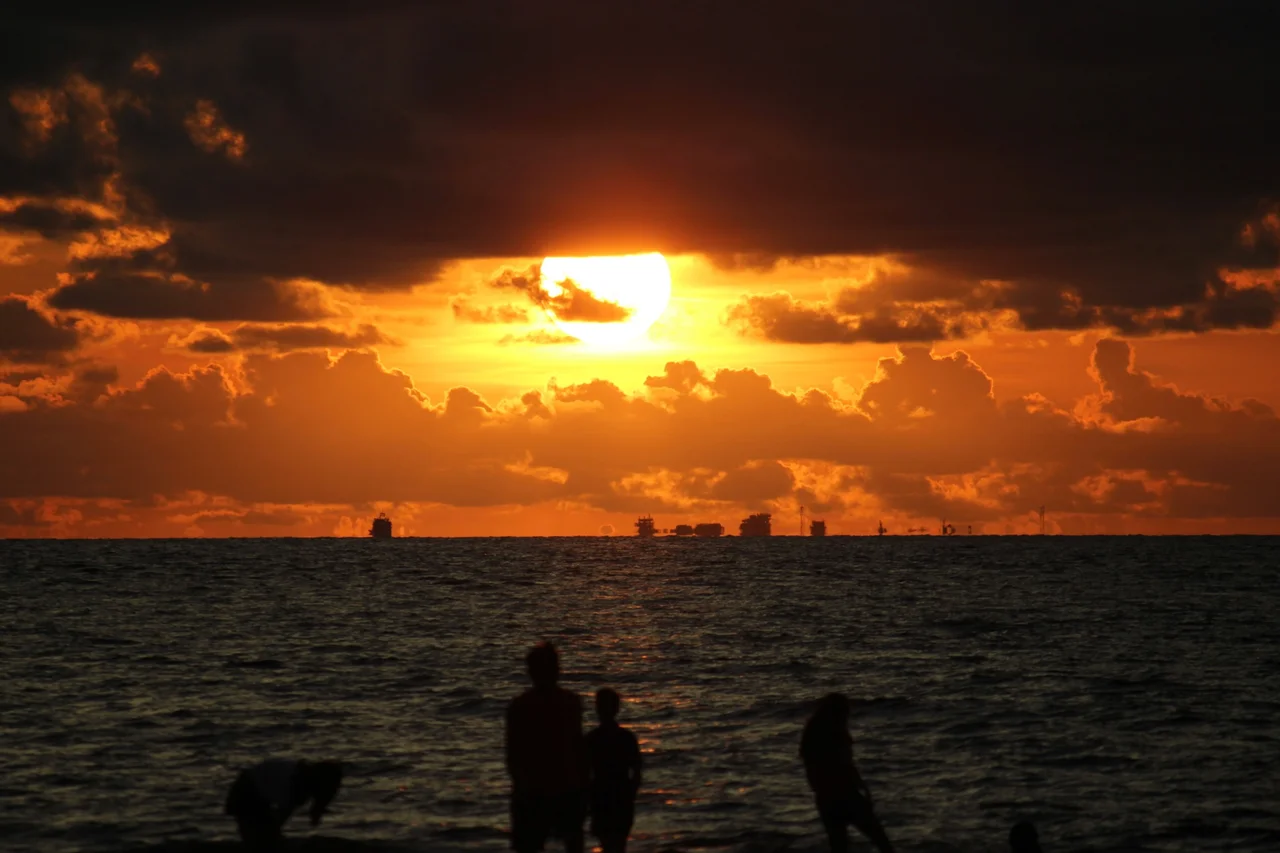
Coordinates: 4.614N, 114.330E. Seria sits on the coast of Belait District, Brunei, along the South China Sea. The town is identifiable from the air by rows of pumpjacks (nodding donkeys) along the shoreline, the Seria Crude Oil Terminal, and offshore platforms. The Billionth Barrel Monument is a distinctive coastal landmark. The Arena Sports Complex and British Forces Brunei garrison are visible south of the town center. Anduki Airfield is nearby but not commercially active. Brunei International Airport (WBSB) is about 75 km east. Tropical maritime climate with year-round heat, high humidity, and frequent afternoon thunderstorms.
Nearby Stories
- The Sultan's Gurkhas 2.4 km away
- The Town That Splits a Nation 12 km away
- Kelabit Highlands 20 km away
- The Billion-Dollar Playground That Michael Jackson Opened 45 km away
- The Ants of Borneo 56 km away
- Niah National Park 66 km away
- Similajau National Park 156 km away
- Luconia Shoals 185 km away