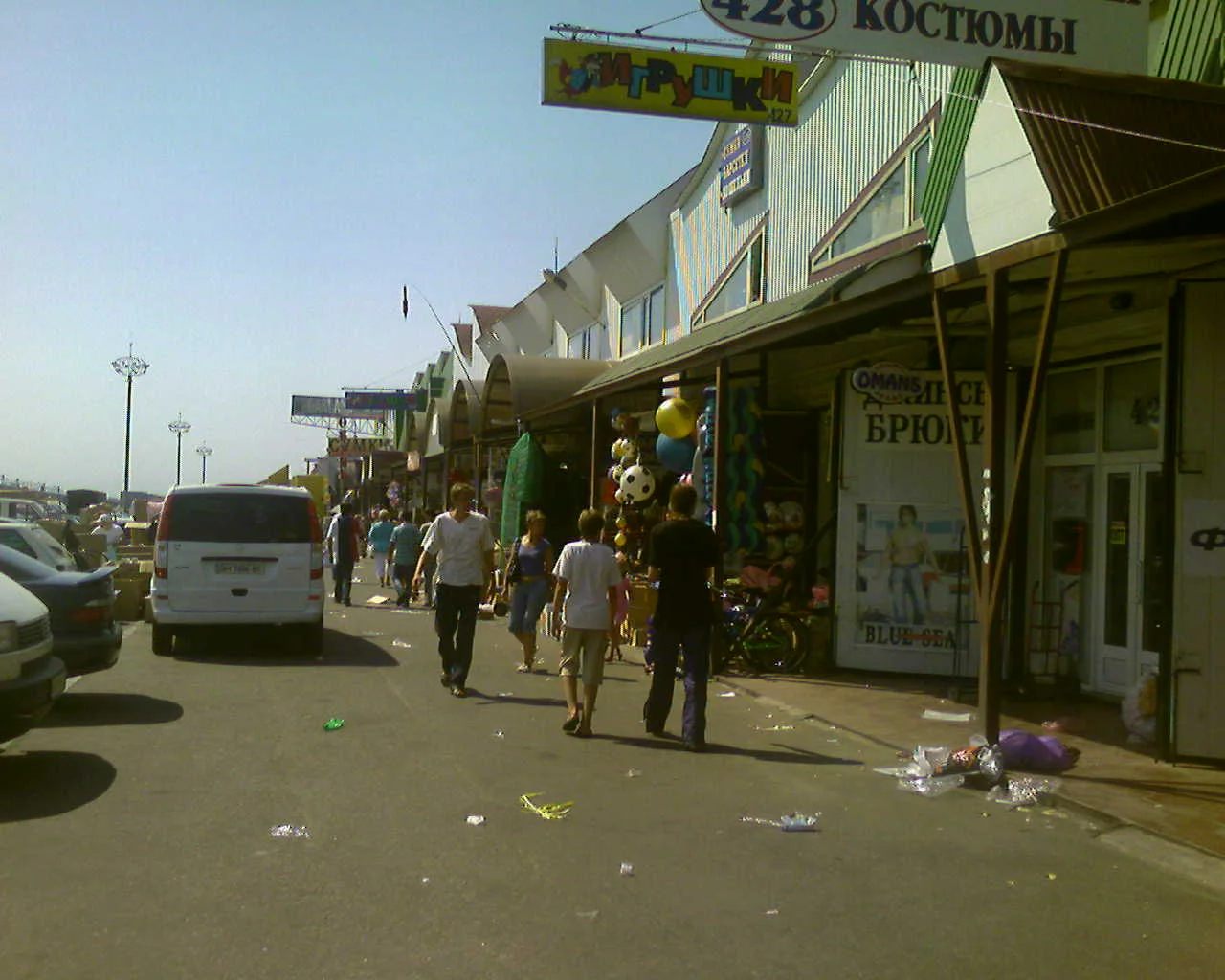

Seventh-Kilometer Market
Picture thousands of steel shipping containers, stacked and lined up in endless corridors across 170 acres of flat land, each one a shop. Some 6,000 traders work here, and on a busy day around 150,000 customers pour through. This is the Seventh-Kilometer Market on the edge of Odesa, a place so large and self-contained that one Ukrainian newspaper called it a state within a state, with its own laws and rules. A New York Times reporter who wandered its aisles in 2006 struggled for a comparison and settled on this: part third-world bazaar, part post-Soviet Walmart.
Born in the Shuffle
The market's roots lie in the 1960s and 1970s, in a cramped walled lot near an old cemetery in the Slobidka district, open only on Sundays and later Saturdays. It was hopelessly small, barely 150 meters by 250, and the crush of bodies gave the place its lasting association with shoving. Getting there was an ordeal: until 1966, shoppers faced a two-kilometer walk from the nearest tram stop, and the best goods vanished by late morning, so arriving at dawn was essential. Officially it was a flea market for used goods only, but clever traders skirted the rules by selling new items straight from their hands as they walked, a practice woven so deep into local life that the phrase for it, z ruk, from the hands, became part of the market's language.
The Container City Rises
Everything changed in 1989, during the loosening reforms of Perestroika, when the market was relocated to open ground at the seventh kilometer of the Odesa–Ovidiopol highway, giving it the name it still carries. Freed from its old constraints, it exploded. In place of ground displays came thousands of shipping containers, the humble steel boxes of global trade repurposed into a permanent marketplace. Prime containers can rent for six thousand dollars a month or more, and ordinary buildings have sprung up among them. By the mid-2000s daily sales were estimated in the tens of millions of dollars. With a staff of over a thousand, mostly guards and janitors, the market became the largest employer in the whole region.
A World of Its Own
To walk the Seventh-Kilometer is to enter a place governed by its own logic. The traders are independent, and the goods run the full range, from authentic merchandise to cheap imports and counterfeit luxury labels. Questions about salaries, rents, taxes, or even last names tend to be met with a shrug or a wary silence. One observer described it as a sinecure for the rich and a trade haven for the poor, a single sprawling economy where fortunes are made and modest livings are scratched out side by side. The market has drawn the attention of the state, too: in 2005 Ukraine's president announced plans to bring its vast shadow economy under tax law, a reminder that even a state within a state answers eventually to the real one.
Commerce as Spectacle
There is something genuinely astonishing about the scale of the place, a testament to the raw commercial energy that Odesa has channeled for two centuries. Where the historic Pryvoz market downtown trades in produce and gossip, the Seventh-Kilometer trades in sheer volume, an ocean of goods that seems to stretch past the horizon. Visitors come as much to marvel as to buy. Standing in one of its long metallic canyons, watching the endless flow of buyers and sellers, you feel the pulse of a certain kind of freedom, unpolished and unregulated, that rushed in when the old order fell away and never quite left.
From the Air
The Seventh-Kilometer Market lies southwest of Odesa proper at 46.439°N, 30.639°E, along the Odesa–Ovidiopol highway. From about 3,000 feet its vast rectangular grid of container rows is unmistakable against the open farmland, distinct from the dense city to the northeast. The nearest airport is Odesa International (UKOO), roughly 2 nm to the southeast.
Nearby Stories
- Lower Dniester National Nature Park 9.3 km away
- Battle of Berezan (1788) 15 km away
- Moldavian Autonomous Soviet Socialist Republic 46 km away
- Black Sea Shipyard 57 km away
- Racecourse of Achilles 57 km away
- Tiraspol 87 km away
- Zaliznyi Port 119 km away
- Danube Delta 128 km away