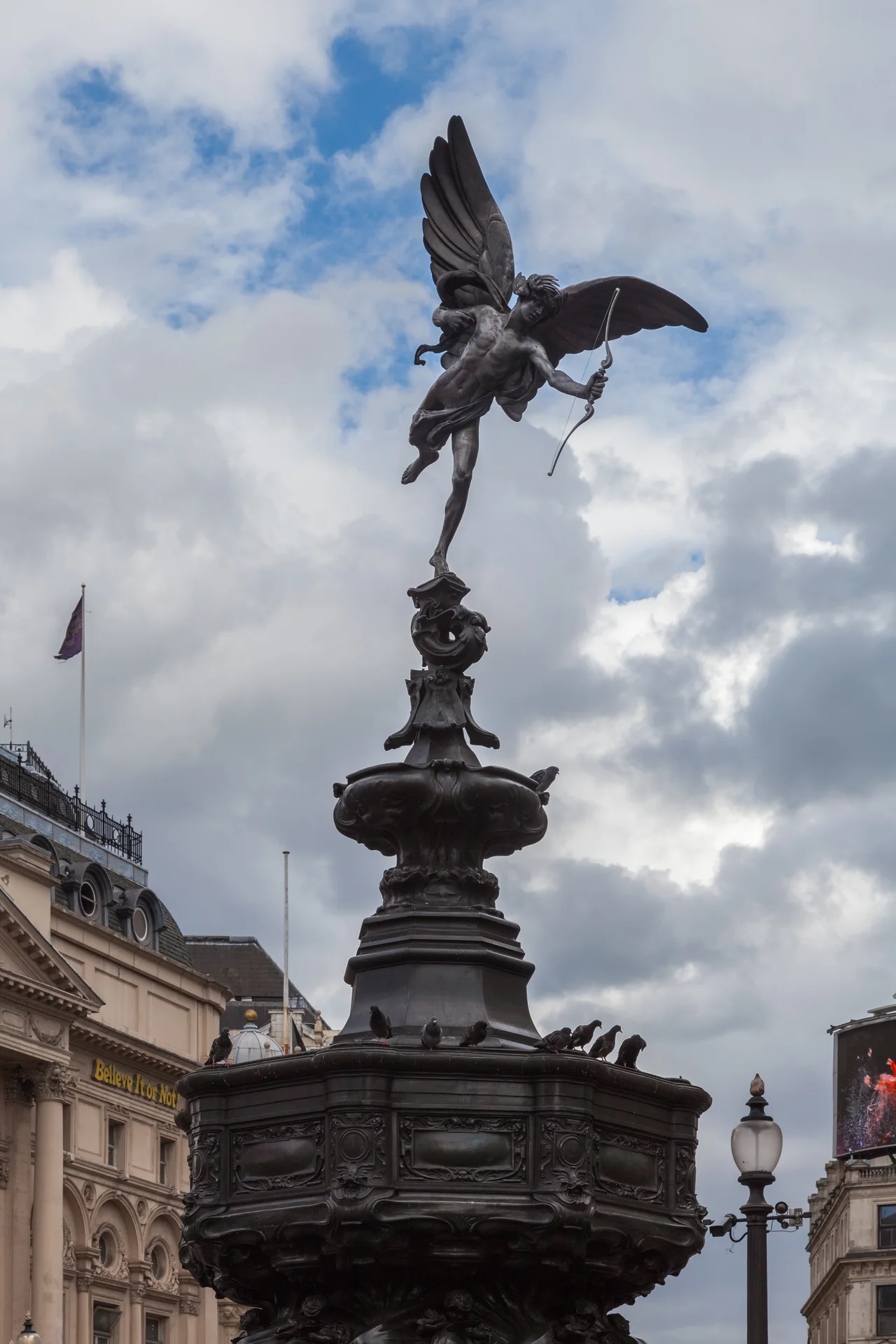

Shaftesbury Memorial Fountain
Everyone calls him Eros, the Greek god of erotic love. Everyone is wrong. The winged figure poised above the fountain at Piccadilly Circus is actually Anteros, Eros's lesser-known brother, the god of selfless and mature love. The sculptor Alfred Gilbert chose him deliberately, as a tribute to a Victorian earl who had spent his life pulling children out of factories and putting them into schools. The renaming committee tried desperately to call the statue The Angel of Christian Charity. Londoners ignored them. The wrong name stuck, and a memorial to philanthropy became the unofficial mascot of theatreland, neon, and a thousand drunken rendezvous beneath those aluminium wings.
An Earl Worth Remembering
Anthony Ashley Cooper, 7th Earl of Shaftesbury, was the kind of aristocrat the Victorian age occasionally produced and then mostly forgot. He campaigned against children working in mines and chimneys, against the use of small boys as sweeps, against the conditions that ground bodies and minds to powder in textile mills. When he died in 1885, a public meeting at the Mansion House decided that a marble effigy in Westminster Abbey would not be enough. London needed a second monument, bronze, in one of its most-trafficked thoroughfares, where the people he had fought for could actually see it. They also founded the Shaftesbury Homes for poor children, paid for by the same public appeal. The fountain at Piccadilly Circus was meant to make philanthropy visible at street level.
The Sculptor's Quiet Joke
The Memorial Committee handed the commission to a 32-year-old sculptor named Alfred Gilbert, who had loudly deplored what he called the "coat and trousers style" of British public statues. Gilbert had no interest in another bronze man in a frock coat. Instead, he chose to recast a winged figure he had already sculpted: Anteros, whom he described as portraying "reflective and mature love, as opposed to Eros or Cupid, the frivolous tyrant." The model was Angelo Colarossi, Gilbert's 16-year-old Anglo-Italian studio assistant, born in Shepherd's Bush in 1875. The figure was the first sculpture in the world to be cast in aluminium, then a costly, almost magical metal, set above a heavy bronze fountain ornamented with fish and waves. When the Duke of Westminster unveiled it on 29 June 1893, the response was immediate, vocal, and not what the committee had hoped.
The Wrong Name That Wouldn't Die
Critics complained that the statue was too sensual for a sober, respectable earl, and too vulgar for the theatre district that surrounded it. Some called it indecent. The committee tried to head off the scandal by rechristening the figure The Angel of Christian Charity, the closest Christian approximation they could invent for the Greek role Anteros played. Nobody listened. Within months the statue had been nicknamed Eros, the god of carnal love rather than the god of selfless love, and the joke wrote itself: a memorial to a chaste philanthropist standing watch over what was, even then, a neighbourhood famous for its appetites. The Evening Standard adopted a stylised version of the statue as its masthead emblem. The naming was wrong, and the wrongness was perfect.
Travels and Returns
The whole monument has been hauled away from the circus twice. In 1925 it was dismantled so engineers could excavate the Piccadilly Circus tube station directly beneath it, and it spent five years in Embankment Gardens before returning in 1931. When war broke out in 1939, the statue alone was evacuated to Coopers Hill, a country house near Egham in Surrey that the London County Council had bought as an emergency headquarters; the bronze fountain stayed in place, ringed with sandbags. Anteros came home on 29 June 1947, watched by a crowd of thousands in heavy rain. Two flower sellers also returned, each of whom claimed to have been working at the foot of the statue for more than fifty years. During the 1953 coronation, Sir Hugh Casson designed an ornamental cage to protect the statue from revellers. In 2012 a tourist broke the bow string and a new one was fitted.
Aluminium Under Neon
Today the fountain sits not at the centre of Piccadilly Circus but at the south-east corner, where it was repositioned after the war. The illuminated advertising hoardings opposite have cycled through generations of brands, but the boy with the bow has stayed roughly where the city put him. Tourists still arrange to meet "by Eros," still pose at the steps for photographs, still assume he represents desire rather than the quieter virtues that built the Shaftesbury Homes. The wings catch streetlight after dark and turn the same colour as the surrounding signs. Anthony Ashley Cooper, who would probably have preferred a portrait in a frock coat, ended up with a winged boy in aluminium standing for him in the loudest junction in London. It is the most wrong, and the most right, memorial in the city.
From the Air
Coordinates 51.5098 N, 0.1345 W in the heart of London's West End. Recommended viewing altitude 800-1500 ft from the south to keep Piccadilly Circus framed by Regent Street, Shaftesbury Avenue, and Coventry Street. The Shaftesbury Memorial Fountain sits at the south-east corner of the circus, with Eros's wings visible in good light. Nearest airports: London City (EGLC) about 7 nm east, London Heathrow (EGLL) about 14 nm west. Class D airspace under London City CTR; transit clearance required. Best visibility in clear evenings when the circus's advertising screens illuminate the bronze fountain below.
Nearby Stories
- Stevenage 5.7 km away
- Malling Abbey 5.7 km away
- 1952 Farnborough Airshow Crash 7.7 km away
- Ingatestone Hall 8.2 km away
- Hellfire Caves 9.1 km away
- The Carrington Event: The Solar Storm That Could Happen Again 9.8 km away
- Bletchley Park 16 km away
- Castle Hedingham 23 km away