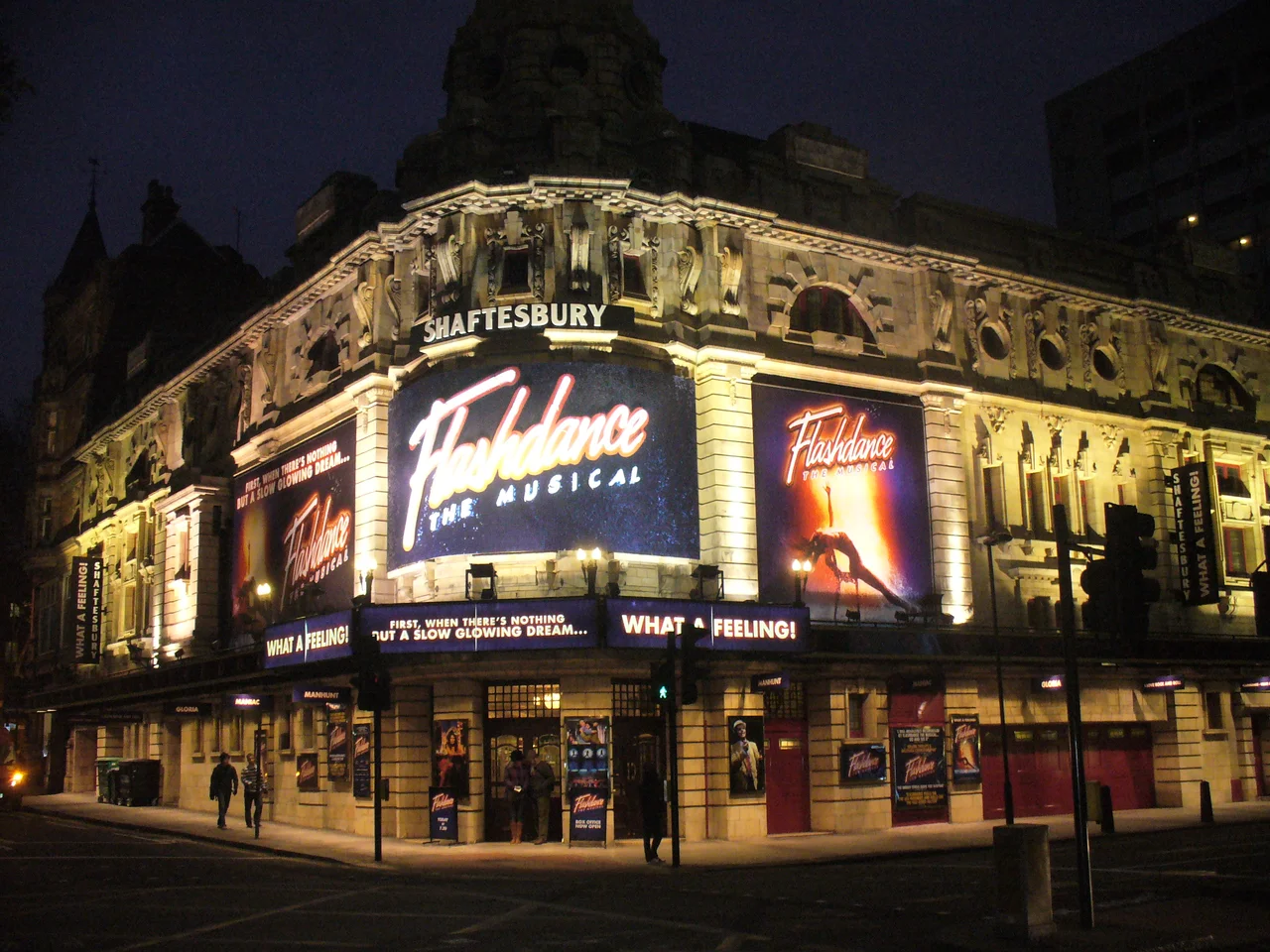

Shaftesbury Theatre
On the evening of 26 September 1968, Britain abolished theatre censorship. The Lord Chamberlain's office, which had spent two centuries deciding what could and could not be said or shown on a stage, was stripped of its powers. The very next night a musical called Hair opened at the Shaftesbury Theatre on Shaftesbury Avenue. It contained profanity, drug references, and a scene in which the cast appeared naked, all of which would have been unthinkable forty-eight hours earlier. The show ran for almost five years, ending only when part of the ceiling actually collapsed. The Shaftesbury has a habit of arriving at moments like that, where the rules change and the building is the room where the change becomes visible.
Last in the Avenue
The brothers Walter and Frederick Melville already ran the Lyceum, and they wanted a second theatre for the popular melodramas that filled their houses. They commissioned the architect Bertie Crewe to build it on a triangle of derelict property at the junction of Shaftesbury Avenue and High Holborn. When the New Prince's Theatre opened on 26 December 1911, it was the last new theatre ever built on the avenue. The Edwardian terracotta facade still wears a pillared cupola above the entrance, and a three-tier arrangement of vertically aligned windows that nods to its melodramatic ambitions. The interior carried London's first all-steel theatre frame, which meant no supporting pillars and no obstructed sightlines for the 2,500 paying customers below. The original colour scheme was cream and gold.
Stars on a Soft Stage
Melodrama paid the bills only briefly. From 1915 the D'Oyly Carte Opera Company moved in for an eighteen-week sellout season of Gilbert and Sullivan, including the first revival of Princess Ida since 1884. Sarah Bernhardt played the title role in Daniel in April 1921. In 1928, Fred and Adele Astaire arrived with the Gershwins' Funny Face; a gas explosion in High Holborn briefly halted the run, but the show went on for 263 performances after the theatre reopened. Sybil Thorndike played in Macbeth in 1926. During the Second World War, with Sadler's Wells closed, both its opera and ballet companies moved their London seasons here, presenting La boheme, The Marriage of Figaro, and the premiere of Robert Helpmann's Miracle in the Gorbals, danced by Margot Fonteyn and Moira Shearer.
The Most Expensive Flop
The Prince's closed for a complete rebuild in November 1962. The owners took the opportunity to grab the name of the older Shaftesbury Theatre further down the avenue, which had been bombed to a ruin in the Blitz and was not coming back. When the rebranded Shaftesbury Theatre reopened on 20 November 1965, it did so with Lionel Bart's Twang!!, a musical Robin Hood from the composer who had given the world Oliver! The Times later called it the most expensive flop in West End history to that date. The critic J. C. Trewin described the first night as "a rout" with "some fairly general booing." Twang!! closed after 43 performances and left the theatre dark for almost a year. The farce Big Bad Mouse, ad-libbed mercilessly by Eric Sykes and Jimmy Edwards, eventually broke the spell and ran for 634 performances.
The Night the Rules Changed
Theatre censorship in Britain ended at midnight on 26 September 1968. The next evening Hair opened at the Shaftesbury, billed as an "American Tribal Love-Rock Musical." Its nudity was carefully staged in stillness, its profanity strewn freely through the dialogue, and its anti-war politics blunt enough to embarrass the establishment. It became one of the longest-running shows the building had ever known. It was just short of its 2,000th performance in July 1973 when a section of the auditorium ceiling collapsed and the theatre had to shut. The building was already at risk: the Greater London Council was proposing a massive road-building programme that would have swept the Shaftesbury away entirely, and developers had pencilled in an office block. The Save London's Theatres campaign saved it. In March 1974 it received Grade II listed status, and the theatre reopened in December with West Side Story.
Home of British Comedy
In the 1980s the actor, playwright, and impresario Ray Cooney founded the Theatre of Comedy, backed by a long list of British comic actors and writers. The company leased the Shaftesbury and later bought it outright. "We have the finest comedy talents in the world in this country, both performers and writers, and I could never understand why we could not create our own theatre of comedy," Cooney said. Cooney's farce Out of Order won the Olivier Award for Best Comedy in 1991. Stephen Sondheim's Follies ran for 645 performances. Peter O'Toole appeared in Pygmalion. Rowan Atkinson did Saturday Night Live there. By the 21st century, programming had shifted from farce to long-run musicals, with Hairspray, Memphis, Motown, & Juliet, and Mrs Doubtfire each holding the stage for years at a time. The last theatre built on Shaftesbury Avenue is still working, and Avenue Q is scheduled in for 2026.
From the Air
Coordinates 51.5161 N, 0.1258 W on the corner of Shaftesbury Avenue and High Holborn in the West End. Recommended viewing altitude 800-1500 ft. From the air the theatre presents a distinctive Edwardian terracotta facade with a pillared cupola at the corner; the avenue itself runs north-east from Piccadilly Circus and is an obvious axis from low altitude. Nearest airports: London City (EGLC) about 6 nm east, London Heathrow (EGLL) about 14 nm west, London Stansted (EGSS) about 30 nm north-east. Class D airspace under the London City CTR; central London is restricted for sightseeing without coordination. Best visibility on clear evenings when the avenue is lit.
Nearby Stories
- Stevenage 5.7 km away
- Malling Abbey 5.7 km away
- 1952 Farnborough Airshow Crash 7.7 km away
- Ingatestone Hall 8.2 km away
- Hellfire Caves 9.1 km away
- The Carrington Event: The Solar Storm That Could Happen Again 9.8 km away
- Bletchley Park 16 km away
- Castle Hedingham 23 km away