
Sharm el-Sheikh
Two things have made Sharm el-Sheikh famous, and they could hardly be more different. Beneath its waters lie some of the finest coral reefs on the planet. Above them, in its summit halls, presidents and prime ministers have gathered again and again to negotiate the fate of the Middle East. The Egyptians call it the City of Peace - a name that carries both genuine hope and a touch of irony, for this resort at the southern tip of the Sinai has known war, occupation, and terror as intimately as it has known tourism. It began as nothing: a strip of desert with no trade routes, no pilgrim roads, no mineral wealth, and a handful of fishermen.
An Accident of Strategy
Geography, not commerce, first put Sharm on the map. The cape commands the shipping lanes - east up the Gulf of Aqaba toward Jordan, west up the Gulf of Suez toward the canal - and that made it a naval prize. It also made it a target. In 1956 Israel occupied the Sinai during the Suez conflict, withdrawing the next year. In 1967 Israel returned, and this time stayed fifteen years, building the bones of a tourist resort here and along the coast before a peace deal led to a gradual handover, completed in 1982. The Egyptians named it the City of Peace that same year. By the 1980s, with Egypt courting mass tourism, Sharm grew fast - a desert outpost reinventing itself, one hotel at a time, into a playground on the Red Sea.
The Reefs That Built a Resort
Diving is the heart of it. Slip beneath the warm surface and the bleak desert vanishes, replaced by a world of color and motion. The reefs of Ras Mohammed and the Strait of Tiran rank among the best dive sites anywhere, reachable by boat within a couple of hours. At Ras Mohammed, the southernmost point of Sinai, the currents of the Gulf of Aqaba and the Gulf of Suez collide, and the plankton they stir up draws fish in staggering numbers - great schools of barracuda, the flash of passing sharks. The wreck of the SS Thistlegorm, a British steamship bombed in 1941, is widely held to be one of the world's finest wreck dives, though its strong currents and overhead passages make it a challenge for experienced divers only.
The Weight of the Name
Peace has been the city's aspiration and its burden. Sharm has hosted landmark talks for decades - a 1999 summit that carried forward the Oslo accords, with Israeli and Palestinian leaders at the table, and ceasefire negotiations through the violence of the early 2000s. As recently as October 2025, world leaders convened here for a Gaza peace summit. Yet the city has also borne terrible blows. In 2005, a series of bombings killed 88 people across town. In 2015, a Russian airliner was destroyed by a bomb shortly after takeoff from Sharm's airport, killing all 224 people aboard - most of them tourists. Each attack was designed to strangle the tourism the city lives on, and each time recovery has been slow and hard-won.
Desert at the Edge of the Sea
Step away from the dive boats and Na'ama Bay's glittering nightlife, and the Sinai itself becomes the draw. Beyond the resort strip lie the rugged interior mountains, the striped sandstone of the Colored Canyon, and the deep desert where Bedouin guides lead camel treks to sleep beneath a sky thick with stars. Farther afield rise the great pilgrimage sites - Saint Catherine's Monastery and Mount Sinai, where tradition holds that God spoke to Moses. A word of caution shadows the romance: Egypt's deserts hold a vast share of the world's buried landmines, some closer to Sharm than anyone would like, so guided paths are not optional. The city today is a walled and heavily guarded place, considered the safest in the Sinai - a resort that has learned to keep watch even as it keeps its doors open.
From the Air
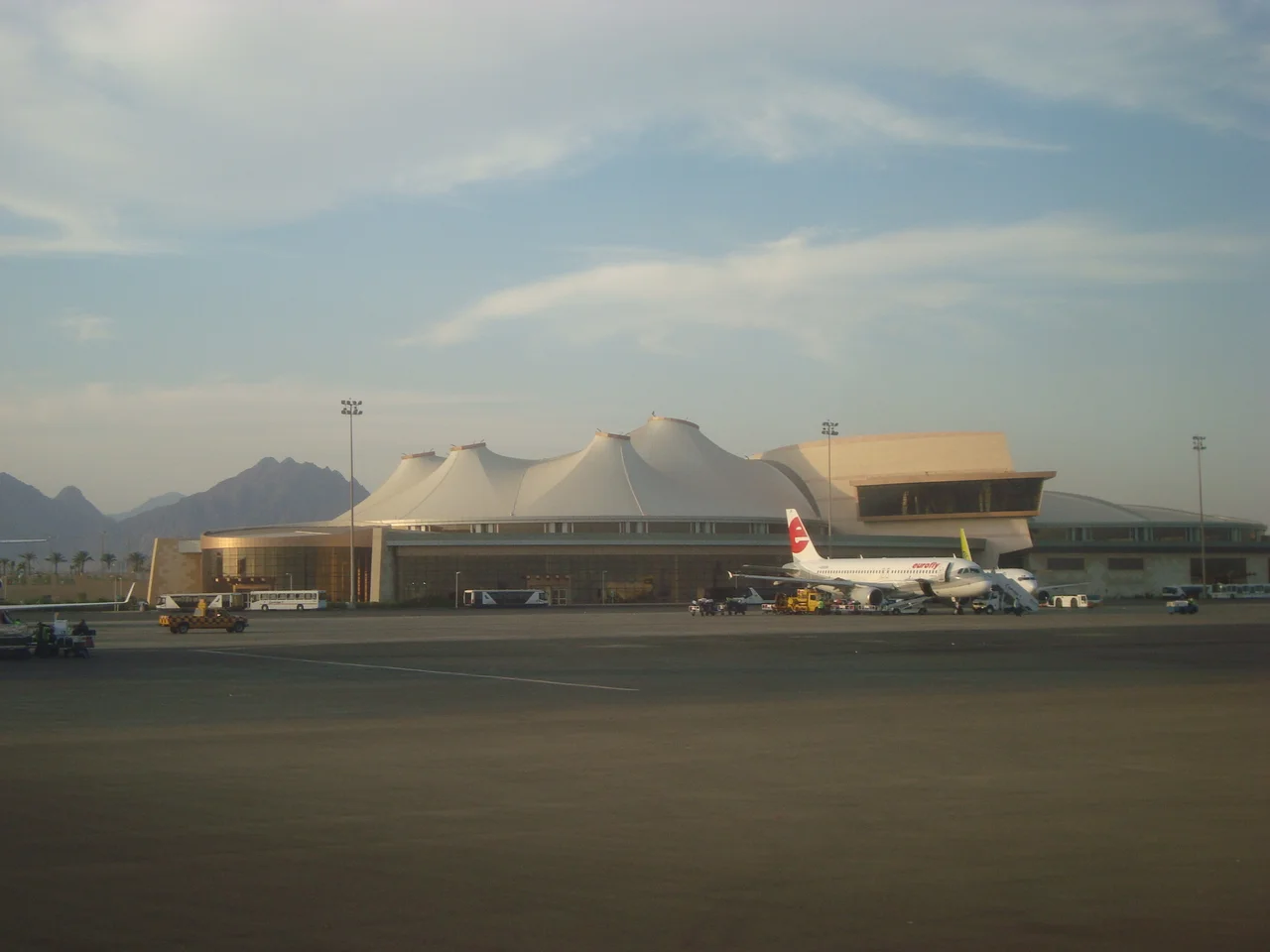
Sharm el-Sheikh occupies the southern tip of the Sinai Peninsula at 27.912 N, 34.330 E, overlooking the Strait of Tiran at the mouth of the Gulf of Aqaba. From the air, the city reads as a band of dense resort development along the coast, backed by stark desert mountains, with the turquoise reefs of Tiran and Ras Mohammed (about 12 km south) standing out against deep-blue water. Sharm El Sheikh International Airport (ICAO HESH, IATA SSH) sits just north of the resort areas and is the region's primary gateway. Recommended viewing altitude 4,000-8,000 ft for the coastline, the Strait of Tiran, and the surrounding mountains. The climate is extremely dry with reliable visibility year-round; the chief considerations are intense summer heat, occasional northerly shimal winds in winter, and the busy controlled airspace around the international airport.
Nearby Stories
- Neom 42 km away
- Saint Catherine's Monastery 56 km away
- Hurghada 60 km away
- Wadi Rum 172 km away
- Dendera Temple complex 194 km away
- Naqada culture 235 km away
- 2021 Suez Canal Obstruction 239 km away
- Hegra 323 km away