
Sherlock Holmes Museum
For decades, letters addressed to Sherlock Holmes at 221B Baker Street were delivered to the Abbey National Bank, whose building occupied the actual 221B address. The bank employed a special secretary whose job was to reply to the correspondence on behalf of a fictional Victorian detective. This arrangement — a financial institution answering fan mail for a fictional detective — continued until 2002, when Abbey National vacated its headquarters and the museum finally took delivery of what had always been, in spirit if not in postal geography, its own mail.
A House That Never Was
The Georgian townhouse at what is designated 221B Baker Street was built in 1815 and operated as a boarding house from 1860 to 1936 — exactly the kind of establishment where Sir Arthur Conan Doyle's detective might plausibly have lodged. When the Sherlock Holmes Museum opened in 1990, it did so at what is physically between numbers 237 and 241 on Baker Street. The City of Westminster granted special permission for the premises to bear the 221B number regardless.
A commemorative blue plaque on the exterior records the "years of Holmes's supposed residency." It is one of the more unusual plaques in London — commemorating a person who never existed, at an address that is technically a fiction layered onto an already fictional biography. Yet the effect is entirely convincing. The house looks exactly as visitors imagine it should, and that imagining does much of the museum's work.
The Sitting Room at the Top of the Stairs
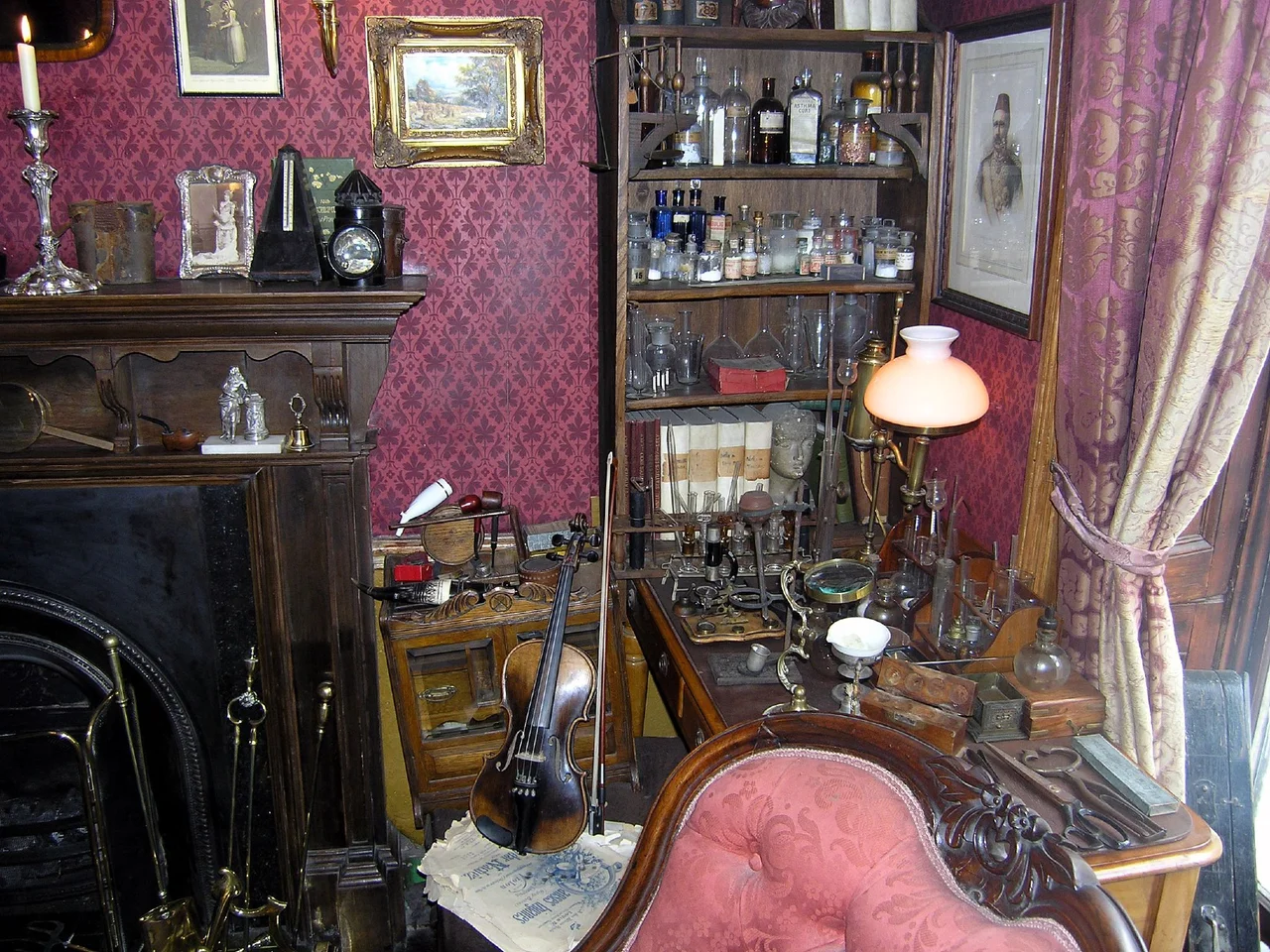
The museum recreates the rooms described in Conan Doyle's stories, supplemented by props and set pieces from various screen adaptations — including the 1984 Granada Television series with Jeremy Brett, which many consider the definitive screen Holmes. Visitors climb the narrow staircase that Watson describes in the stories, enter the first-floor sitting room with its cluttered fireplace and mismatched furniture, and find themselves in a space that feels simultaneously Victorian and slightly stagey — because it is both.
The exhibits include Holmes's study, Dr Watson's room, Mrs Hudson's room, and a laboratory space. Wax figures populate several rooms. A typewriter from the late 19th century sits on display. These are not artifacts from Holmes's life — there is no life to have artifacts from — but they are props in an extremely sophisticated piece of sustained theatrical imagination.
The Mail Dispute
The prolonged fight over Holmes's fan mail illuminates something interesting about the museum's relationship with its subject. The museum's position was straightforward: it was the most appropriate organization to receive and respond to correspondence addressed to Holmes, given that it exists specifically to honor the detective's cultural legacy. The bank's counter-position was essentially bureaucratic: it occupied the registered 221B address, so the Royal Mail delivered there.
The museum's appeals were unsuccessful until circumstances resolved the matter. When Abbey National relocated in 2002, the postal situation was finally resolved. Today, the museum receives the letters — from around the world, many of them written in complete earnestness, asking Holmes for help solving real problems. Dame Jean Conan Doyle, daughter of the creator, supported the museum in Switzerland at its 1991 opening but declined to contribute a room dedicated to her father in the London museum.
Baker Street's Victorian Street
Baker Street itself has changed considerably since the 1880s, when Conan Doyle was writing the Holmes stories. The area near Regent's Park is now busy with commuters and tourists, the buildings mostly Victorian and Edwardian but mixed with later additions. The museum is near the north end of Baker Street, a few minutes' walk from Regent's Park.
The world's first museum dedicated to a literary character — as opposed to a historical figure — Sherlock Holmes Museum has occupied this unusual cultural niche since 1990. It is privately run, charging admission, and draws visitors from across the world to stand in rooms that evoke a life that was never lived, in an address that is simultaneously real and invented. In that sense, it is a perfect monument to one of literature's great creations: a place that exists entirely because a character is more real to millions of readers than most real people ever become.
From the Air
Located at 51.5237°N, 0.1610°W on Baker Street in the City of Westminster. Regent's Park is a few hundred meters to the north and easily visible from the air. Nearest airports: London City (EGLC, ~8nm east), Heathrow (EGLL, ~12nm west). Baker Street tube station is immediately adjacent. Marylebone Road runs east-west just to the south.
Nearby Stories
- Stevenage 5.7 km away
- Malling Abbey 5.7 km away
- 1952 Farnborough Airshow Crash 7.7 km away
- Ingatestone Hall 8.2 km away
- Hellfire Caves 9.1 km away
- The Carrington Event: The Solar Storm That Could Happen Again 9.8 km away
- Bletchley Park 16 km away
- Castle Hedingham 23 km away