
Sheung Yiu Folk Museum
The name says it all, if you know the Cantonese. Sheung Yiu means "above the kiln" — and the kiln was the point. A family named Wong built this cluster of eight houses in the hills above Sai Kung sometime in the late 19th century, close enough to coral deposits and shellfish beds that they could bake lime in quantity and sell it to builders and farmers across the region. For a while it worked. The village on the Pak Tam Chung Nature Trail thrived on chemistry: coral and shells, heated until they broke down into calcium oxide, produced a product that bonded stone walls and fertilized rice paddies. Then Portland cement arrived, concrete became cheap, and the lime kiln's era ended. The Wongs, like villagers all over the New Territories, started leaving. By September 1968, the last resident had gone. What remained was a row of stone buildings going slowly back to the forest — until someone decided to bring it back.
The Hakka Who Built Here
The Hakka people — their name means roughly "guest families" in Chinese — were relative latecomers to the valleys and coasts of what is now Hong Kong. Many arrived in the New Territories after 1669, when the Kangxi Emperor rescinded the Great Clearance that had swept coastal communities inland. The Wongs who built Sheung Yiu were part of this pattern: a family who found a hillside niche in Sai Kung and made it pay through industry rather than agriculture alone. The Pak Tam Chung area where they settled held six villages in 1911, with a combined population of fewer than 405 people — Wong Yi Chau, Pak Tam, Sheung Yiu itself, Tsak Yue Wu, Wong Keng Tei, and Tsam Chuk Wan. All but two hamlets in Pak Tam were Hakka. They grew rice and kept pigs, but the lime kiln at Sheung Yiu gave the Wong family an economic edge that made their village notable in the district.
Kiln, Coral, and Commerce
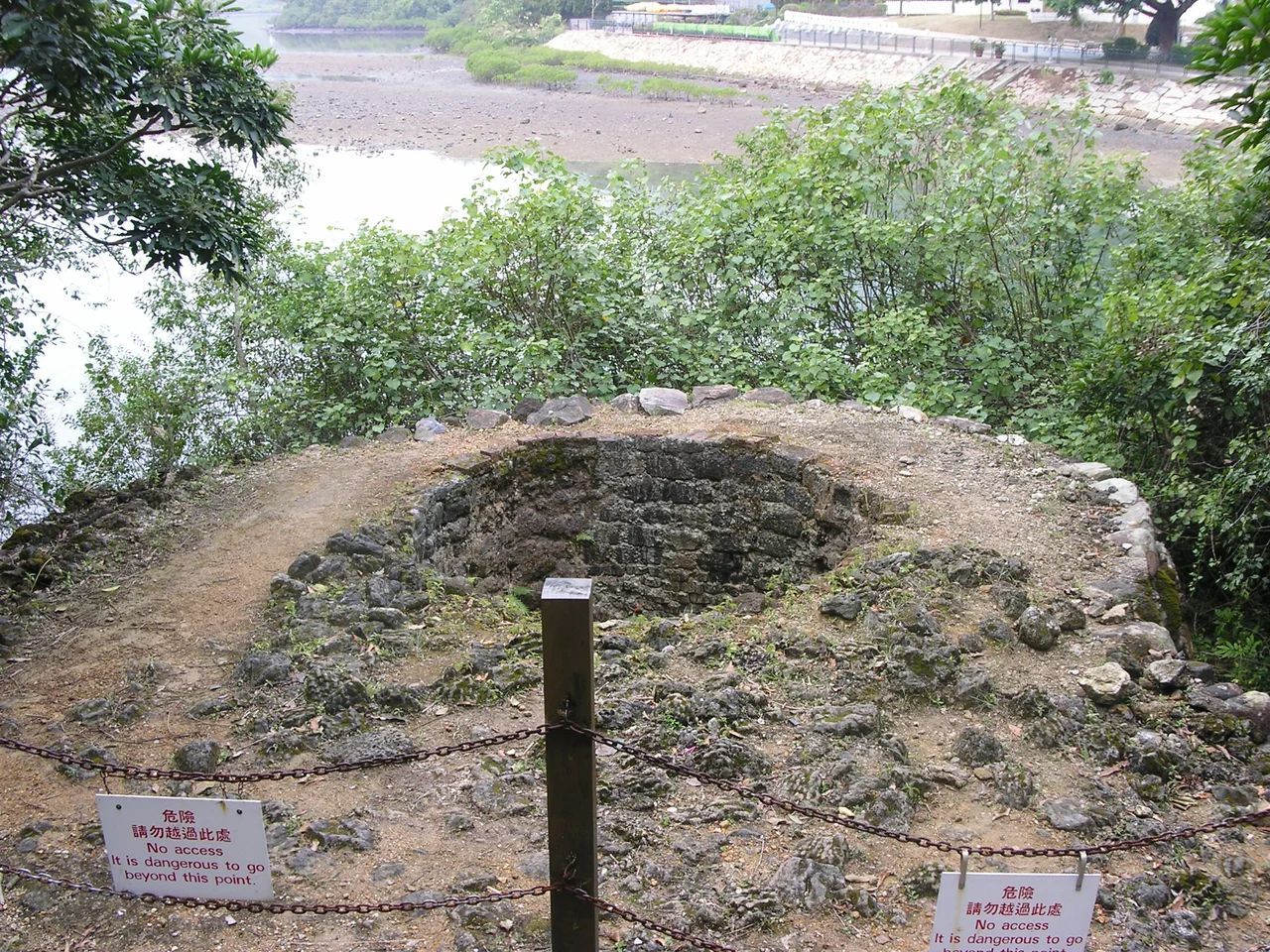
Making lime is older than writing. You gather calcium carbonate — shells, coral, limestone — pile it in a kiln, and burn it for days at temperatures around 900 degrees Celsius. What emerges is quicklime: caustic, reactive, and enormously useful. Mixed with water and sand, it becomes mortar for stone walls. Applied to fields, it neutralizes acid soil and releases nutrients. The lime kiln at Sheung Yiu served both markets. Sai Kung's coast provided raw material in abundance — coral from the bays, shells from the fishing catch — and the boat traffic through the district distributed the finished product. The village grew prosperous enough to build a watch tower at the platform entrance, a feature that spoke to both security and status. When cement and fired brick undercut the lime market in the early 20th century, the economic rationale for the village began to erode as steadily as the mortar it had once supplied.
The Slow Departure
Villages in Hong Kong's rural interior did not usually empty in a single dramatic moment. They drained. Through the 1950s, the men of Sheung Yiu followed a pattern common across the New Territories and the broader Chinese diaspora: they moved to Kowloon or Hong Kong Island to find factory work, or they went overseas — to Britain, to Australia, to Canada — wherever a restaurant or a laundrette needed hands. The aged and children stayed behind, tending the houses, working the remaining fields. Remittance money kept the village technically alive. But the critical mass needed to sustain a community kept falling. September 1968 is the date the last inhabitant left. The forest began reclaiming the terraced fields almost immediately.
Restoration and Memory
The Hong Kong government fully restored Sheung Yiu in 1983, and the following year it opened as the Sheung Yiu Folk Museum, a branch of the Hong Kong Heritage Museum. The eight houses on their raised platform, the watch tower, and the lime kiln were all preserved and opened to the public. Nine galleries inside the houses display the material culture of Hakka rural life: farming tools, furniture, daily utensils, the paraphernalia of people who raised pigs, grew rice, and made mortar from the sea. The lime kiln where coral and shells were baked has been restored for viewing. Admission is free. The museum is open daily from 10am to 6pm, closing at 5pm between October and February, and closed on Tuesdays and the first two days of the Lunar New Year. Walking the Pak Tam Chung Nature Trail to reach it is part of the experience — the forest has grown back thickly around the stone buildings, giving the site an atmosphere of rediscovery that a museum in an urban precinct could never replicate.
From the Air
Sheung Yiu Folk Museum sits at 22.393°N, 114.321°E in the Sai Kung District of Hong Kong's New Territories, within Sai Kung Country Park. From the air at 3,000 to 5,000 feet, the rugged coastline of the Sai Kung Peninsula is visible to the east, with the calm waters of Sai Kung's many bays and inlets below. The site itself is small and forested, but the Pak Tam Chung area and the road running through it can serve as navigation references. Nearest airport: Hong Kong International (VHHH), approximately 45 km to the west-southwest. The area is best viewed in clear weather; morning haze from the South China Sea can reduce visibility.
Nearby Stories
- Sha Chau and Lung Kwu Chau Marine Park 5.9 km away
- Wanshan Archipelago 22 km away
- Hong Kong 12 25 km away
- Second Battle of Chuenpi 27 km away
- Mount Guanyin (Dongguan) 43 km away
- Battle of Penghu 474 km away
- Penghu Air Raids 482 km away
- Checheng Fu'an Temple 592 km away