
Shoreditch
In 1576 a carpenter and actor named James Burbage put up a wooden building on the site of the dissolved Holywell Priory just outside the City of London. He called it The Theatre. It was the first purpose-built playhouse in England, and the reason he built it where he did was simple: the puritanical aldermen who ran the City had just banned playhouses inside its walls, and Shoreditch was outside their jurisdiction. The early plays of William Shakespeare were first staged here. So was Romeo and Juliet. So, almost certainly, was an early Hamlet. Four and a half centuries later, the same instinct still draws people across the same boundary: Shoreditch is where you go to do what the City won't quite allow.
Outside the Walls
The name comes from Old English scoradic, meaning shore-ditch. Toponymists argue about which shore was meant, but the area was certainly boggy ground sliced by the Walbrook stream, known here as the Deepditch. Folk legend insists that the name commemorates Jane Shore, Edward IV's mistress, supposedly buried in a ditch nearby, but documents show the place was already called Shoreditch long before she was born. Shoreditch Church, St Leonard's, gave the area its medieval centre at the crossroads where Shoreditch High Street meets Old Street and Hackney Road; its bells appear in the nursery rhyme Oranges and Lemons, ringing the line "When I grow rich, say the bells of Shoreditch." The crossroads itself stood on the line of Ermine Street, the Roman road north out of the City.
The First Playhouse
Burbage's Theatre opened on the site of the dissolved Holywell Priory in 1576. A second playhouse, the Curtain, went up the following year about 200 yards south. Shakespeare lived nearby in Bishopsgate, and his early career unfolded inside these two wooden polygons. The Prologue of Henry V calls the Curtain "this wooden O." When the Theatre's lease expired in 1599, Shakespeare's company quietly dismantled the building, carried its timbers across the river by night, and rebuilt them as the Globe in Southwark. The Curtain kept going until at least 1627. Moralists of the day complained bitterly about the playhouses and about the "dissolute, loose, and insolent people" the suburb attracted, but the audiences kept coming. A plaque on Curtain Road marks where Burbage built England's first theatre. MoLAS archaeologists dug out the foundations in 2008.
Looms, Furniture, Decline
After the revocation of the Edict of Nantes in 1685, French Huguenot silkweavers fled persecution in France and resettled across east London. Many came to Shoreditch and neighbouring Spitalfields, bringing their looms with them and turning the area into a textile district. The trade lasted into the 19th century before declining. Furniture-making rose in its place, centred on Curtain Road, and is now remembered in the nearby Museum of the Home on Kingsland Road. By the late Victorian era, Shoreditch had become one of the poorer parts of London, its old houses subdivided into tenements. Father Arthur Osborne Montgomery Jay built Holy Trinity Church in Old Nichol Street with a boxing club and gymnasium attached, on the theory that giving local men somewhere to fight one another under rules was better than letting them brawl on the street.
Bombs and the Blitz
During the Great War, the borough raised its own battalion of volunteers. They were enlisted at Shoreditch Town Hall, trained at Victoria Park and Columbia Market, and went to France in 1916 as the 20th (Service) Battalion of the Middlesex Regiment, the so-called Shoreditch Battalion. The unit fought at the Hindenburg Line and at Bourlon Wood, and was almost destroyed during the German spring offensive of 1918. The memorial to its dead stands in St Leonard's Church. The Second World War was harder still. At least 279 high-explosive bombs, six parachute mines, seven V-1 doodlebugs, and two V-2 rockets fell on the borough, together with thousands of incendiary devices. The wholesale destruction of housing eventually opened the ground for Shoreditch Park and Haggerston Park, but the loss of streets and people from the air raids reshaped the area for generations.
Silicon Roundabout
By the 1960s a one-way gyratory had been pushed through the centre of Shoreditch, choking the streets with traffic and discouraging the kind of foot traffic small businesses depend on. By the 1990s the area was at low ebb. Then artists arrived for the cheap warehouse space. Damien Hirst and Joshua Compston were early. Curtain Road filled with bars and galleries. By 2002 most of the gyratory had been turned back to two-way working. By the late 2000s the cluster of tech companies around the Old Street Roundabout, including Last.fm, Songkick, and 7digital, had earned the area a new nickname: Silicon Roundabout, used by Prime Minister David Cameron in a 2010 speech. Tall buildings now line the southern edge where Shoreditch meets the City. The hipster cliche has spawned its own vocabulary, from "Shoreditchification" to "Very Shoreditch." The instinct that drew Burbage and his actors over the City line still works.
From the Air
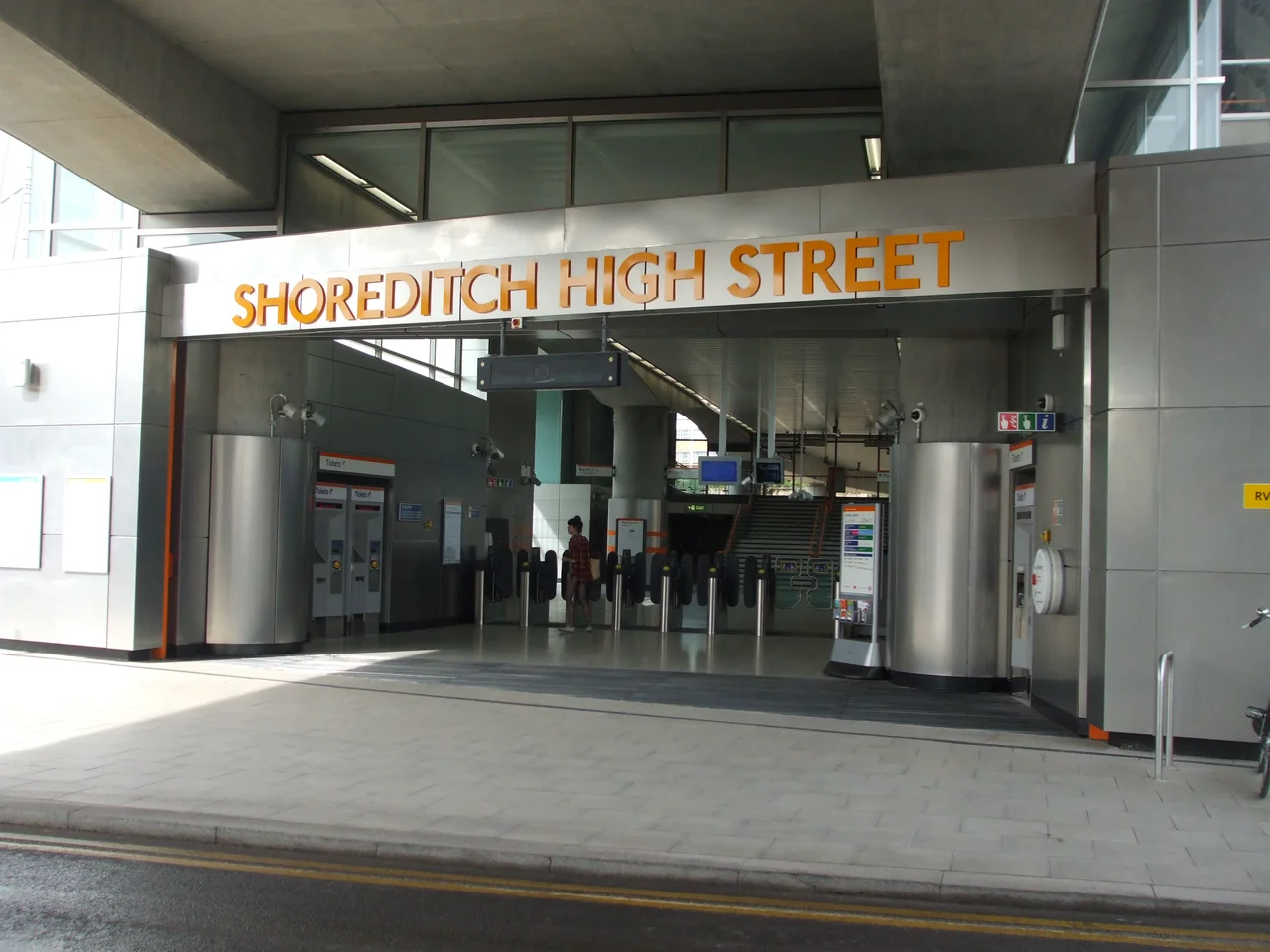
Coordinates 51.526 N, 0.078 W in inner east London. Recommended viewing altitude 1000-1500 ft from the south-east to keep both Shoreditch High Street and the Old Street Roundabout in the frame. From the air, look for St Leonard's Church spire at the historic crossroads, the long line of Kingsland Road running north-east, and the railway viaduct carrying the Overground into Shoreditch High Street station, which is enclosed in its distinctive concrete box. Nearest airports: London City (EGLC) about 4 nm south-east; London Heathrow (EGLL) about 18 nm west; London Stansted (EGSS) about 26 nm north-east. Class D airspace under the London City CTR; transit clearance required. Best visibility in clear daylight when the area's contrast of Victorian brick and contemporary glass is apparent.
Nearby Stories
- Stevenage 5.7 km away
- Malling Abbey 5.7 km away
- 1952 Farnborough Airshow Crash 7.7 km away
- Ingatestone Hall 8.2 km away
- Hellfire Caves 9.1 km away
- The Carrington Event: The Solar Storm That Could Happen Again 9.8 km away
- Bletchley Park 16 km away
- Castle Hedingham 23 km away