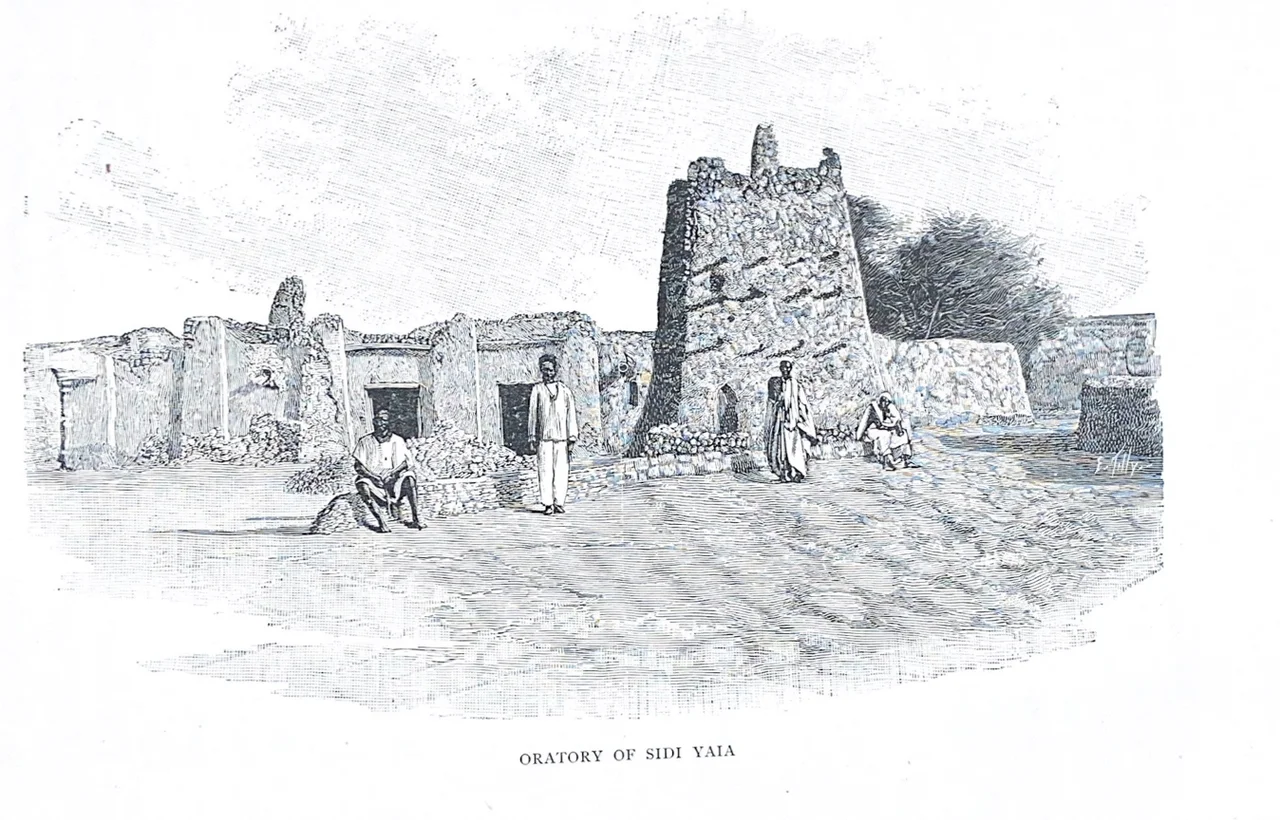

Sidi Yahya Mosque
There was a door in Timbuktu that no one was supposed to open until the end of the world. For generations, the people of the city walked past the sacred gate of the Sidi Yahya Mosque and left it shut, believing that to force it would invite the apocalypse. Then, on a July morning in 2012, eight armed men pried it loose. They said they wanted to destroy the mystery. Instead, they wounded a city.
Earth, Not Heaven
Construction on the mosque began around 1400 under Sheikh el-Mokhtar Hamalla of Timbuktu and was completed by 1440. It was named for its first imam, Sidi Yahya al-Tadelsi, a revered scholar whose memory still anchors the building. Where much Islamic architecture reaches upward toward the divine, the Sidi Yahya Mosque does something quieter and more grounded. Built of clay, mud, and rock, it speaks of earthiness rather than the heavens, of permanence and connection to the ancestors whose bodies lie buried within its walls. Its roof, like the rest of Timbuktu, rests on beams cut from the indigenous ronier palm, then sealed under layer upon layer of mud smoothed into a plaster-like skin. The whole structure looks as though it grew from the desert floor.
The Living and the Dead
Step inside and the mosque reveals itself as more than a place of prayer. The imams are buried in an underground chamber north of the building, where the faithful recite the morning and evening prayers among the graves of their predecessors. The old courtyard was once turned into a cemetery, now no longer in use. A smaller exterior court serves as a reading space during Mawlid, the celebration of the Prophet Muhammad's birth. This is architecture as memory, a building that holds the dead close and keeps the living in conversation with them. For the people of Timbuktu, the mosque was never a museum piece. It was a protective presence, a guardian of the city itself.
The Day the Door Opened
In 2012, jihadist fighters seized northern Mali and turned on Timbuktu's shrines and mausoleums, declaring them idolatrous under their rigid reading of Islam. They came for the Sidi Yahya gate too. "It is said that the main gate will not be opened until the last day," the town imam, Alpha Abdoulahi, told Reuters afterward. Eight men ignored the warning and tore the door down. The act sent a tremor of dread through the city, where residents had guarded that threshold for centuries. The militants meant to dispel a superstition. What they actually did was attack something the community held sacred, and the fear they unleashed was not of the apocalypse but of all that was being lost.
Putting It Back
The story does not end in destruction. Beginning in 2013, Timbuktu's own woodworkers and carpenters set about restoring what had been broken, working with the support of UNESCO. The sacred gate was formally reinstalled on September 19, 2016, and the mosque's minaret was repaired by 2019. The man who led the wider campaign of destruction was eventually tried and convicted at the International Criminal Court in The Hague, the first person ever prosecuted there for the war crime of attacking cultural heritage. Today the restored door stands again in its frame, a quiet rebuke to the idea that history can be erased by force, and a sign that a city can mend what zealotry tried to take from it.
From the Air
The Sidi Yahya Mosque sits at 16.77°N, 3.01°W in the heart of Timbuktu's old town, on the southern edge of the Sahara. From the air, Timbuktu reads as a low, sand-colored grid pressed against the dunes a few kilometers north of the Niger River floodplain. The mosque's stubby earthen minaret rises only modestly above the rooftops, so look for the dense cluster of the historic center rather than a single spire. The nearest airport is Timbuktu (GATB), just southwest of town; Mopti (GAMB) lies roughly 280 km to the southwest. Best viewing is mid-morning in the dry season, when haze is lowest and the low sun rakes shadow across the mud architecture. Harmattan dust can cut visibility sharply from December to February.
Nearby Stories
- Essakane 13 km away
- Liptako 18 km away
- Tondidarou 86 km away
- Hand of Fatima (rock formation) 159 km away
- Lake Débo 184 km away
- Hombori 187 km away
- Festival au Désert 332 km away
- Oualata 374 km away