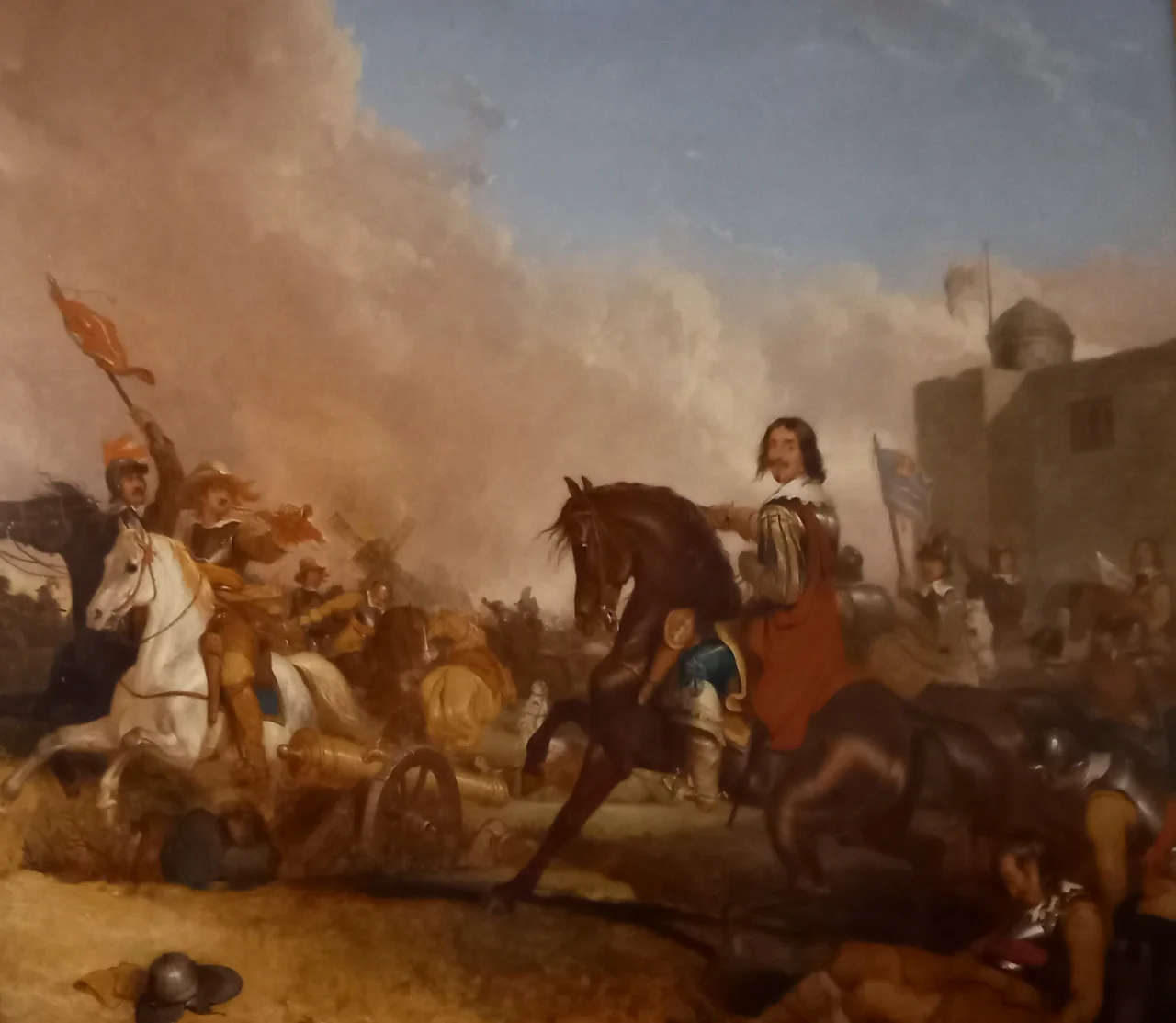

Siege of Colchester
By the second week of August 1648 the people inside Colchester were boiling leather. They had eaten the cats first, then the dogs, then the horses, then anything that could be rendered down to broth. The town's old Roman walls had held an army of starving Royalists since June, ringed outside by Thomas Fairfax and the New Model Army. Women carrying babies came to the town gates to beg for bread; Parliamentary soldiers turned them away. When the commander, Lord Goring (Earl of Norwich), eventually sent five hundred starving townswomen out to plead with the besiegers, Parliament's Colonel Rainsborough ordered them stripped naked. The siege had become something the English Civil Wars rarely produced: a deliberate, calculated cruelty inflicted by one side of an English-speaking population on another, in a town whose loyalty had always been Parliament's.
How an Army Ended Up Behind a Wall
The Second English Civil War had reignited in May 1648 when Kent rose against Parliament. Fairfax crushed the Kentish revolt at Maidstone on 1 June. The remnants of that army, under the Earl of Norwich, slipped across the Thames to join Essex Royalists led by Sir Charles Lucas - himself a Colchester man, whose family seat lay just outside the town walls. By 12 June Lucas had assembled around four thousand men. He marched them into Colchester, intending to rest, recruit, and then drive into Suffolk and Norfolk to raise those counties for the king. Fairfax caught him before he could leave. On 13 June, after a bitter fight along the Maldon Road where Parliamentary infantry was repelled three times by Royalists firing from behind hedgerows, Fairfax's superior cavalry finally turned the Royalist flanks. Lucas's men retreated into the town. Fairfax's pursuing troops followed through the gates and were routed by a counter-attack. By midnight the Royalists were inside the walls; Fairfax was outside them. The siege had begun by accident, and would last until the town was reduced to candle-grease.
The Ring of Forts
Fairfax did what New Model Army commanders did best: he engineered. Forts went up around Colchester at every approach. Cannon were sited against the curtain wall. The River Colne was blockaded by Parliamentary ships at its mouth. The Suffolk Trained Bands - who were meant to be coming over to the Royalist side, by Norwich's reckoning - instead came over to Fairfax, and were posted to guard the bridges across the Colne. On 2 July the encirclement was complete. The Royalists tried to break it. On 5 July Lucas led 400 cavalry and Sir George Lisle led 600 infantry against the Suffolk men at the East Gate; the surprise attack succeeded, but the Royalists pushed too far and were counter-attacked, losing their gained artillery. On 14 July Fairfax launched a night assault on the outlying defences. St John's Abbey, just south of the walls, and Sir Charles Lucas's own family house were taken in fierce fighting. The Royalist battery at St Mary's church was destroyed by artillery fire.
The Town Inside
Colchester had fought for Parliament in the First Civil War. Its loyalties were known. The Royalist army inside the walls in 1648 was not welcome - the soldiers seized provisions, and the townspeople watched their food disappear. As July became August and the town's stores ran out, soldiers and civilians alike began to starve together. Cats and dogs vanished from the streets. Horses were slaughtered. People ate soap. They ate candles. Repeated petitions from Colchester Town Council asked Fairfax to allow non-combatants to leave or supplies to be brought in. Fairfax, who knew exactly how the siege would end if he simply held the line, refused. The 500 women sent out to beg returned naked and emptyhanded. A break-out attempt by the Royalist cavalry on 15 July was intercepted near Boxted in a tangle of engagements lasting two days. Only Sir Bernard Gascoigne and a few horsemen got clear, fighting their way out down the Maldon Road on 22 July.
Lucas and Lisle
On 24 August Fairfax received word that Cromwell had crushed the Scottish Royalist army at Preston three days before. The last hope of relief was gone. Parliament's gunners fired celebratory salutes; Fairfax had kites flown into Colchester carrying the news. That evening Lord Norwich opened negotiations. Fairfax offered terms only, not negotiations: common soldiers and junior officers would be granted quarter; senior officers must surrender to mercy, with no guarantee of their fate. On 28 August the Royalists laid down their arms. The town agreed to pay £14,000 to be spared pillage. That same evening, by Fairfax's order, Sir Charles Lucas and Sir George Lisle were taken behind Colchester Castle and shot. They had been judged guilty of high treason for, among other things, breaking the parole they had given after the First Civil War. The execution by firing squad was unusual in the English Civil Wars; Fairfax and Ireton wanted to make a point. Pamphlets quickly recast Lucas and Lisle as martyrs. A monument still stands in the castle grounds where they fell. Local tradition holds, four centuries later, that grass will not grow on the spot.
Humpty Dumpty and the Long Echo
The siege has slipped into folklore as well as memory. A persistent local story claims that the nursery rhyme 'Humpty Dumpty' began as a name for a large Royalist cannon mounted on the wall beside St Mary's Church, which the Parliamentary bombardment of 14 July knocked off its perch - and all the king's horses and all the king's men could not lift it back up. Other versions attribute Humpty Dumpty to a Royalist sniper, 'One-Eyed Thompson,' shot down from the church belfry. Neither is documented before 1996, when the East Anglia Tourist Board first put the connection on its website; the rhyme itself is only attested from 1797. What is unquestionable is that the siege left a long shadow on the town. The Royalist aristocrats Capel was later beheaded; Norwich and Loughborough were exiled. Lord Goring eventually died abroad. Colchester rebuilt. The garrison tradition continued. And in the castle grounds, a small obelisk still marks where two men were shot for treason on a summer evening, by an army of Englishmen.
From the Air
The siege took place in and around the walled town of Colchester, centred on approximately 51.89 N, 0.90 E in Essex. The Roman wall circuit and Colchester Castle remain visible from the air; St Mary's Church (within the wall on the western side) and the ruins of St John's Abbey gatehouse (just south of the wall) are key sites from the siege. Recommended viewing altitude is 1,500-2,500 ft AGL. London Stansted (EGSS) is 28 nm west; Southend (EGMC) is 24 nm south-west; Wattisham military airfield is 23 nm north. Class G airspace below the Stansted TMA.
Nearby Stories
- Woolpit 2 km away
- Tilty Abbey 3.6 km away
- Saxmundham 5.6 km away
- RAF Bottisham 6.5 km away
- Kelvedon Hatch Secret Nuclear Bunker 6.6 km away
- Maunsell Forts 7.4 km away
- Battle of Assandun 15 km away
- Broadstairs 36 km away