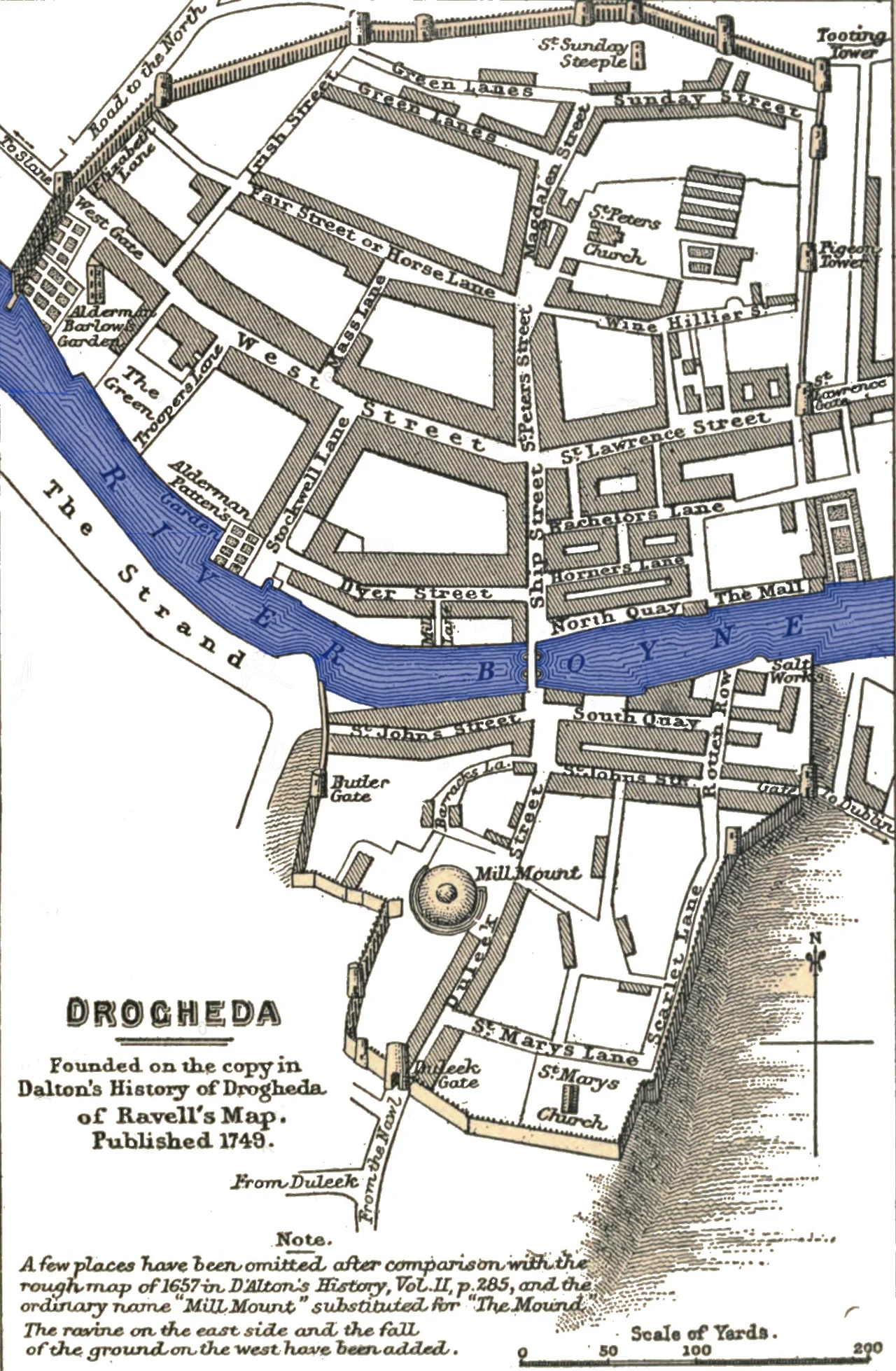

Siege of Drogheda
At five in the afternoon on 11 September 1649, after eight days of siege and an artillery bombardment that had opened two breaches in the medieval walls, Oliver Cromwell's New Model Army broke into Drogheda. By the morning of 13 September, somewhere between 2,800 and 4,000 people were dead. Soldiers who had surrendered on a promise of quarter had been clubbed to death at a windmill. About a hundred men who took refuge in the steeple of St Peter's Church were burned alive when the soldiers set the steeple on fire on Cromwell's orders. The dead included Royalist English, Confederate Irish, Catholics and Protestants, and an uncertain but substantial number of civilians. It was the worst single act of state violence in the seventeenth-century history of these islands, and it still casts a long shadow over Cromwell's name.
Why Drogheda
Cromwell landed near Dublin in August 1649, six months after the execution of King Charles I, to reconquer Ireland for the new English Commonwealth. The country was held by an alliance of Irish Catholic Confederates and English Royalists who had named the dead king's son Charles II as their king. Drogheda was the next domino north of Dublin - a walled town on the mouth of the Boyne, controlling the road to Ulster. The garrison had about 2,550 men under Sir Arthur Aston, an English Catholic professional soldier who had served in the wars in Poland and Russia and now wore a wooden leg. Cromwell brought 12,000 men and eleven 48-pounder siege guns, the heaviest cannon of the day, hauled up the coast by sea. He had landed late in the year. There was no time for a long blockade. The ports on Ireland's east coast had to be taken quickly, or his army would not survive the winter.
The Summons
By 10 September, Cromwell's guns had opened two breaches in the medieval walls south of the river. He sent a letter under flag of truce to Aston. The contemporary laws of war were brutally clear: if a garrison refused a summons and was then taken by assault, the attacker had legal discretion to kill any defender. Aston refused. The garrison was nearly out of gunpowder, but Aston was holding out for relief by the Duke of Ormonde, who had 4,000 troops at Tecroghan to the west. Ormonde never came. At five PM the next day, Cromwell ordered the assault. Three regiments went into the breaches. They were beaten back in the east. Two more regiments were sent in. The second wave climbed over a heaped pile of their comrades' corpses, in the words of one survivor. At the southern breach the defenders counterattacked, and Colonel Wall, their commander, was killed. With Wall down, the defence collapsed. About 150 Parliamentary soldiers, including Colonel Castle, died at the walls. Then 6,000 of Cromwell's men poured into the town.
No Quarter
Riding into Drogheda over the bodies of his own men piled in the breaches, Cromwell gave the order: no quarter to any man under arms. In his own words afterwards, written to the Speaker of the Commons - I forbade them to spare any that were in arms in the town, and that night they put to the sword about two thousand men. Soldiers who had thrown down their weapons were chased through the streets and killed in private houses. The drawbridge over the Boyne was not raised in time, and the killing continued in the northern half of the town. Arthur Aston and about 250 men took refuge in Millmount Fort. Colonel Daniel Axtell offered to spare them if they surrendered. They did. They were marched out, disarmed, taken to a windmill, and clubbed to death an hour later. Aston, whose soldiers believed his wooden leg was hollowed out and full of gold, was reportedly beaten to death with it. There was no gold.
The Steeple of St Peter's
About a hundred men - some soldiers, possibly some civilians - took refuge in the wooden steeple of St Peter's Church at the northern end of town. On Cromwell's orders, Colonel John Hewson set fire to the steeple. The men inside burned to death. There is no record of their names. Two days later, Lieutenant-Colonel Richard Boyle, an Anglo-Irish Episcopalian who had been taken prisoner, was dining with a Drogheda woman when an English Parliamentary soldier entered and whispered to him. Boyle stood up. His hostess asked where he was going. Madam, he said, to die. He was shot in the next street. The only surviving civilian account is from Dean Bernard, a Protestant cleric who was a Royalist. Thirty of his parishioners were sheltering in his house when Parliamentary troops fired in through the windows, killing one and wounding another. They broke in firing, and stopped only when an officer recognised Bernard as a Protestant. Catholic householders did not have an officer to recognise them. Their fate is the silence in the record.
How Many
The total dead at Drogheda will never be known exactly. The Parliamentary chaplain Hugh Peters - on Cromwell's own council - reported 3,552 dead, of whom about 2,800 were soldiers, leaving 700 to 800 civilians killed. The Royalist press a week later claimed 2,000 of 3,000 dead were civilians. Irish clerical sources in the 1660s, writing in living memory of the siege, gave 4,000 civilian dead, calling the sack unparalleled savagery and treachery beyond any slaughterhouse. The historian John Morrill, the leading modern scholar of Cromwell, has concluded that the massacre was without straightforward parallel in seventeenth-century British or Irish history. What is certain is that civilians died alongside soldiers, that prisoners were murdered after surrendering, and that the killing was both ordered from above and pursued with thoroughness through the houses of the town for two days and nights. The neighbouring garrisons of Trim and Dundalk surrendered without a fight when the news reached them. Cromwell had calculated correctly. The terror worked.
What Cromwell Wrote
In his letter to Parliament, Cromwell called the killing a righteous judgement of God upon these barbarous wretches. Historians have argued for three centuries about who he meant by barbarous wretches. Some have read it as Catholics generally, in reprisal for the 1641 Irish rebellion in which Protestant settlers had been killed in Ulster. But Cromwell knew that the Drogheda garrison was not those people - it was a mixed Royalist-Confederate force, English and Irish, Catholic and Protestant, and most of its officers were English. Morrill argues he meant the English Royalist officers who had carried on fighting after King Charles I lost. They had refused to accept God's verdict in the English Civil War. Whatever Cromwell meant theologically, the people who burned in St Peter's steeple, who were clubbed to death at the windmill, and who died with their families in the houses of Drogheda were not abstractions. They were people - and their names, in nearly every case, are lost. The town rebuilt. The Boyne kept flowing. The memory has lasted four centuries. Cromwell remains a hated name in Ireland today because of what happened in eight days in September 1649.
From the Air
The site of the siege is the historic core of Drogheda, at 53.71 degrees north, 6.35 degrees west, on the River Boyne in County Louth. Nearest airport is Dublin (EIDW) about 35 miles south. From 2,000-3,000 feet in clear weather, the town walls have largely vanished, but St Laurence's Gate still spans the eastern entrance, and Millmount Fort - the great hill-top redoubt where Aston's men surrendered - rises distinctively on the south bank of the river. St Peter's Church of Ireland still stands at the north end of the town, on the site where the burning steeple killed about a hundred men in 1649. Spring offers the clearest visibility.
Nearby Stories
- Cootehill 8.4 km away
- Maynooth University 8.7 km away
- Oldcastle, County Meath 12 km away
- 1989 Jonesborough Ambush 15 km away
- Slieve Donard 24 km away
- Kilbeggan Distillery 32 km away
- German submarine U-1051 40 km away
- Minesto 80 km away