
Siege of Gloucester
On 10 August 1643 a herald rode up to Gloucester's south gate carrying a demand for surrender from Charles I. The city's governor, a 23-year-old Lieutenant-Colonel named Edward Massey, sent back the kind of insolent refusal that ends in someone losing their head. Then the Parliamentarians inside the walls set fire to their own suburbs to deprive the Royalists of cover. The smoke had not cleared when Charles realised what he had walked into. Bristol had fallen to his armies two weeks earlier with thousands of casualties, and he had marched on Gloucester believing the city would crumble at the mere sight of his banners. It did not crumble. For the next twenty-six days, the king sat in a country house at Matson, two miles south of the walls, and watched his army fail to take a city of five thousand souls.
Why Gloucester Mattered
If Charles took Gloucester, he could supply his garrisons all the way up the Severn to Worcester and Shrewsbury from Bristol. He could tax wealthy Gloucestershire. He could move Welsh recruits and money freely across the country. He could choke off Parliament's last serious foothold in the west. His wife Queen Henrietta Maria thought he should march straight on London and end the war in one stroke. Prince Rupert wanted to take Gloucester first and then turn east. Charles split the difference in the worst way - he went for Gloucester but refused to risk the casualties of an assault, hoping the city would honourably surrender to a king rather than fight a prince. Massey, secretly negotiating, encouraged the belief that he might. Whether this was sincere or a bluff to buy time, historians still argue.
An Inadequate Bombardment
The Royalists had only eight cannon and two mortars. One of the mortars, reportedly the largest in England, exploded the first time it fired. The remaining guns were too light for serious siege work. They opened up on 13 August. By 14 August, the breach they had blown in the south wall had been plugged with woolsacks and gabions, and the Royalists had run out of ammunition. They tried again on 19 August. Same result. At one point during the siege, the besiegers ran so low on shot that they were reduced to firing stones at the walls. The 300 to 400 cannonballs and 20-odd mortar bombs that landed inside Gloucester over four weeks failed to blow any major breach, start any significant fire, or cause more than a handful of casualties. Massey had reinforced his medieval walls with five feet of packed earth, which absorbed shot beautifully.
Massey's Raids
What Massey did instead of waiting was attack. With a garrison of just 1,500 men - two half-strength regiments plus dragoons, trained band and a single troop of cavalry - he mounted raid after raid out of the gates. On 16 August, 150 musketeers sallied from the north gate at sunset and turned a quiet Royalist evening into chaos. On 18 August, four hundred men in a coordinated attack disabled four of Sir William Vavasour's cannon. On 21 August, a force came down the Severn by boat and stormed a Royalist redoubt opposite the castle. The raids were costly but they kept the besiegers off-balance, denied them their artillery, and used up the besieging army's morale faster than the Royalists could rebuild it. The Royalist commanders themselves later identified Massey's countermining as the reason they had to give up.
Miners from the Forest of Dean
When the guns failed, Charles turned to digging. Royalist engineers brought in miners from the Forest of Dean and later Welsh miners to tunnel beneath Gloucester's walls. The plan was to fill the moat with fascines, undermine the foundations, and blow a hole into the city. It was slow, dangerous, and constantly disrupted - the defenders dug counter-mines, listening for the sound of picks below ground, ready to break through and fight underground or flood the workings. Springs flooded one Parliamentarian counter-mine on 28 August. Welsh miners arrived on 29 August and quickened the Royalist pace. By 3 September the king's miners were within a day of reaching the east gate. The defenders' gunpowder was almost gone. They were down to their last barrels. They didn't know it, but they were one day from losing the war here.
Essex Arrives
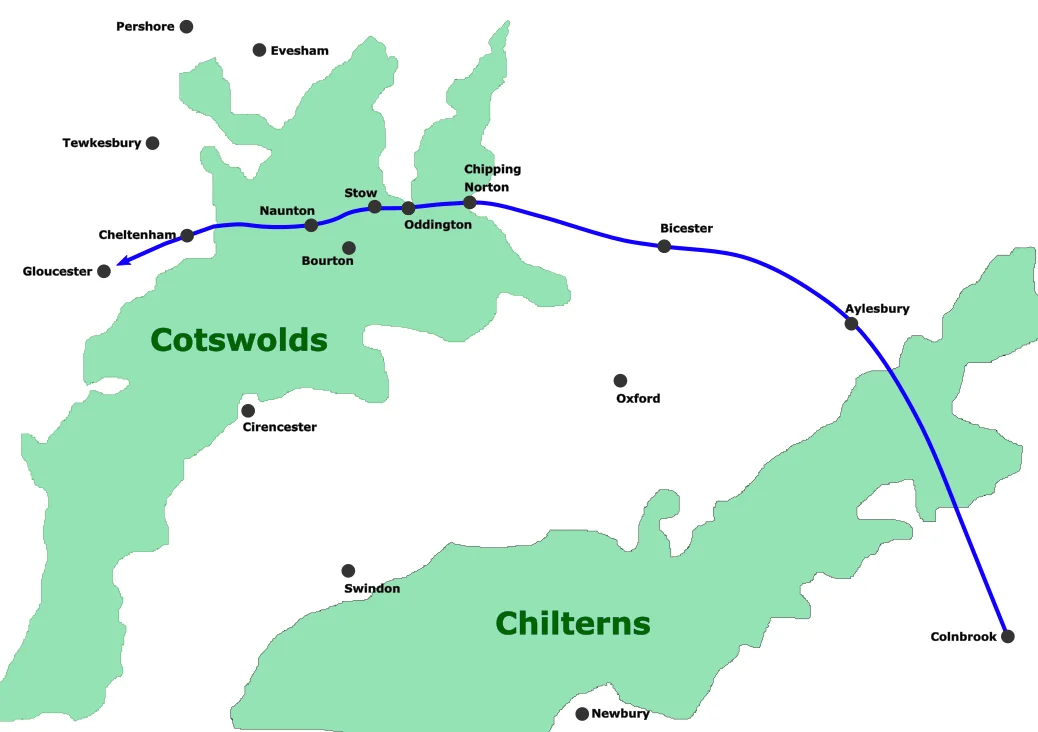
On 26 August, the Earl of Essex had marched out of London at the head of 10,500 infantry and 4,500 cavalry. His route was carefully chosen - north of Oxford, across the Cotswolds, avoiding the open country where Royalist cavalry would have the advantage. Prince Rupert was sent to delay him and failed. On 5 September, Essex's lead elements descended the steep escarpment at Prestbury Hill toward Cheltenham, just east of Gloucester. The defenders, watching from the walls, saw signal fires on Wainlode Hill and dared to believe. The Royalists struck their tents, lifted their siege and withdrew to Matson. Charles had already ridden ahead to Painswick. The siege was over. Gloucester would never be retaken. The campaign that followed brought Charles and Essex to inconclusive battle at Newbury two weeks later, and Essex reached the safety of London with his army intact. Gloucester's defence had pulled Parliament out of the worst hole of the war and arguably saved its cause. Massey was removed as governor two years later, switched sides, and ended his career as Member of Parliament for the city he had once defended. In 1660 the restored Charles II ordered the city's walls demolished. Some grudges last a long time.
From the Air
The siege site is centred at 51.864 degrees north, 2.244 degrees west, covering Gloucester city centre and the surrounding ground east and south of the walls. Best viewed from 2,500 to 5,000 feet. Gloucester Cathedral's tower is the obvious landmark. Look for the modern street pattern - Eastgate, Southgate, Northgate, Westgate - which still preserves the lines of the besieged walls. The ground south at Llanthony Secunda Priory and the open spaces toward Matson, where Charles set up headquarters, are visible to the south. Nearest airport is Gloucestershire Airport (EGBJ) at Staverton, eight miles east-northeast.
Nearby Stories
- Grosmont Castle 4.8 km away
- Charfield Railway Disaster 9.8 km away
- Stratford-upon-Avon Canal 9.9 km away
- Droitwich Spa 11 km away
- Caerleon 12 km away
- Wigmore Castle 13 km away
- Church of the Holy Trinity, Stratford-upon-Avon 27 km away
- Marlborough Castle 29 km away