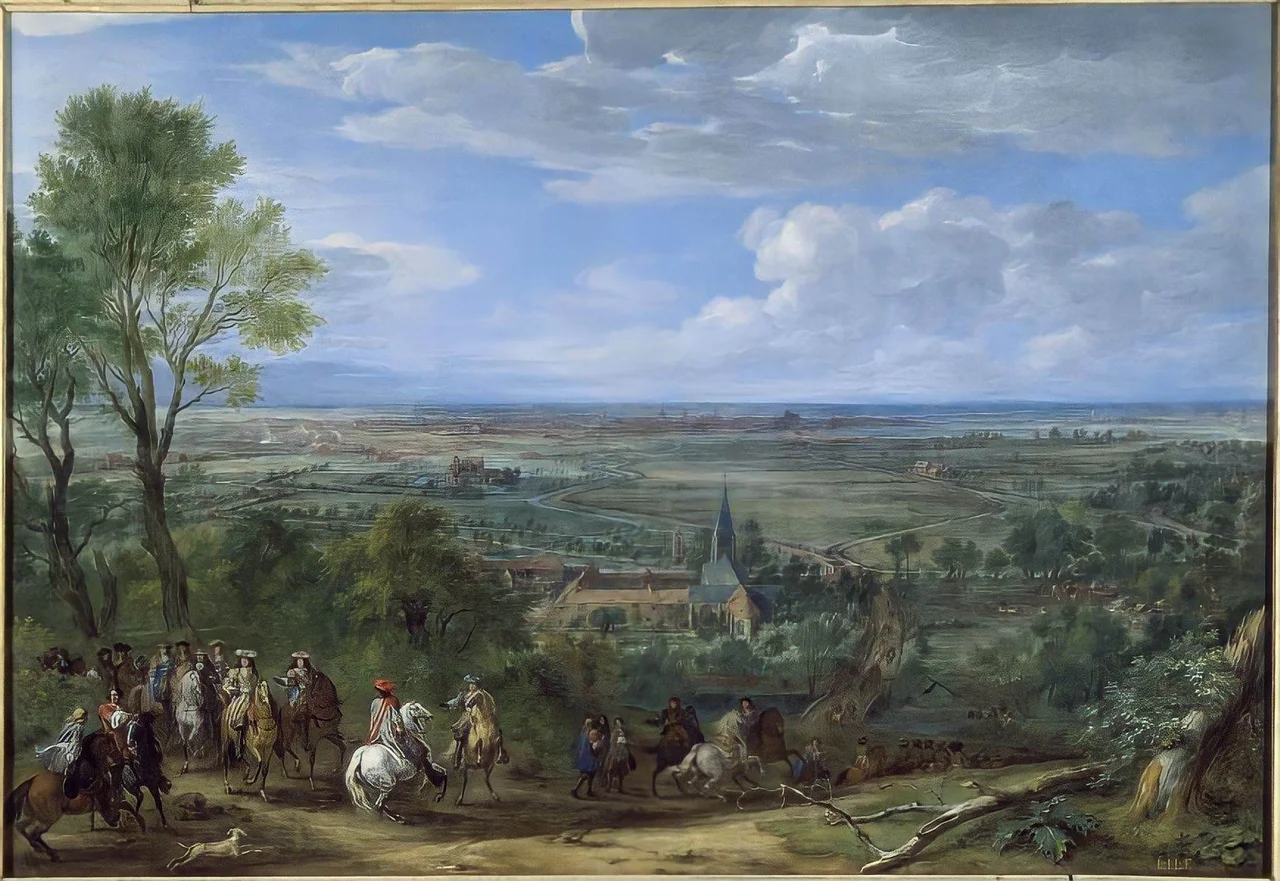

Siege of Lille (1667)
On the eleventh day of August 1667, French troops appeared in front of the walls of Lille and began to dig. They did not dig in straight lines. They did not rush the gates. They cut zigzag trenches, called approaches, that crept toward the Spanish fortifications at angles so oblique that the defenders' cannons could not enfilade them. Behind the trenches they built batteries, and then more trenches, and then more batteries, each closer than the last. The man directing all this digging was a thirty-four-year-old military engineer named Sébastien Le Prestre de Vauban, and the technique he was demonstrating in front of Lille was a method he had been refining for ten years. It worked. Eighteen days later the city surrendered. It was the first major victory for Vauban's system. The next two centuries of siege warfare were already taking shape in the trenches outside the Thebes Gate.
Why Lille
The pretext was a dowry. Louis XIV had married Maria Theresa, daughter of Philip IV of Spain, in 1660. Part of the marriage settlement had specified a substantial cash payment to the French crown; the Spanish, weakened by decades of war, had never paid. Louis announced in 1667 that the unpaid dowry made his wife the legal heir to portions of the Spanish Netherlands, under a piece of Brabantine inheritance law called droit de dévolution, and marched into Flanders to collect. The war was called the War of Devolution. Strategically, what Louis wanted was Lille — the wealthiest city of Flemish industry, the gateway to the north, the prize that any French king dreaming of natural frontiers had been looking at for centuries. By August his armies had taken Charleroi, Tournai, and Douai. Lille was the heart of the operation.
What Vauban Had Been Working On
Vauban had served in the army since he was seventeen, originally on the side of the Fronde rebellion against the young Louis XIV — captured, switched sides, became a royalist engineer. By 1667 he had directed or assisted at more than a dozen sieges. He had been collecting what he learned. The traditional siege, before Vauban, was a brutal affair of frontal assault, breach, and storm; casualties were heavy and outcomes uncertain. Vauban's insight was systematic: a properly conducted siege should be a methodical engineering operation in which the besiegers worked their way forward through parallel trenches dug perpendicular to zigzag approaches, building batteries at each stage to suppress the defenders' guns, until the wall could be breached at point-blank range. Each step was calculable. Each step was relatively safe. The siege of Lille was the first time he had been given a free hand to demonstrate the full method against a major fortress.
The Siege
Louis XIV himself came to watch. He was twenty-eight, vain, theatrical, and determined to be seen leading. He camped with the army and gave personal orders. The Spanish garrison under Philippe Spinola, comte de Bruay, had powder for perhaps ten days. The town signalled with fires from the steeple, hoping that watchers on the hills near Kemmel might pass the alarm back to the field army of Count Marsin somewhere east. Nothing came. By 19 August, Vauban's approaches had reached the outer works in front of the Thebes Gate. On the night of 27 August, French Guards rushed the half-moon outwork in front of the gate and seized it; Auvergne infantry took the ravelin in front of the Nobltur Bastion at the same moment. The walls were now uncoverable. On 28 August, Bruay opened negotiations. The city surrendered. Vauban had taken a major Spanish fortress in eighteen days, with about four thousand French casualties — heavy, by his own later standards, but trivial by the standards of every previous war.
The Scar
Vauban did not come out of Lille unmarked. A Spanish musket ball had hit him in the cheek during the siege works, leaving a scar he would carry for the rest of his life. He never seems to have minded the scar. He had also won the king's trust completely. Louis XIV ordered him to rebuild the fortifications of Lille at once, this time in his own style. Between 1668 and 1672, Vauban constructed the great five-sided citadel of Lille at a cost of one and a half million florins — a five-bastion star fort surrounded by flooded ditches, the model for the rest of his career. He called it the Queen of Citadels. It still stands. It is the most complete surviving Vauban fortress anywhere in France, and one of the twelve UNESCO-listed Vauban sites along France's old frontiers.
After the Siege
By the Treaty of Aix-la-Chapelle in 1668, Lille was permanently annexed to France. It was the first piece of the long process by which the French frontier moved north from the Somme to the Belgian border, where it still runs today. The War of Devolution had been almost over before it began — Lille was its only serious engagement — but it was the moment when Louis XIV announced that France was now a power capable of taking what it wanted. Vauban went on to design or improve over a hundred and fifty fortifications across France, including Besançon, Briançon, Mont-Dauphin, Saint-Martin-de-Ré, Neuf-Brisach, and the citadels of Arras and Cambrai. The methodical, geometric, almost mathematical siege he demonstrated outside Lille became the standard for European warfare until the rifled artillery of the nineteenth century made stone walls obsolete. For all that, it began in a few zigzag trenches in front of the Thebes Gate, dug by a young engineer with a scar on his cheek.
From the Air
Located at 50.629 degrees north, 3.057 degrees east, in central Lille, France, very close to the modern Belgian border. The original siege focused on the eastern walls; Vauban's later citadel stands at the northwest of the old town, on the river Deûle. Nearest major airport is Lille (LFQQ) about 5 km south; Brussels (EBBR) about 110 km east. The star-shaped outline of the Citadelle de Lille is one of the most distinctive features of the city from the air.
Nearby Stories
- Museum van Deinze en de Leiestreek 0.9 km away
- Castle of Ronse 6.7 km away
- Hooglede German War Cemetery 7.4 km away
- Courrieres Mine Disaster 7.4 km away
- Dunkirk Memorial 7.8 km away
- Arques, Pas-de-Calais 11 km away
- Marcinelle Mining Disaster 66 km away
- Royaumont Abbey 145 km away