
Sieges of Bradford
Picture the scene: a Royalist officer charges down the hill toward Bradford's parish church, sword drawn, expecting professional warfare to do the talking. The townsfolk - Puritan clothworkers, not soldiers - beat him from his horse. Wounded and trapped, he cries the standard plea of a defeated gentleman: "Quarter!" In military convention, the word meant mercy, surrender accepted. But the men of Bradford either misheard or pretended to. They told him grimly that yes, they would indeed quarter him - the medieval butchering sense. The phrase "Bradford Quarter" entered the language that December day in 1642, and it would echo back at the town with terrible meaning the following summer.
Wool Sacks Against Cannonballs
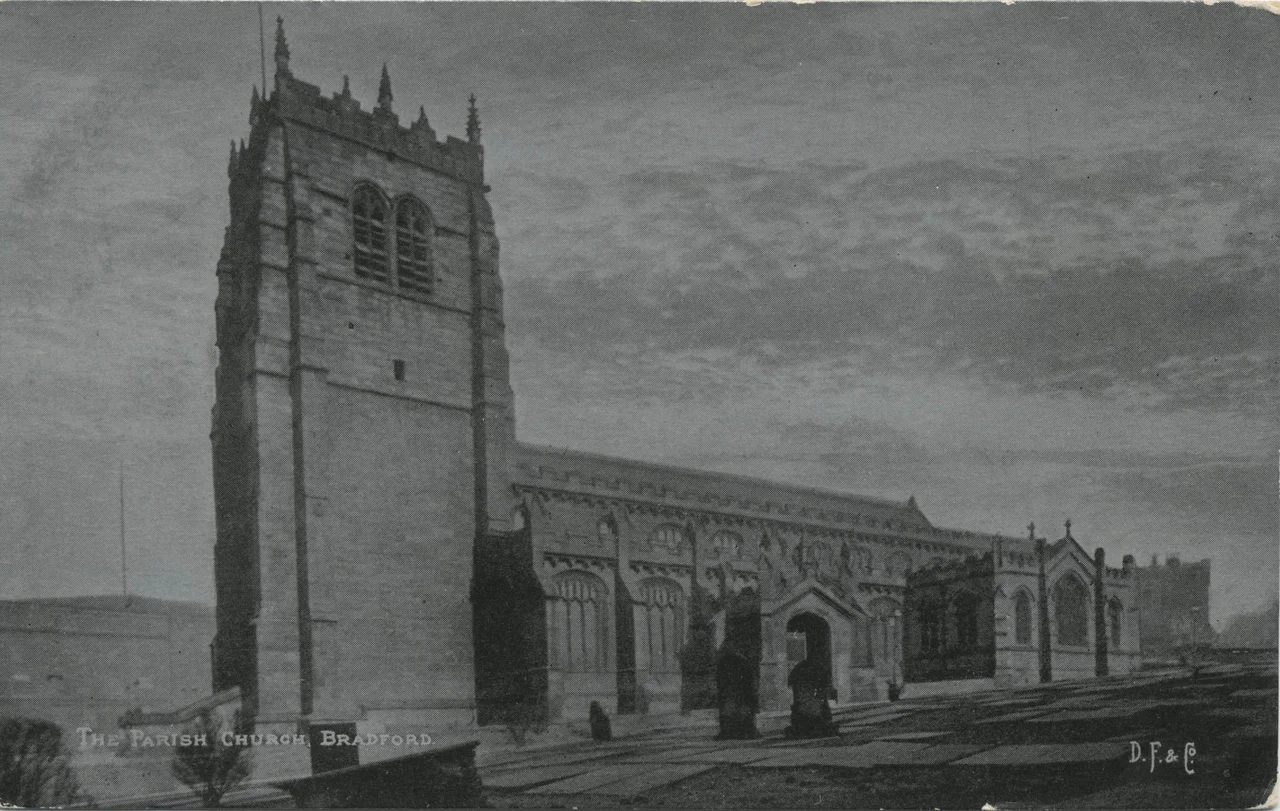
Bradford in the 1640s was a small settlement of three main streets - Ivegate, Kirkgate, Westgate - and a population of clothworkers fiercely loyal to Parliament. The townspeople had reasons to hate the king: Charles I's Catholic queen, his suspected papist sympathies, a high-church vicar imposed on their parish, taxes on their cloth trade. When the Royalists came, the Puritans of Bradford improvised. They hung woolen bales from the parish church tower - their economic livelihood transformed into armor. A contemporary 1643 woodcut shows the tower draped with six vertical rows of bales, four across, like a quilted breastplate. The wool absorbed cannon fire from the Royalist position 300 paces away at Barkerend, and behind that woolen shield Bradford's "choicest marksmen" picked off the king's men. The siege became known as the Battle of the Steeple.
The Apparition at Bolling Hall
Six months later, Bradford's luck ran out. After the Royalist victory at nearby Adwalton Moor, Sir Thomas Fairfax slipped away in the early hours of 2 July 1643, leaving the town to its fate. The Earl of Newcastle, furious at Bradford's defiance, billeted himself at Bolling Hall on the town's edge and ordered his troops to give the inhabitants "Bradford Quarter" - the very phrase the townspeople had invented to humiliate his soldiers, now turned back as a death sentence. Then something strange happened. Three times that night, Newcastle's sleep was broken by what witnesses described as a girl clad in white, who beseeched him: "Pity poor Bradford." Whether ghost, dream, or - as John Nicholson's 1821 dramatization suggested - a clever servant girl with whitened face, the next morning Newcastle rescinded the order. The town was occupied largely without slaughter.
The Long Aftermath
Bradford survived the second siege but not its consequences. Famine and pestilence followed, sweeping through a population already exhausted by violence and the loss of food stores. The town's recovery took, by traditional reckoning, a hundred years. While Bradford withered, nearby Leeds flourished - some historians have argued that the sieges directly enabled Leeds to overtake Bradford as the trading powerhouse of the West Riding. In 1951, the Bradford Historical and Antiquarian Society installed a plaque inside Bradford Cathedral, the descendant of the medieval parish church whose tower had once worn its strange woolen armor. The inscription remembers the wool sacks, the cannonballs, and the two sieges of 1642 and 1643. By then, the Industrial Revolution had made Bradford the world capital of wool processing - a strange poetic justice for a town that had once defended itself with the same humble fiber.
Walking the Battlefield Today
Modern Bradford has long since swallowed the separate village of Barkerend where the Royalist cannons stood. Undercliffe, where the first Royalist guns burst asunder in snowfall and strong winds, is now a Victorian cemetery overlooking the city. Bolling Hall still stands - a stone manor house that became a museum in 1915, and visitors today can see the chamber where Newcastle was supposedly visited. Bradford Cathedral, much rebuilt over the centuries, occupies the same site where the wool bales once hung. The cathedral's modest scale - far from the soaring Gothic of Ripon or York - hints at the small parish church it was when 800 Royalists tried to take it from townspeople who simply refused to lose.
From the Air
Bradford lies at 53.795°N, 1.747°W in West Yorkshire, England. The nearest airport is Leeds Bradford (ICAO: EGNM), 8 miles east. The historic town centre sits on a south-facing slope, with Bradford Cathedral visible as a small spired church beside the modern Centenary Square. Bolling Hall stands to the south-east on a low ridge. From altitude, Bradford's urban sprawl merges seamlessly with Leeds 9 miles east-northeast. Look for the dramatic moorland edge of the Pennines just to the west - the green-brown wall that marks the boundary of the South Pennines.
Nearby Stories
- Hovingham Hall 6 km away
- RAF Elvington 7.6 km away
- Battle of Hatfield Chase 9.1 km away
- Wentworth Castle 11 km away
- Murder of Suzanne Capper 12 km away
- Pendle Hill 13 km away
- RAF Topcliffe 15 km away
- Hawes Junction Rail Crash 26 km away