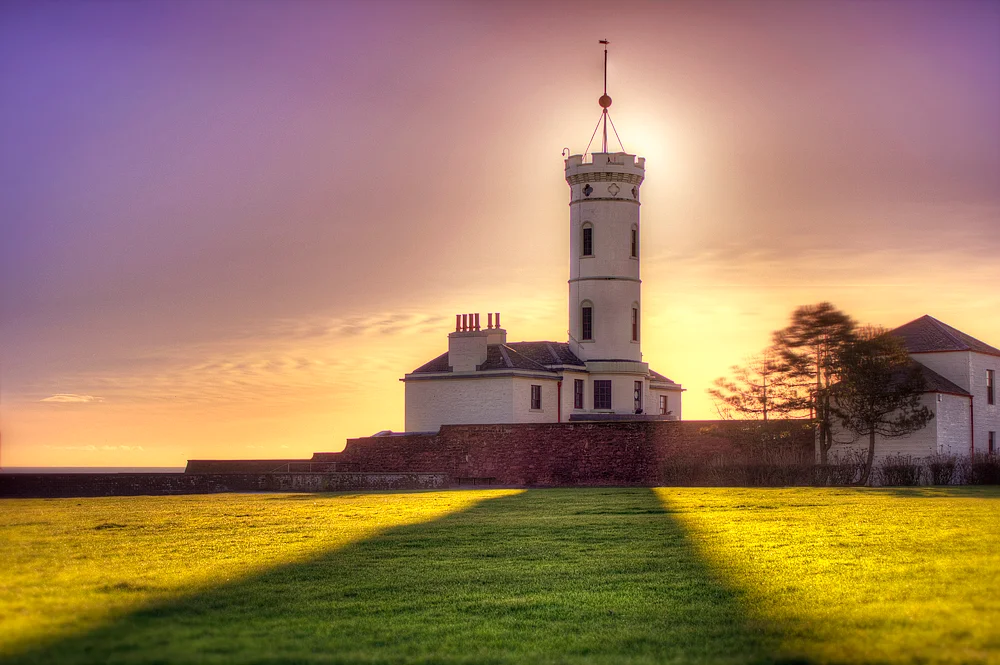

Signal Tower Museum
Every morning between 9 and 10 a.m., the Master of the Tender at this small square building on Arbroath harbour would put his eye to a powerful telescope and stare out across eleven miles of open North Sea toward the Bell Rock. If everything was well, the lighthouse keepers raised a black ball up a pole on the roof of their tower. If they raised it, the ball would appear in the telescope, and the master could go and have his breakfast. If the ball stayed down - shortage of food, an injury, a death - a vessel was launched, and somebody set sail. This was state-of-the-art communications in 1813. It worked for over a century.
A Conversation in Black Balls
The Signal Tower was completed in 1813, three years after the Bell Rock Lighthouse itself, as the lighthouse's shore station. Identical signalling apparatus was installed on top of both buildings: a vertical pole, a heavy black ball that ran up and down it on a rope, and a fixed routine for raising it. In foggy weather, when nothing could be seen at 9 a.m., the watch was postponed to 1 p.m. in the hope that conditions might clear. The Signal Tower also housed the families of the keepers who served their long shifts on the rock. While their husbands or fathers were off at sea, the wives and children lived here on the harbour, watching the same horizon. At night any flicker in the lighthouse beam would send the tender out before dawn.
Fresh Rolls for the Keepers
Arbroath fishing vessels, returning to harbour, would routinely carry small comforts out to the rock. Newspapers. Fresh bread rolls. Tobacco. A letter from home. They would relay messages back to the shore station too, either officially for the Master of the Tender or unofficially as favours to friends. In an age before radio, this informal communication mattered. The keepers depended on it for sanity as much as for supplies. The system held until 1955, when helicopters and faster boats made it obsolete. Staffing was transferred to Leith, home of the Northern Lighthouse Board. The tower's job, after 142 years of silent dialogue with a light eleven miles away, was finally over.
Council Housing and Curiosity
What do you do with a stone building you no longer need? Arbroath Town Council took it over and, for about fifteen unlikely years, used it as council housing. People lived in the keepers' old quarters, raised children where the master of the tender had once kept his telescope, hung washing where signals had been hoisted. In the 1970s the building was converted into a museum. The transformation revealed the depth of stories Arbroath had to tell. The town had once been a major jute processor, home to Shanks Lawnmowers, Giddings + Lewis-Fraser, and Keith & Blackman, all world-known firms. The museum kept the records and the machinery.
Lawnmowers and Lighthouse Lights
Today the Signal Tower Museum houses an unlikely combination of subjects: Bell Rock Lighthouse exhibits and a scale model of the Inchcape Rock alongside vintage Shanks lawnmowers and fishing gear. One of the original light mechanisms from the lighthouse is on display - the brass and glass apparatus that turned night into a warning across the North Sea. Scale models of fishing vessels from Arbroath's harbour show the ships that once carried bread rolls out to the rock. The museum is run by ANGUSalive, the local culture trust. It is small. It is free. It is the kind of place where you can spend an hour and come out understanding more about a particular eleven-mile stretch of water than you ever expected to.
From the Air
The Signal Tower Museum sits at 56.55°N, 2.59°W at the mouth of Arbroath harbour, on Ladyloan, immediately southwest of the harbour basin. From 2,000-3,000 ft AGL look for the small square stone tower right at the harbour entrance. The Bell Rock Lighthouse itself, the tower's historic partner, lies 11 nm east-southeast in the open North Sea. Nearest airports: Dundee (EGPN) 14 nm southwest; Leuchars (EGQL) 18 nm southwest; Aberdeen (EGPD) 35 nm northeast.
Nearby Stories
- Edzell Castle 4.7 km away
- Coupar Angus Abbey 7.5 km away
- Isle of May 8.5 km away
- Lochleven Castle 15 km away
- Lochnagar 21 km away
- Eyemouth Disaster 39 km away
- River Dee Ferryboat Disaster 40 km away
- Girdle Ness Lighthouse 70 km away