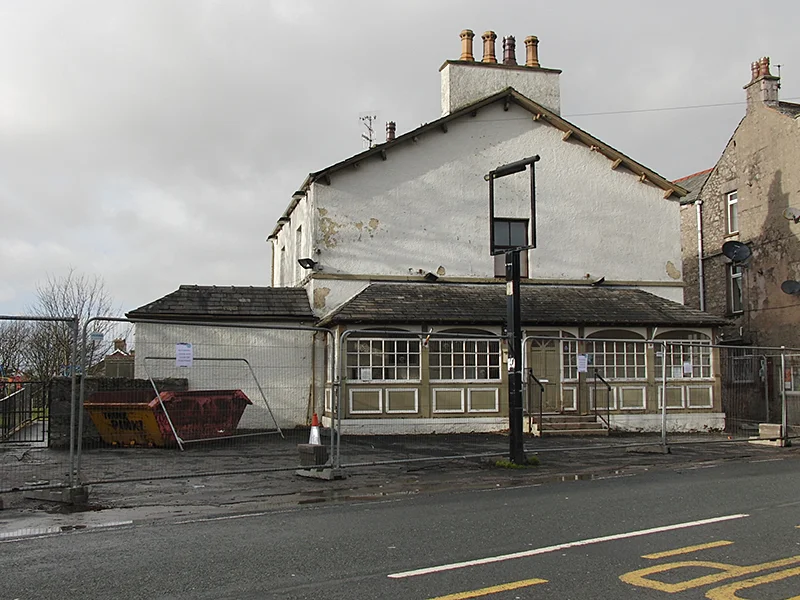

Silverdale, Lancashire
In September 2011, a metal detectorist working a field near Silverdale heard the familiar bleep of his machine and dug down. What came up was 201 pieces of silver — coins, jewellery, ingots, and hacksilver — all packed into a lead container by Viking hands more than a thousand years before. It became known as the Silverdale Hoard - one of the most significant early-10th-century Viking finds in northern England. The treasure later went to the Lancashire Museums Service, but the village it had named is still here: a quiet limestone parish of 1,519 souls, hard against the Cumbrian border, where the geology underfoot is almost as striking as anything the Vikings left behind.
On the Edge of Two Counties
Silverdale stands on Morecambe Bay, four and a half miles north-west of Carnforth and eight and a half miles from Lancaster. Administratively it is in Lancashire - the City of Lancaster district, the Morecambe and Lunesdale constituency - but you can almost throw a stone into Cumbria from the highest paths above the village. The whole parish lies within the Arnside and Silverdale National Landscape, formerly an Area of Outstanding Natural Beauty. The Lancashire Coastal Way begins here, running south all the way to Freckleton. The Cumbria Coastal Way starts here too, heading north to Gretna on the Scottish border. Few villages get to anchor two long-distance footpaths.
Limestone, Reeds, and Climbing Routes
The geology shapes everything. The parish includes Eaves Wood, Gait Barrows National Nature Reserve, Hawes Water (not to be confused with the Haweswater reservoir over in Cumbria), Jack Scout, the RSPB's Leighton Moss, and Trowbarrow Quarry - all Sites of Special Scientific Interest, with the whole of Morecambe Bay another SSSI alongside them. Leighton Moss is one of the great northern wetland reserves, all reed beds and water rails and bittern booms in spring. Trowbarrow Quarry, once a Tarmac operation, is now a popular climbing crag, its limestone walls reading like a textbook of the Carboniferous. Twenty listed buildings stand within the parish, including the grade II* parish church of St John, built in 1885-86 to a Gothic Revival design.
Elizabeth Gaskell's Holiday Tower
Silverdale has more literary associations per resident than most villages its size. Elizabeth Gaskell, the Victorian novelist of Mary Barton and North and South, holidayed regularly in Silverdale between writing trips and is said to have written parts of her work in Lindeth Tower - a Grade-II-listed folly above the bay. The Gaskell Memorial Hall in the village centre is named for her. Other residents have included the poet Gordon Bottomley (1874-1948), whose visitors included the painter Paul Nash; the comic novelist Kyril Bonfiglioli, author of the Mortdecai books, who lived here in the 1960s and put his Silverdale home into his fiction; and the comedian Victoria Wood (1953-2016), who was at one time resident. The Yorkshire-born novelist Willie Riley moved here in 1919 and named his house Windyridge after the title of his first novel.
A Bay That Has Taken Its Tributes
The view across Morecambe Bay is one of the great consoling vistas in the north of England - sand, sky, and the long blue ridges of the Lake District floating beyond. The same bay has also taken its tribute. On 3 September 1894 the Morecambe pleasure boat Matchless capsized off Jenny Brown's Point during a trip from Morecambe to Grange-over-Sands. Twenty-five holidaymakers from the industrial towns of Lancashire and Yorkshire drowned. It remains the largest single loss of life in any incident on Morecambe Bay. The village's Leeds Children's Charity ran a holiday camp for children from working-class Leeds families from 1904 until 2016, often bringing youngsters who had never before left the city - some of whom, in the camp's own records, were seeing cows in a field for the first time. Among the charity's patrons is Matthew Lewis, the Leeds-born actor who played Neville Longbottom in the Harry Potter films.
An Old Village With Recent Tremors
Life in Silverdale moves at a measured pace. The handbell ringers, founded in 1906, still entertain at Christmas. The village players stage a pantomime each year. The library, briefly closed in 2016 in the face of village protests, was reopened in November 2017. The Silverdale and Arnside Art and Craft Trail draws artists each summer. And then, just before Christmas 2025, the ground itself spoke up. At 23:23 on 3 December an earthquake of magnitude 3.2 struck with its epicentre just off the coast of Silverdale. Residents reported it as 'so powerful it shook the whole house' - 'like someone driving into the house.' No serious damage. A magnitude-0.8 aftershock followed an hour and a half later, with smaller tremors over the following weeks. The bay, the limestone, the village - all of them still settling, in their own slow way.
From the Air
Silverdale sits at 54.167N, 2.827W on the north coast of Lancashire, hard against the Cumbria border on the northeastern shore of Morecambe Bay. From altitude look for the wooded limestone rise of the village, the reed beds of Leighton Moss to the south, and Trowbarrow Quarry just east. Morecambe Bay itself dominates the southern horizon. Nearest airports are Blackpool (EGNH) about 25 nm south, Walney Island (EGNL) 22 nm west, and Carlisle Lake District (EGNC) 55 nm north. Recommended viewing altitude 2,000-3,000 ft AGL.
Nearby Stories
- Red Tarn 4.2 km away
- Fleetwood Lifeboat Station 4.3 km away
- St Bees Priory 5 km away
- Brough Castle 9.5 km away
- Sawley Abbey 9.8 km away
- Hawes Junction Rail Crash 15 km away
- Egremont Castle 28 km away
- Celtic Array 63 km away