.jpg)
Simpson's-in-the-Strand
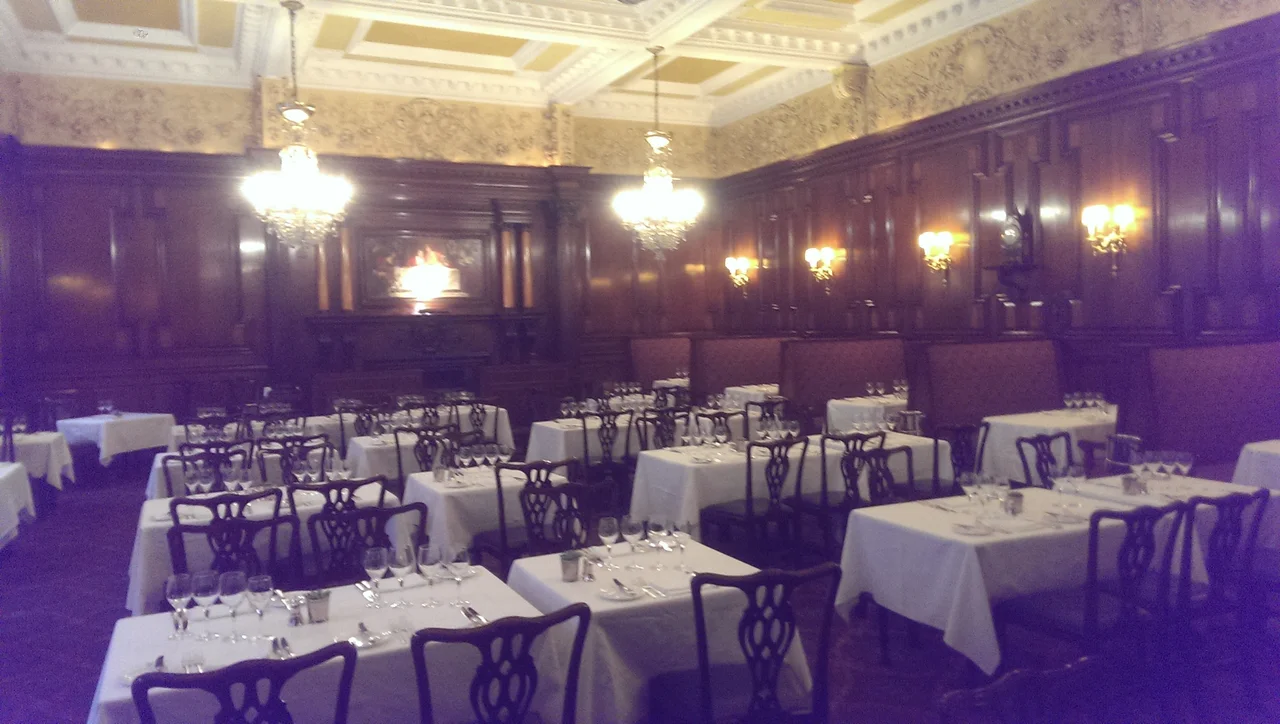
P.G. Wodehouse called it "a restful temple of food." He was not alone in that view. In his 1915 description, Wodehouse conjured the scene perfectly: white-robed attendants wheeling smoking silver trolleys through the dining room, the absence of any "strident orchestra" forcing diners to bolt their beef, the solid comfort of a place where a man could sit alone with his food and be left in peace. Sherlock Holmes, at the conclusion of "The Adventure of the Dying Detective," pronounced that "something nutritious at Simpson's would not be out of place." Both were right. Simpson's-in-the-Strand opened in 1828 and for nearly two centuries was one of the most celebrated dining rooms in England.
The Chess Capital of England
Before it was famous for roast beef, Simpson's was famous for chess. When the establishment opened in 1828, it was a smoking room, then a coffee house, and by around 1850 it had become the Grand Cigar Divan — the most important chess venue in Britain in the nineteenth century. Matches were played against other coffee houses across the city, with top-hatted runners carrying the news of each move between locations.
Howard Staunton, the unofficial world chess champion during the 1840s and 50s, played here regularly. The chess sets were serious, the players often world-class, and the atmosphere sufficiently prestigious that The Times would later note that the removal of chess from the premises when the Savoy Hotel group bought it at the end of the century "was sufficient to shift the centre of the chess world away from London permanently."
The Silver Trolley Tradition
When the restaurant was expanded and renamed Simpson's Grand Divan Tavern in the mid-19th century, the proprietor introduced the tradition that would define its identity for 150 years: large joints of meat wheeled silently on silver dinner trolleys to each table, then carved in front of the guests. Aged Scottish beef on the bone was the signature. Saddle of lamb, steak and kidney pie with Yorkshire pudding, potted shrimps — these were the landmarks of the menu.
The head chef Thomas Davey, who died at 72 in 1914 having spent decades in the kitchen, commanded a brigade of 100 men and oversaw the daily preparation of 1,400 pounds of English meat, 300 pounds of turbot, and 100 pounds of Scotch salmon. The Times covered his death under the headline "Thomas Davey and his culinary patriotism." A chef dying in harness was news fit to print.
Through Two World Wars
The First World War initially left Simpson's supplies relatively intact, though manpower was scarce. By 1917, all luxury restaurants were required to offer a meat-free menu one day per week. Simpson's managed with fish — salmon, sole, turbot — on the designated days. The restaurant's famous sirloins and saddles of mutton disappeared from the trolleys during the Second World War and were not fully restored until well after the war ended, since Britain remained on food rationing until 1954.
Through the inter-war years, the restaurant retained its prestige. The death of its long-serving doorman in 1934 warranted press coverage: "it is estimated that 'Old Matt' opened the doors of over 2,000,000 private cars, taxicabs, and — in Edwardian days — hansom cabs which drew up outside Simpson's." The scale of that estimate, true or not, speaks to how embedded the restaurant was in London's social landscape.
The Closed Doors and the Return
Simpson's dropped its rule barring women from the panelled street-level dining room at lunchtime in 1984 — a reform that required spelling out only because the restriction had existed until that year. The restaurant was awarded a Michelin star in 1974, the first year the Michelin Guide covered England. It earned its 150th anniversary in 1978 with a menu reconstructed from the earliest records: turtle soup, roast sirloin, saddle of mutton, boiled syrup roll.
The restaurant closed in March 2020 due to the COVID-19 pandemic. In 2023, the Savoy auctioned off the silver trolleys, grand pianos, fireplaces, chandeliers, and furnishings that had defined the dining room. The restaurant reopened in March 2026 under new management, restaurateur Jeremy King. The building itself remains part of the Savoy complex on the Strand, and whatever form the reopened Simpson's takes, it returns to one of London's most historically layered addresses.
From the Air
Located at 51.5106°N, 0.1208°W on the Strand in the City of Westminster, adjacent to the Savoy Hotel. The Thames is approximately 0.2 miles south. Nearest airports: London City (EGLC, ~7nm east), Heathrow (EGLL, ~14nm west). Waterloo Bridge and the South Bank are visible across the river. Trafalgar Square is 0.3 miles to the west.
Nearby Stories
- Stevenage 5.7 km away
- Malling Abbey 5.7 km away
- 1952 Farnborough Airshow Crash 7.7 km away
- Ingatestone Hall 8.2 km away
- Hellfire Caves 9.1 km away
- The Carrington Event: The Solar Storm That Could Happen Again 9.8 km away
- Bletchley Park 16 km away
- Castle Hedingham 23 km away