
Slane
In the spring of 433 AD, according to the seventh-century monk Muirchu, Saint Patrick climbed the hill north of what is now the village of Slane and lit a Paschal fire to mark Easter. Sixteen kilometres south on the Hill of Tara, the High King Laoire was holding his own festival fire, and had decreed that no other fire could be lit in the kingdom while his was burning. Patrick lit one anyway. Laoire could see the flames from Tara. According to the legend, the king was so impressed by the audacity that he let Patrick keep preaching. Historians do not believe the story exactly as Muirchu told it, but the Hill of Slane has been a place of fire and ceremony for so long that the legend feels like it has always belonged here.
The Hill
The Hill of Slane rises 158 metres above the river, and from its summit on a clear day you can see the Mournes to the north, the Wicklows to the south, and the Hill of Tara across the country to the southwest. The Fir Bolg king Sláine mac Dela is said in the Metrical Dindshenchas to have been buried here - the place was once called Druim Fuar and came to be called Dumha Sláine in his memory. There is an artificial mound on the western end of the hilltop, possibly a burial. The Christians who came after Patrick chose the hill almost certainly because something already stood there - perhaps a Tuatha Dé Danann shrine, possibly marked by the two standing stones that survive in the burial yard. By the medieval period, the hill held a monastery, a school, and a round tower; the Annals of the Four Masters record that in 948 Vikings burned the belfry of Slane with its full of relics and distinguished persons inside, along with the lector Caeineachair and the patron saint's crozier. What stands on the hilltop today are the ruins of a friary church and a 19-metre Gothic tower from a 1512 restoration. The friary was abandoned in 1723.
The Castle and the Concert
Slane Castle stands on the north bank of the Boyne about a kilometre upstream of the village. The Conyngham family acquired it during the Williamite confiscations of the seventeenth century, replacing the Flemings, who had been Norman lords of Slane since the 1170s and whose original motte and bailey can still be found in the trees on the Hill of Slane. The current castle is mostly an eighteenth- and nineteenth-century rebuilding, with grounds landscaped by Capability Brown. South of the castle, the ground slopes toward the river in a natural amphitheatre that has hosted concerts since 1981 - Thin Lizzy, the Rolling Stones, U2, Bowie, Springsteen, Queen, Dylan, Madonna, the Foo Fighters, Eminem, Harry Styles. In the grounds is an ancient well, blessed in Irish mythology by the physician-god Dian Cecht so that the Tuatha Dé Danann could bathe and heal from any wound short of decapitation. After Christianity arrived, the well was rededicated to Our Lady. The Legion of Mary still leads pilgrimages there every August.
Gallows Hill
The centre of the village incorporates a rise called Gallows Hill, named for what was done there after the failed United Irish rebellion of 1798. In the aftermath, captured United Irishmen from the local area were hanged in public on a gallows at the foot of the hill - in the place where the present-day Slane Credit Union stands - as deterrent to further agitation for independence. There is no memorial; just a name on a map, and a building doing modern banking on top of an execution site. The 1798 rising was the largest single revolutionary attempt in Irish history before 1916, and its suppression killed perhaps 30,000 people across the country. The young men hanged at Slane are not individually remembered. The hill that took their names is now a quiet residential street.
Mill, Bridge, and Whiskey
David Jebb, the engineer who built the Boyne Navigation canals in the 1760s connecting Slane to the port at Drogheda ten kilometres downstream, also built Slane Mill. The five-storey cut-stone building stands on the north bank by the bridge, completed in 1766, and for a while it was the largest flour mill in Ireland. Water from the Boyne, channelled through a weir under the building, turned the grindstones until the 1870s. The mill was later converted to processing scutch flax for linen, then to hydroelectricity. Both old and new mills are now largely silent, victims of the same global textile collapse that emptied so many similar buildings across the British Isles. The 14th-century bridge below the mill is a different kind of monument. The N2 descends a steep hill from the village and makes a near-ninety-degree turn onto the bridge, and the wall on the right-hand side has a row of small white crosses, one for each death on this stretch of road. A 30 kilometre-per-hour speed limit was imposed in 2009, and fatal accidents have ceased. The bridge has one happier memory: on the evening of 18 May 1969, a truck loaded with Bushmills whiskey lost its brakes coming down the hill and rolled over the wall into the river. The driver survived. The village did not let the cargo go to waste. Vans and trucks were seen leaving in the dark. Five Irish divers arrived the next day and recovered 408 bottles. The local butcher was reportedly still drinking Bushmills four years later.
The Bones of the Country
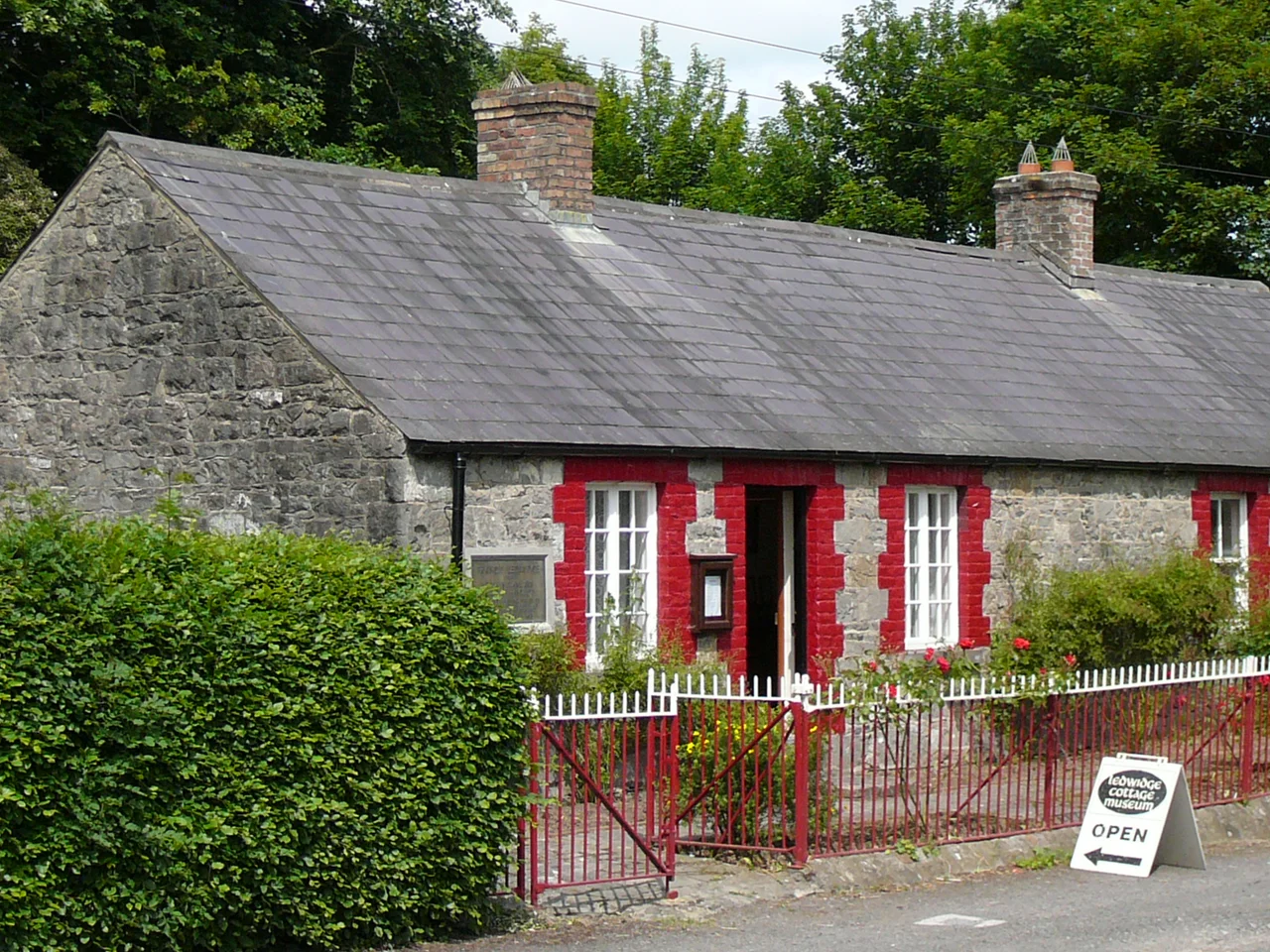
Slane sits at the centre of one of the densest concentrations of ancient sites in Europe. Five kilometres downstream, on a bend in the Boyne, lies Bru na Boinne - the UNESCO complex of Neolithic chamber tombs that includes Newgrange, built about 3200 BC, older than the pyramids and aligned so precisely that the rising sun at the winter solstice illuminates its inner chamber. Ten kilometres downstream is the site of the Battle of the Boyne, where William of Orange defeated James II in 1690. The Hill of Tara, the inauguration site of the High Kings of Ireland, lies sixteen kilometres south. A proposed bypass to take heavy traffic out of Slane village was refused in 2012 because it would have crossed the viewshed of Newgrange. The poet Francis Ledwidge was born here in 1887 and killed at Passchendaele in 1917; his cottage on the road north of the village is now a small museum. The village population is 1,445 at the 2022 census. Most days the place is quiet. On a Saturday in August every few years, 80,000 people walk down the hill toward the river and the castle, and the concert begins.
From the Air
Slane village is at 53.71 degrees north, 6.54 degrees west, on the north bank of the Boyne about 30 miles north of Dublin in County Meath. Nearest airport is Dublin (EIDW) about 30 miles south. From 2,000-4,000 feet in clear weather, the Hill of Slane rises 158 metres just north of the village, with the friary ruins on its summit. The Boyne loops east from here, passing Newgrange and Bru na Boinne 5 km downstream and the Battle of the Boyne site at Oldbridge 10 km downstream. Slane Castle stands 1 km upstream of the village on the north bank. The Hill of Tara is visible to the south-southwest on a clear day. Best aerial visibility in spring and early summer.
Nearby Stories
- Cootehill 8.4 km away
- Maynooth University 8.7 km away
- Oldcastle, County Meath 12 km away
- 1989 Jonesborough Ambush 15 km away
- Slieve Donard 24 km away
- Kilbeggan Distillery 32 km away
- German submarine U-1051 40 km away
- Minesto 80 km away