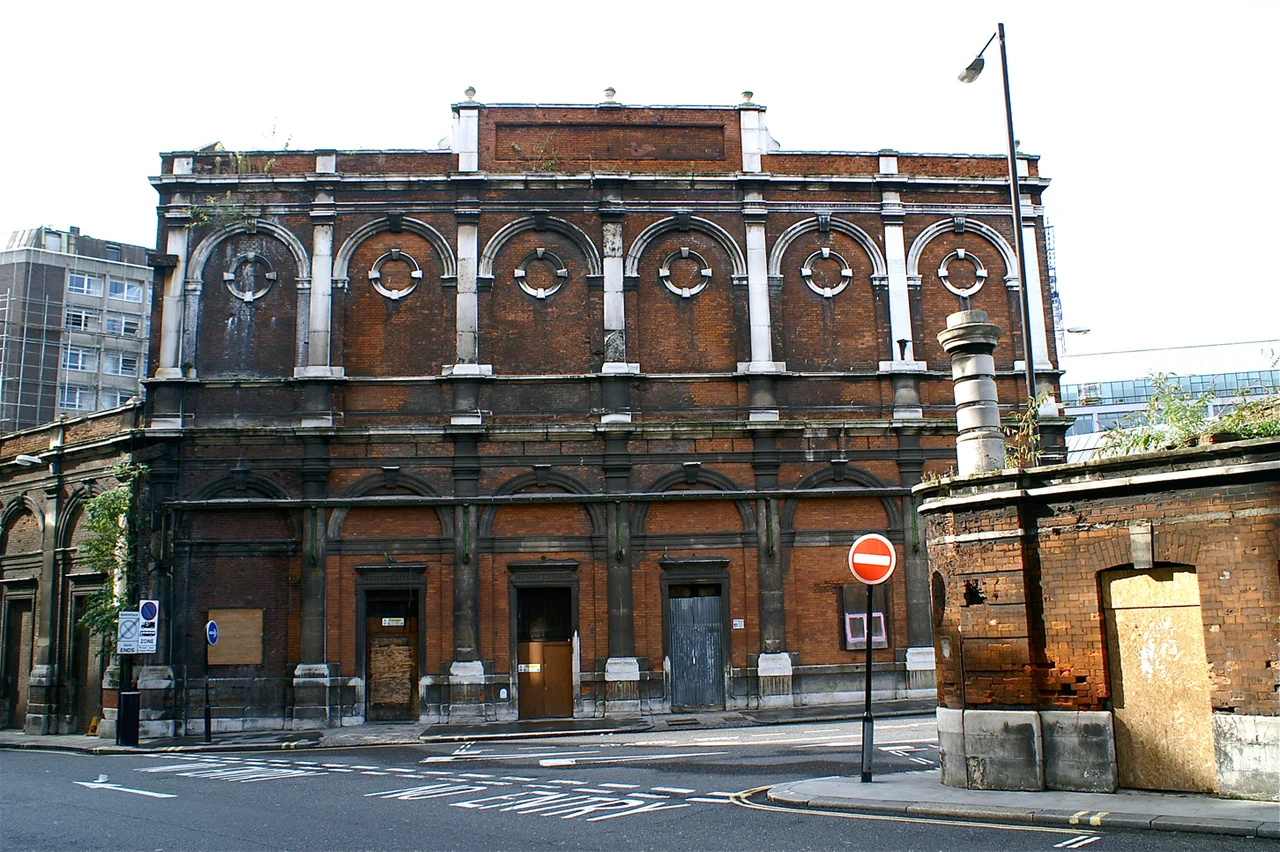

Smithfield, London
On 23 August 1305, the Scottish nobleman Sir William Wallace was dragged through the streets of London, brought to West Smithfield, and put to death in the open ground beside the priory wall. The crowd had come to watch. For perhaps a thousand years before, the same broad grassy field outside the City walls had hosted weekly livestock markets, summer fairs, and jousting tournaments. For five centuries after, it would host the killings of religious dissenters caught on the wrong side of England's shifting faith. Today the same patch of land carries London's only remaining wholesale market, a Grade II listed iron-and-glass cathedral to meat, and the oldest parish church the Great Fire failed to destroy. Few squares of ground in any city have absorbed more.
The Smooth Field
Smithfield's name comes from Smooth Field, the medieval description of the broad grassy area outside London Wall that stretched east to the River Fleet. Easy of access and watered, it was the obvious place to drive livestock into the City, and a livestock market established itself here as early as the 10th century. The trade survives in street names, the ones that still exist and the ones that have vanished: Cow Cross Street, Cock Lane, the lost Chick Lane, Duck Lane, Cow Lane, Pheasant Court, and Goose Alley, all sluiced away in the great Victorian rebuilding. In 1123, King Henry I granted land near Aldersgate to a man named Rahere, a former courtier who had been nursed back to health by Augustinian canons and who founded the Priory of St Bartholomew in gratitude. The priory church, St Bartholomew-the-Great, still stands. It is the oldest church building in the City of London.
The Fair and the Tournament
From 1133 the Augustinian canons hosted the annual Bartholomew Fair, which began each year on 24 August. It was a four-day cloth-trading event and a pleasure ground at the same time, drawing crowds from every layer of English society. It ran for over seven centuries before the City closed it down in 1855, by which time the authorities considered it a magnet for debauchery and disorder. The same grassy field, in the late 14th century, hosted enormous jousting tournaments. Jean Froissart described one called by Richard II at which sixty knights jousted for two days "accompanied by sixty noble ladies, richly ornamented and dressed." Geoffrey Chaucer, in his day job as clerk of the King's Works, supervised the preparations. A Portuguese legend, the Twelve of England, traces back to a Smithfield tournament of the late 14th century, when twelve Portuguese knights are said to have come to defend the honour of John of Gaunt's wife's ladies-in-waiting.
Where the Reformation Burned
The fields outside Newgate were also for centuries London's main place of public execution. Wallace died here in 1305. Wat Tyler, leader of the 1381 Peasants' Revolt, was killed at Smithfield by the Lord Mayor, William Walworth, on 15 June of that year. Most painfully, Smithfield became the principal stake-site for religious dissenters during the convulsions of the English Reformation. About fifty Protestants and reformers, the Marian martyrs, were burned to death here during the reign of Mary I in the 1550s; Catholics and Anabaptists died here too, under reigns that ran the other way. These were ordinary men and women, weavers and apprentices alongside clerics, who refused to recant a creed and paid for that refusal in the most public way the law could manage. On 17 November 1558, several Protestants awaiting execution were saved when a royal herald arrived to announce that Queen Mary had died that morning, before the faggots were lit. The plaque in the wall of St Bartholomew's Hospital today names what happened on this ground and asks the reader to remember the dead by their names where they survive.
Plague Pit and Hospital
In 1348 the Black Death reached London. Walter de Manny rented 13 acres of land north of Long Lane from the Master and Brethren of St Bartholomew's Hospital to use as a graveyard and plague pit. A chapel and hermitage rose over the bodies, and in 1371 the land was granted to a new Carthusian monastery, the Charterhouse. The monks lasted until Henry VIII. In May 1535 the prior, John Houghton, and two companions from other London Carthusian houses were hanged at Tyburn for refusing the Oath of Supremacy. Ten of the monks who refused the oath later starved to death in Newgate Prison. Meanwhile St Bartholomew's Hospital, which had treated the sick from its priory days, was refounded by Henry in 1546 as the House of the Poore in West Smithfield. Its great Henry VIII Gate, opening onto the field, was finished in 1702 and is still the hospital's main entrance.
The Iron Cathedral
By the 19th century, Smithfield's living livestock market had become a public-health scandal. Pamphlets called it cruel and pestilential. Charles Dickens, in 1851, called it a Beast Market in the heart of London such as the French would never tolerate. An act of Parliament moved the livestock north to Copenhagen Fields in Islington, and Smithfield's old field stood empty for a decade. Then between 1866 and 1868, Sir Horace Jones, the same architect who built Billingsgate and Leadenhall, raised the Central Meat Market, an iron-and-glass hall of imperial ambition, served by railway sidings tunnelled directly beneath it. Further halls followed, the Poultry Market between 1873 and 1876, the General Market in the early 1880s, and the Fish Market and Red House cold store at the end of the century. A V-2 rocket destroyed part of Charterhouse Street on the very last days of the war in 1945, killing more than 110 people. A devastating fire in 1958 killed two firefighters and led directly to the London Fire Brigade adopting breathing apparatus. The replacement Poultry Market, completed in 1963, sits beneath what was then the largest concrete shell dome in Europe. The wholesale meat trade still runs here at dawn, 800 years after the first cattle were driven onto the Smooth Field.
From the Air
Coordinates 51.519 N, 0.101 W in the north-west corner of the City of London, just outside the old London Wall. Recommended viewing altitude 1000-1500 ft from the south to keep St Bartholomew's Hospital, St Bartholomew-the-Great church, and the long iron market halls of Charterhouse Street all in the same frame. The General Market and Central Market line the south side of the square; the Charterhouse complex sits to the north. Nearest airports: London City (EGLC) about 6 nm south-east, London Heathrow (EGLL) about 14 nm west. Class D airspace under the London City CTR; transit clearance required for central London. Best visibility in late morning when the market is closed and tour boats below carry visitors who often head here next.
Nearby Stories
- Stevenage 5.7 km away
- Malling Abbey 5.7 km away
- 1952 Farnborough Airshow Crash 7.7 km away
- Ingatestone Hall 8.2 km away
- Hellfire Caves 9.1 km away
- The Carrington Event: The Solar Storm That Could Happen Again 9.8 km away
- Bletchley Park 16 km away
- Castle Hedingham 23 km away