
Smoke Hole Caverns
Local lore says the moonshiners liked Smoke Hole Caverns for three reasons: one entrance to guard, fresh water that never stopped flowing, and a ceiling high enough to keep the smoke from giving them away. During Prohibition, when revenue agents combed the Allegheny ridges of West Virginia's Eastern Panhandle looking for illegal stills, the cave under Smoke Hole Canyon was, by every practical measure, the perfect place to make whiskey.
How a Cave Becomes a Hideout
The cave takes its name from Smoke Hole Canyon, the steep gorge of the South Branch Potomac that surrounds it. Long before tourists arrived, the geology was already doing the work the bootleggers needed. A single entrance meant a single watch post. The constant drip and pool of cave water meant no hauling barrels uphill. And the second-highest ceiling of any cavern in the eastern United States meant fires could be banked and vapors could drift up into the dark without betraying the operation. Whether every detail of the moonshining stories is true is hard to say. What is certain is that Smoke Hole was a working underground space long before it became a show cave, and the canyon country around it - thirteen kilometers west of Petersburg on West Virginia Route 28 - was famously hard for outsiders to police.
The Ribbon and the Helictites
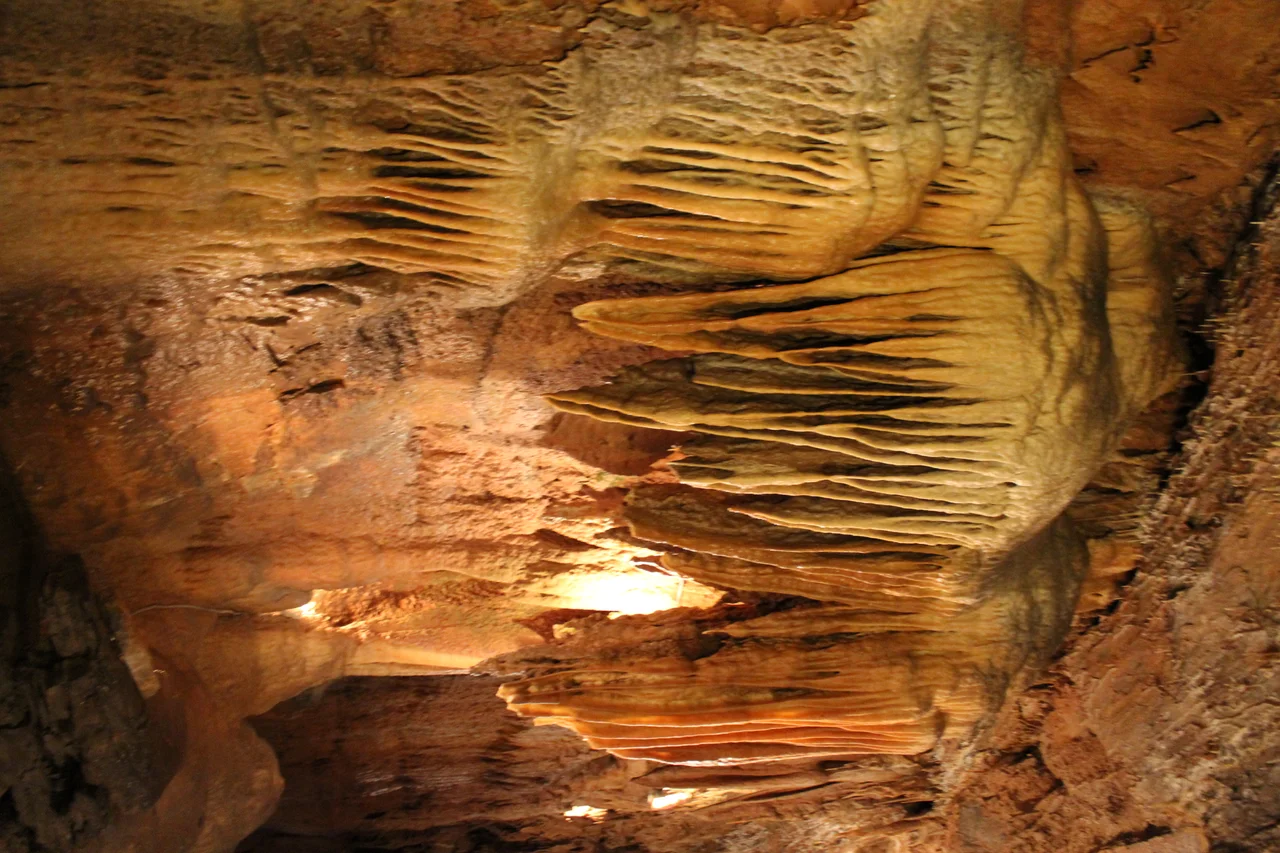
When Smoke Hole Caverns opened to the public on May 30, 1940, it was marketed for things older and stranger than Prohibition. The signature feature is billed as the world's largest ribbon stalactite - a long, banded sheet of calcite that hangs from the ceiling like a frozen curtain. Elsewhere in the cave, helictites grow in directions gravity does not permit, twisting sideways and even upward as crystal forms outpace whatever rules water alone would impose. The crystal cave coral pool, a clear basin lined with delicate calcite, is reportedly found in only one other cavern in the world. For a small show cave on a back highway in the Eastern Panhandle, that is an unusually high concentration of mineralogical rarity.
A Tourist Cave in Tension With Itself
Making Smoke Hole accessible required compromises that geologists have not been quiet about. Concrete walkways were poured to keep visitors dry and steady. Rainbow trout were introduced and the coral pool aerated to make it more visually striking. Lighting was installed to highlight features the eye could not see in pure darkness, but the lamps proved harsh for cave ecology. The combined effect, by the cavern's own scientific descriptions, has caused extensive damage to the stalactites and stalagmites - the very formations that brought visitors in the first place. It is a familiar pattern in American show caves: the modifications that allowed millions of people to wander into the underground also accelerated the slow chemistry that had been shaping these chambers for tens of thousands of years.
Family Operation in Canyon Country
Smoke Hole Caverns has operated as a family-run roadside attraction since 1940, the kind of independent show cave that once dotted Appalachian highways and is now rarer every year. The setting helps. Smoke Hole Canyon is one of the deepest gorges in West Virginia, with limestone walls rising sharply above the South Branch Potomac River, and the surrounding country is part of the same wild Allegheny landscape that produced Seneca Rocks and the Monongahela National Forest. Stop for the cave, and you find yourself in a corner of West Virginia where the geology has not finished writing the next chapter.
From the Air
Located at 38.99 degrees north, 79.27 degrees west, along WV 28 in the Smoke Hole Canyon of Grant County, West Virginia. From 5,000 to 7,000 feet AGL the deep canyon of the South Branch Potomac is the prominent feature; the cavern itself is below ridge level and not visible from the air. Nearest airports are Grant County (W99) just to the north near Petersburg and Eastern WV Regional / Martinsburg (KMRB) farther east. Watch for ridge turbulence in westerly winds.
Nearby Stories
- Mount Storm Power Station 1.3 km away
- Davis & Elkins College 3.7 km away
- Battle of New Market 7 km away
- Cheat Mountain 10 km away
- North Fork Mountain 14 km away
- International Mother's Day Shrine 24 km away
- Jackson's Valley Campaign 33 km away
- Willa Cather Birthplace 38 km away