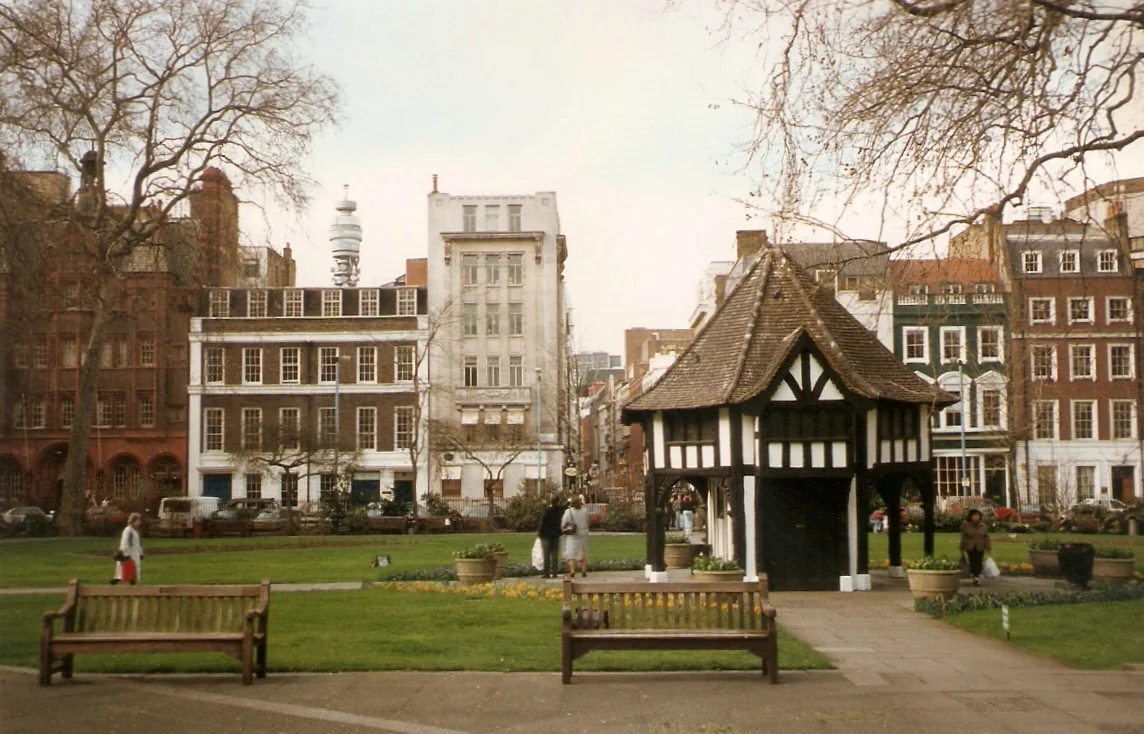

Soho Square
On the central lawn of Soho Square stands a tiny black-and-white half-timbered gardener's hut, built in 1926 to disguise an electricity substation. It looks like a market cross dropped in from a Cotswold village. A few yards away, a weathered statue of Charles II watches the office workers eat their lunches; the sculpture has stood here, with one long interruption, since 1681. On a bench at the western edge, fans of the singer Kirsty MacColl gather each October, near her birthday, to read aloud the lyrics inscribed on the brass plaque: "One day I'll be waiting there. No empty bench in Soho Square." Few squares in London are so small. Almost none carry as much in so little space.
King's Square
The square was laid out in the late 1670s on what had been hunting ground for Henry VIII, and was first called King's Square in honour of the restored Charles II. The Danish sculptor Caius Gabriel Cibber carved a statue of the king while he was still on the throne, in 1681, and it was set at the centre of the garden. In its early decades the square was one of the most fashionable addresses in London. The Duke of Monmouth had a great house on the south side. By the mid-18th century the aristocracy had begun drifting west toward Mayfair, and Soho's social rank started its long descent into theatres, brothels, and immigrant communities. The name eased to Soho Square at some point before John Rocque's keynote London map of 1746. The statue itself was removed in 1875 by the condiments magnate Thomas Blackwell, whose company Crosse & Blackwell occupied numbers 20 and 21 on the east side, and who placed it for safekeeping in the country garden of his friend the painter Frederick Goodall. It later passed to the dramatist W. S. Gilbert of Gilbert and Sullivan, before eventually returning to the square, though not to the centre.
Joseph Banks's Scientific Salon
In the 1770s the naturalist Joseph Banks, who had circumnavigated the globe with James Cook on the Endeavour, moved into number 32 on the south-west corner. He was elected president of the Royal Society in 1778. His house quickly became one of the most important scientific gathering-places in Europe. Visiting scientists from across the world came to consult Banks's enormous personal library and his herbarium, which preserved plants gathered on his Pacific voyages, and which Banks opened, remarkably, to the general public. The square also held darker histories. Between 1778 and 1836 the house at number 21, the old Manor House, ran as the notorious White House brothel; the magistrate Henry Mayhew called it a place of ill-fame. The women who worked in such houses were largely poor and often trafficked into the trade. Their lives, like the lives of the Huguenots and Italians and Greeks who later filled the neighbouring streets, are easier to lose from the record than the lives of the celebrated philosophers next door.
Animation Drawn in Soho
From 1955 to 1993, number 13 Soho Square housed Richard Williams Animation. Williams, a Canadian-born perfectionist, made television commercials and title sequences from this address while spending decades on a feature that became the never-finished The Thief and the Cobbler. His version of Dickens's A Christmas Carol, animated in the basement, won the Academy Award for Best Animated Short in 1972. Down the corridor in 1967 and 1968, TVC Animation rented studio space at number 20 to produce the Beatles' Yellow Submarine. The square has long been a media address: 20th Century Studios UK is still there; so is Dolby Europe, Tiger Aspect, and Paul McCartney's MPL Communications. The British Board of Film Classification, which decides what Britain may legally see in a cinema, has been at number 3 since 1950. The Football Association sat at number 25 from 2000 to 2009. The houses look like Georgian residences. The basements run with fibre and the upper floors with editing suites.
The Two Churches and the House
The square has three quiet, dignified buildings that remember other Sohos. On the east side stands St Patrick's Catholic Church, built in 1792 for the area's poor Irish immigrants, descendants of the families who had crossed the sea in the wake of the Williamite wars and the slow strangling of Irish trade. The church now runs significant social outreach for Soho's homeless and addicted populations. On the west side stands the French Protestant Church of London, built in 1893 in Flemish Gothic style by the architect Aston Webb, a quiet survivor from the Huguenot exodus that scattered French Protestants across north London in the 1680s. Around the corner at 1 Greek Street is the House of St Barnabas, a charity originally founded in 1862 for homeless women; Dickens used it as the model for Doctor Manette's house in A Tale of Two Cities, which is why the street running behind it was renamed Manette Street.
A Bench for Kirsty
The square's most quietly visited memorial honours the singer Kirsty MacColl, who wrote the song Soho Square for her 1993 album Titanic Days. She was killed in a boating accident in Mexico on 18 December 2000, at the age of 41. Her fans bought a bench in the garden and inscribed it with the lines her song promises: "One day I'll be waiting there. No empty bench in Soho Square." Each October, on the Sunday closest to her birthday, those fans gather at the bench to mark the day. The square outside is small, only a few minutes wide on foot, edged by 30 buildings of which 16 are listed. But it carries Charles II and Joseph Banks and Richard Williams and Kirsty MacColl in the same patch of grass, and on a summer evening when the open-air concerts begin, it still serves the function it was laid out for in the 1670s: a place to be outside, together, in the middle of London.
From the Air
Coordinates 51.5153 N, 0.1322 W in the heart of London's West End, immediately east of Oxford Street and north of Shaftesbury Avenue. Recommended viewing altitude 800-1500 ft from the south. The square is small, only a single block, but recognisable from the air by the half-timbered hut at its centre and the cross of paths through the garden. Surrounding streets include Greek Street to the south, Frith Street to the south-east, and Sutton Row to the east. Nearest airports: London City (EGLC) about 6 nm east, London Heathrow (EGLL) about 14 nm west. Class D airspace under the London City CTR; transit clearance required for central London. Best visibility on bright weekend mornings when summer concerts populate the lawn.
Nearby Stories
- Stevenage 5.7 km away
- Malling Abbey 5.7 km away
- 1952 Farnborough Airshow Crash 7.7 km away
- Ingatestone Hall 8.2 km away
- Hellfire Caves 9.1 km away
- The Carrington Event: The Solar Storm That Could Happen Again 9.8 km away
- Bletchley Park 16 km away
- Castle Hedingham 23 km away