
Soldiers of Gloucestershire Museum
The building started life recording cargoes. Sydney Smirke designed it in 1845 to handle the foreign trade pouring through the Port of Gloucester - timber, corn, salt, tobacco - and it kept that role for more than a century. By coincidence Smirke also designed the building that now houses the Imperial War Museum in Lambeth. So when the customs clerks finally packed up and left in the 1970s, the Gloucestershire Regiment moved in with their archive, their medals and their stories, and the Victorian customs house at Gloucester Docks became the Soldiers of Gloucestershire Museum. It still smells faintly of brick dust and gun oil, the way a regimental museum should.
Two Regiments, Two Counties
The museum tells the story of two units that drew their recruits from the same soil: the Gloucestershire Regiment, which traced its origins to the 28th (North Gloucestershire) Regiment of Foot raised in 1694 and the 61st (South Gloucestershire) Regiment of Foot, and the Royal Gloucestershire Hussars, a cavalry regiment formed in the 1790s. Between them they fought in essentially every conflict Britain joined for two and a half centuries - the Peninsular War, Waterloo, the Crimea, the long Victorian small wars, two World Wars, Korea, and the postwar deployments that ended with regimental amalgamations. The Royal Gloucestershire Hussars rooms hold particularly fine silver, painted miniatures of officers, and uniforms preserved in the dim, controlled light that prevents Victorian dyes from fading.
Four Victoria Crosses
Four men whose Victoria Crosses are held here tell four very different stories. Herbert Taylor Reade of the 61st Regiment won his at Delhi during the Indian Mutiny in 1857. Daniel Burges of the Glosters earned his commanding the 7th Battalion in Bulgaria in 1918, despite being severely wounded - he later lost a leg. Hardy Falconer Parsons was a 20-year-old second lieutenant who held a German bombing attack at bay almost single-handedly in 1917, was severely burned, and died of his wounds; his VC was awarded posthumously. James Carne, the most recent of the four, commanded the 1st Battalion the Glosters at the Battle of the Imjin River in Korea in April 1951. He spent two and a half years as a prisoner of the Chinese in conditions that broke many of his fellow officers. He came home and never made a fuss about any of it.
Imjin
The most recent significant acquisition in the museum is a service revolver collected from Gloster Hill - or Hill 235, as the maps called it then - where the 1st Battalion the Gloucestershire Regiment made their last stand against overwhelming Chinese forces on 25 April 1951. The battalion held for three days against a force that outnumbered them roughly ten to one. They ran out of ammunition. They ran out of options. Most who survived became prisoners. The action earned the Glosters a US Presidential Unit Citation and the back-badge tradition - already a Gloster peculiarity since their stand at Alexandria in 1801 - took on a Korean dimension. The Korean War Room at the museum has an audio-visual display in which the surviving soldiers tell the story in their own voices. There is no glamour in their accounts. There is only what happened, what they did, and who did not come home.
Dunkirk, Burma, Trenches
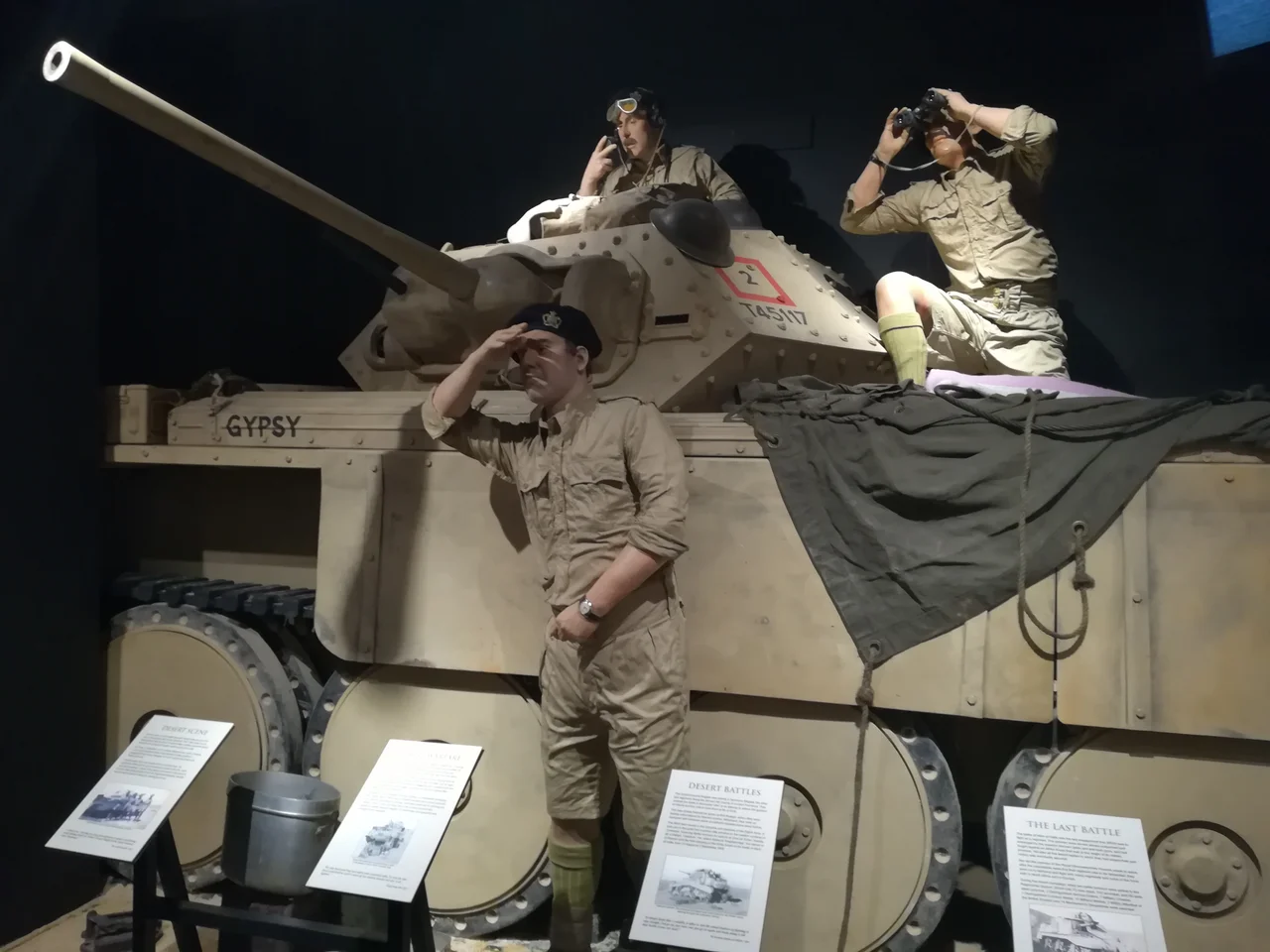
Other rooms unfold chronologically. The World War I rooms display weapons, drawings and the small artefacts of trench life. A lifelike tableau reconstructs a 1916 dugout. World War II tells the bitter rearguard story of the Glosters at Dunkirk in 1940, where the battalion held positions to allow the evacuation. A second tableau shows fighting in the jungles of Burma in 1944. The National Service Room covers the period from the late 1940s to the early 1960s when British young men were conscripted for a couple of years - a memory still fresh for many of the museum's older visitors. Twenty-four drawers of medal cabinets hold groups belonging to individual soldiers, each one a small biographical sketch in ribbon and bronze.
The Building Itself
By the early 1840s the old custom house in Gloucester was no longer big enough for the port's traffic. Work on the new building began in April 1844, and the contractors made a late decision to face the walls with Painswick stone rather than the planned brick - which is why the museum looks the way it does, golden and Cotswold-warm rather than red and industrial. The roof was on by October 1844. The total cost when the final payment was made in September 1845 came to £5,780, including land and fittings. The Collector of Customs and his staff moved in. One officer actually lived in part of the building. Trade eventually shifted downriver to Sharpness, the Port of Gloucester declined, the customs work dwindled, and by the late 1970s the building was empty. The Gloucestershire Regiment took it over in 1980, and the Duke of Gloucester opened the museum. The 2014 refurbishment, funded by the Heritage Lottery Fund, brought new audio-visual displays. The horse-on-display - a 'horse' arriving with much local press coverage in March 2014 - represents one of the more memorable recent additions. It is, of course, not a real horse.
From the Air
The museum sits at 51.864 degrees north, 2.250 degrees west, on the north side of Gloucester Docks. Best viewed from 1,500 to 3,000 feet. Look for the rectangular Victorian basin of Gloucester Docks immediately south of the city centre, with the warehouse buildings around its edges and the museum's Painswick-stone facade fronting the basin. The cathedral tower lies about half a mile north. Nearest airport is Gloucestershire Airport (EGBJ) eight miles east-northeast.
Nearby Stories
- Grosmont Castle 4.8 km away
- Charfield Railway Disaster 9.8 km away
- Stratford-upon-Avon Canal 9.9 km away
- Droitwich Spa 11 km away
- Caerleon 12 km away
- Wigmore Castle 13 km away
- Church of the Holy Trinity, Stratford-upon-Avon 27 km away
- Marlborough Castle 29 km away