
Somerset House
If you were born in England or Wales between 1837 and 1970, the paperwork that recorded the fact lived for a long time in the North Wing of Somerset House. So did the marriage certificates and the death certificates: every formal entry in the public life of the country, gathered in one building beside the Thames. The architecture was Georgian and the bureaucracy was Victorian, and together they produced the strange paradox of a riverside palace whose business was registers, taxes, and stamps. Today the same quadrangle is a centre for art and culture, with fountains that play in summer and an ice rink that fills the courtyard each winter. Few addresses in London have changed function so completely while keeping the same stones.
Old Somerset House
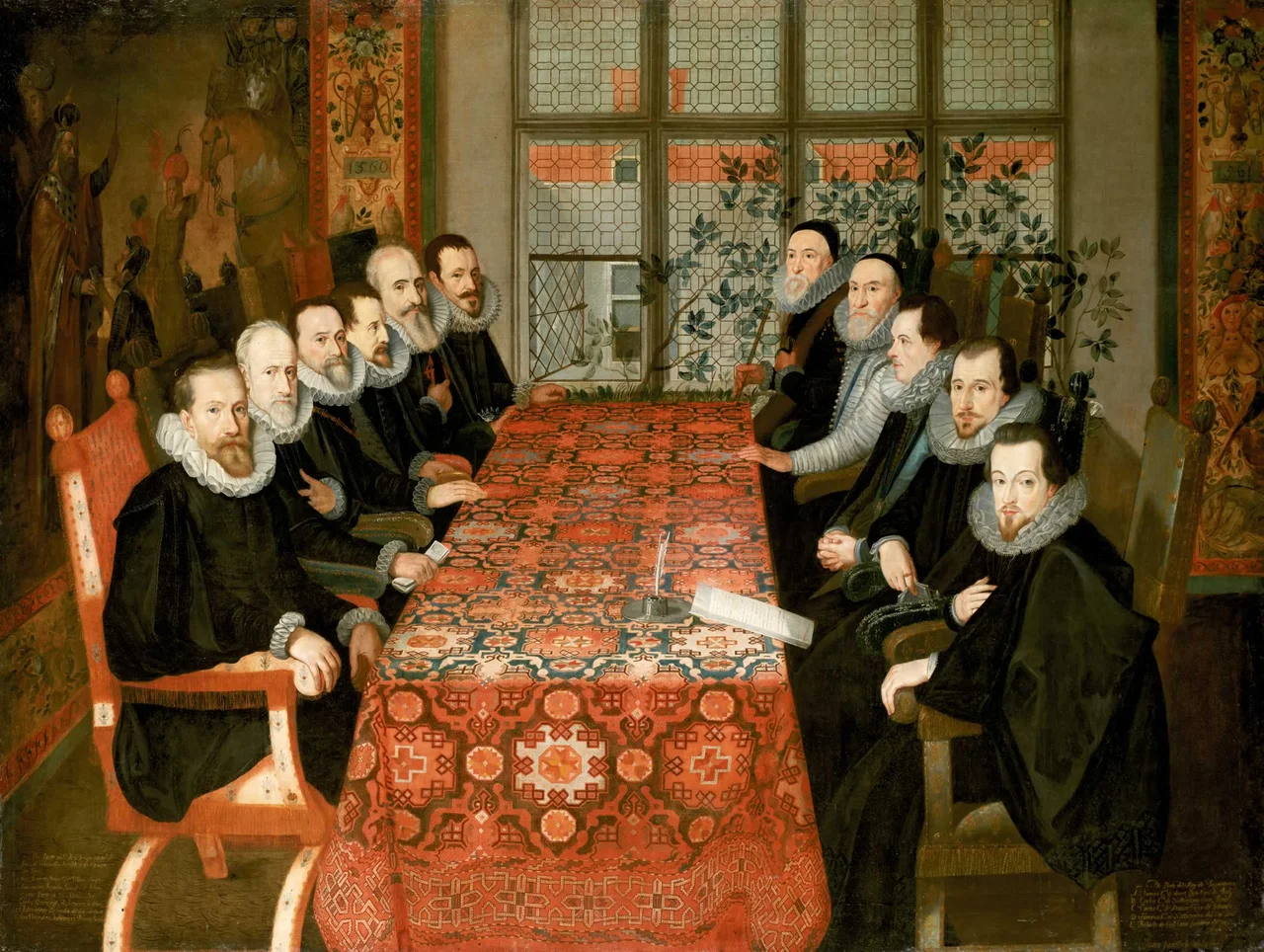
In 1539 the courtier Edward Seymour, soon to be Lord Protector for the boy king Edward VI, obtained a grant of land at "Chester Place, outside Temple Bar" from his brother-in-law Henry VIII. He built a great Tudor palace here, Somerset Place, that fronted directly onto the River Thames. After Seymour's execution it reverted to the Crown. The future Elizabeth I lived in the house during the reign of her half-sister Mary I, between 1553 and 1558. In 1604 the building hosted the Somerset House Conference, the diplomatic negotiations that ended nineteen years of Anglo-Spanish war. Anne of Denmark, James I's queen, took it as her London residence and renamed it Denmark House, and her French gardener Salomon de Caus built her a fountain crowned by a Pegasus and a cistern that survived in nearby Strand Lane and was for centuries misidentified as a Roman bath. James I lay in state here in 1625 before his funeral at Westminster Abbey.
Chambers Rebuilds
By the 1770s the old palace was a sprawling jumble of wings from different periods, and the government had decided to demolish it and build a single grand public building to house the country's expanding bureaucracy. The architect Sir William Chambers, deeply influenced by the Palladian principles he had absorbed in Rome and Italy, was given the commission. Construction began in 1776. Chambers died in 1796 with the work not yet finished and James Wyatt completed it; by 1801 the new Somerset House was deemed done, at a final cost of £462,323. The ornament was sumptuous. Sculptors including Joseph Wilton, John Bacon, and Joseph Nollekens produced statuary and reliefs to Giovanni Cipriani's designs. The result was a building intended for everything at once: learned societies, naval administration, tax offices, an art academy.
The Royal Academy Years
From 1780 the annual exhibition of the Royal Academy of Arts was held in Somerset House. The painters carried their work up the great staircase to the top floor, where canvases were hung from floor to ceiling in the dense fashion of the age. The Royal Society, the Society of Antiquaries, the Geological Society, and the Royal Astronomical Society all kept rooms here, lodged in the same complex as the Stamp Office and the Tax Office. The Inland Revenue, formed by merging Stamps and Excise in 1849, gradually took over more and more rooms as the academies and societies left, and by 1873 the revenue service occupied most of the building. They stayed for 224 years. Every newspaper printed in Britain, up until 1855, had to be brought to Somerset House to be stamped, the impressed duty proving the tax had been paid. Income tax, first levied in 1799 during the wars with France, was administered from here.
Births, Marriages, Deaths
Civil registration began in England and Wales in 1837. The Registrar General set up his office in the North Wing of Somerset House and stayed for over 130 years. Every birth, every marriage, every death in the two countries generated a certificate that was held in this building until 1970, when the archive moved nearby to St Catherine's House at Aldwych. For genealogists tracking ancestors through 19th and 20th-century England, the address "Somerset House" became a kind of shorthand for proof of existence: the place where the paperwork lived. The Principal Registry of the Court of Probate also sat here from 1859 to 1998, holding the wills. Whatever a Briton inherited, whoever they married, whenever they died, the document was archived behind these walls.
Bomb, Restoration, Skaters
Somerset House had a harder Second World War than its exterior suggests. In October 1940 a direct hit destroyed sixteen rooms in the South Wing, including the rotunda of the Nelson Stair, and damaged 27 more in the West Wing. The repairs, requiring stonemasons in short supply after the war, took until 1952 to complete; the Nelson Stair was painstakingly rebuilt by the architect Sir Albert Richardson. By 1989 the Courtauld Institute of Art moved into the North Wing, bringing the Courtauld Gallery's old masters and Impressionists with them. HM Revenue and Customs gradually withdrew between 2009 and 2013, and the Somerset House Trust took over the full building. The trust rents the upper floors to creative businesses and gives the ground floor over to public events. In the great central courtyard, 55 vertical jets of water dance through the summer; from late November to mid-January, an ice rink fills the same space. On 17 August 2024, a large fire broke out on the roof of the West Wing, in offices rather than gallery spaces; the artworks were saved, the wing damaged. The repairs continue.
From the Air
Coordinates 51.5111 N, 0.1178 W on the north bank of the Thames between Waterloo Bridge and Lancaster Place, on the south side of the Strand in central London. Recommended viewing altitude 800-1500 ft. The building is a great Georgian quadrangle clearly visible from the south side of the river; the courtyard is square, with the fountains and ice rink at its centre depending on the season. Waterloo Bridge passes just to the east, Lancaster Place curls south from the Strand on the west side. Nearest airports: London City (EGLC) about 5 nm east, London Heathrow (EGLL) about 15 nm west. Class D airspace under London City CTR; transit clearance required. Best visibility in winter afternoons when the rink is lit.
Nearby Stories
- Stevenage 5.7 km away
- Malling Abbey 5.7 km away
- 1952 Farnborough Airshow Crash 7.7 km away
- Ingatestone Hall 8.2 km away
- Hellfire Caves 9.1 km away
- The Carrington Event: The Solar Storm That Could Happen Again 9.8 km away
- Bletchley Park 16 km away
- Castle Hedingham 23 km away