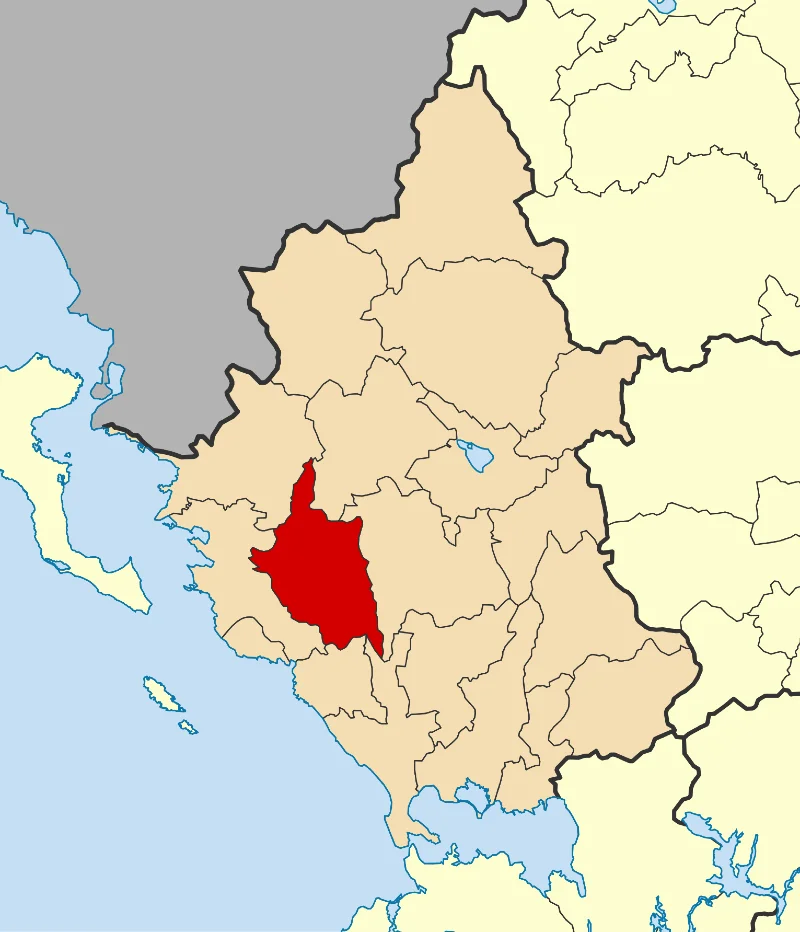

Souli
They came from a village called Gardiki to escape Ottoman oppression, according to the earliest recorded tradition, and they climbed into the mountains of Thesprotia and stayed. The first settlers of Souli were shepherds who found in the rough terrain what the valleys could not offer: distance from authority, defensible ground, and the freedom to live by their own rules. What they built in those mountains over the course of nearly two centuries was something the Ottomans had difficulty classifying: a self-governing Orthodox Christian community, Albanian-speaking, fiercely armed, and remarkably resistant.
Mountain Stronghold
The Souliotes settled a cluster of villages in the steep limestone mountains of what is now the municipality of Souli in Thesprotia, northwestern Greece. At the height of their power in the second half of the 18th century, the Souliote confederation is estimated to have comprised around twelve thousand people across roughly sixty villages. They were Orthodox Christians who spoke Albanian — a community straddling the ethnolinguistic boundaries that the Ottoman system tried to impose on the region.
The name of the place carries its own contested origin story. Christoforos Perraivos, who wrote the earliest historical account of Souli in 1803, recorded a local oral tradition: that a Muslim man named Soulis had tried to expel the first settlers, that they killed him in the ensuing fight, and that the land took his name. The scholar Fourikis, writing more than a century later, suggested that Perraivos may have invented the explanation himself. What is certain is that the community it named was real, and that it knew how to fight.
For decades, the Souliotes successfully resisted Ali Pasha of Ioannina's campaigns to bring them under his control. Ali Pasha, the formidable Ottoman governor who dominated northwestern Greece in the late 18th and early 19th centuries, threw considerable resources at the problem of Souli. The mountains made conventional military approaches difficult; the Souliotes made conventional military approaches dangerous.
The Defeat and the Exodus of 1803
The resistance eventually broke. In 1803, after years of campaigns, Ali Pasha's forces prevailed. The Souliote community — men, women, and children — was forced to abandon the villages in the mountains they had defended for so long. The exodus that followed became one of the foundational images of Greek resistance to Ottoman rule, commemorated in poems, paintings, and folk songs across the Greek-speaking world.
Among the images carried forward from that defeat, the most haunting involves the women of Souli at the monastery of Zalongo. Accounts describe Souliote women, faced with capture, dancing on the clifftop above the monastery and leaping to their deaths rather than surrender to Ali Pasha's forces. The story may be partly mythologized in its details, but the monument at Zalongo — a set of abstract female figures dancing in a spiral toward the cliff edge — stands as a witness to the reality of what was lost. The Souliotes dispersed, many finding refuge in Parga and eventually in the Ionian Islands, others fighting on in the Greek War of Independence that began in 1821.
Ali Pasha built his Castle of Kiafia in the mountains of Souli — the source article notes it was constructed to hide his treasure — but it is now completely abandoned and in ruin. He won the military campaign; the Souliotes outlived his memory.
A Landscape of Abandoned Villages
The municipality of Souli today is a quiet place. Its seat is the town of Paramythia, in the valley below the old Souliote mountains. The villages in the uplands — places like Koukoulios, Zotiko, Tsaggario — are partly abandoned or sparsely populated, emptied not by conquest this time but by the quieter pressures of emigration and urbanization that have drawn people from rural Epirus to cities and abroad throughout the 20th and 21st centuries.
Souliote churches and fortifications survive, some in reasonable condition, others ruined. The landscape that sheltered the community for two centuries — the steep ridges, the limestone outcrops, the sudden views across the Thesprotian lowlands to the Ionian — is still there. By 1972, an Albanian-speaking minority still lived in the area, a linguistic thread connecting the present municipality to the community that founded it.
Memory and Legacy
The Souliotes occupy an outsized place in Greek national memory relative to their numbers. Their resistance to Ali Pasha became a symbol of the broader struggle against Ottoman rule that culminated in the Greek War of Independence. Christoforos Perraivos, who wrote their history in 1803 — the same year of the exodus — helped fix that narrative early.
The question of what made the Souliotes who they were is genuinely interesting. They were Orthodox Christians in a region where many Albanian-speakers were Muslim. They were highlanders in a landscape that rewarded self-reliance. They were neither Greeks nor Albanians in any simple modern sense — they were Souliotes, a community defined by place and practice rather than by the ethnic categories that later centuries would impose on the region. Their descendants eventually dispersed across Greece, Albania, and the diaspora, carrying a name that still carries weight.
From the Air
The Souli municipality centers on approximately 39.37°N, 20.63°E in the interior highlands of Thesprotia, east of the Ionian coast. Flying from Aktion National Airport (LGPZ, approximately 70 km to the south), approach from the southwest at 6,000–8,000 feet to see the rugged limestone ridges of the Souliote mountains. The town of Paramythia is visible in the valley below. The Acheron River plain opens to the southwest. The abandoned villages of the original Souliote community are scattered through the uplands; the Castle of Kiafia ruins lie in the mountains. Clear days offer views across to the Ionian Sea.
Nearby Stories
- Battle of Olpae 9.5 km away
- Achilleion (Corfu) 12 km away
- Battle of Nicopolis (1798) 14 km away
- Corfu 38 km away
- Vikos Gorge 45 km away
- Battle of Karpenisi 49 km away
- Meteora: The Monasteries Built on Impossible Pillars 50 km away
- Hellenic Trench 136 km away