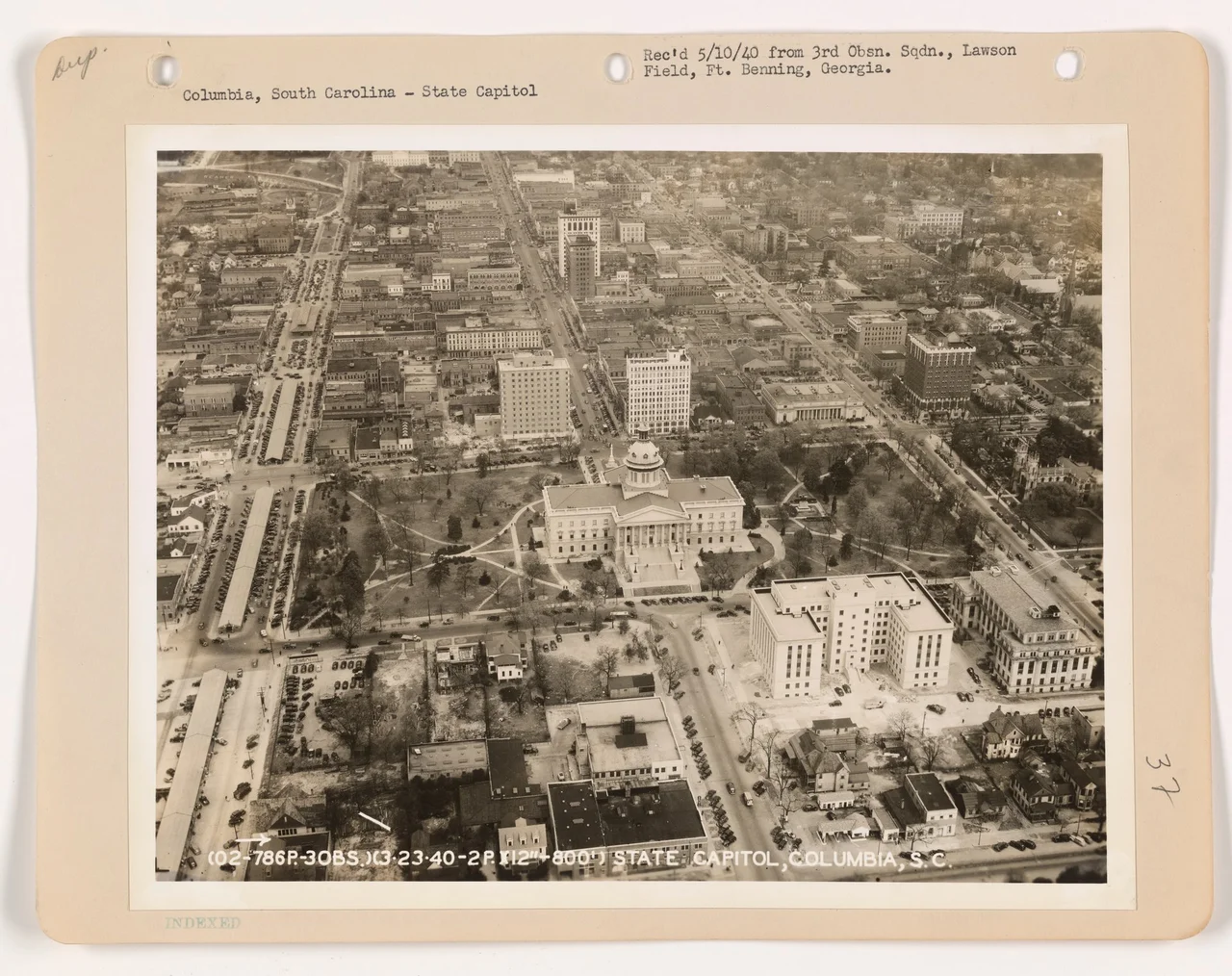

South Carolina State House
Look for the stars first. Six bronze stars are embedded in the western wall of the South Carolina State House, set into the granite by the state itself, marking the spots where Union artillery shells struck the building on February 17, 1865. They are deliberate scars, polished and signed. The capitol that stands today was not yet finished when Sherman's army arrived and Columbia burned. Construction had begun in 1851 and would not be complete for another 56 years. The bronze stars mark a moment in that long building - a moment when the new capitol survived, but the old one across town did not.
Two State Houses, One City
The first South Carolina State House was completed in 1790 to a design by James Hoban, an Irish immigrant who had landed in Charleston after the Revolution. Hoban's work in Columbia caught the attention of Henry Laurens, who recommended him to President Washington. Washington hired Hoban to design the executive mansion in the new federal capital - the building Americans now call the White House. Old prints of the two buildings show clear family resemblance: same proportions, same restraint. The Columbia original burned on February 17, 1865, when Sherman's army occupied the city. The new building, still unfinished, took the artillery hits marked by those bronze stars.
Half a Century of Construction
Construction on the current State House began in 1851 under P. H. Hammarskold. He was dismissed for fraud. The half-built structure was then largely dismantled because of defective materials. John Niernsee took over in 1855 and worked through the Civil War interruption; his son Frank McHenry Niernsee continued in the late 1880s. Frank Pierce Milburn and then Charles Coker Wilson finished the work, completing the exterior in 1907 - the year a 56-year construction project finally ended. The Classical Revival building is about 180 feet tall, 300 feet long, weighs over 70,000 tons, and was designated a National Historic Landmark in 1976 specifically for its role in the Reconstruction era that surrounded its completion.
The Grounds and the Arguments
The grounds carry more arguments than any other state capitol's. The 1879 South Carolina Monument to the Confederate Dead was unveiled before 15,000 people, an early example of Lost Cause commemoration. It went up on the State House grounds only after Reconstruction ended and the biracial Republican legislature was forced out, following the fraudulent and violent 1876 election of Governor Wade Hampton III. The Confederate battle flag flew from the State House dome from 1961 until July 1, 2000, when, after decades of boycotts and protests, lawmakers moved it down to a flagpole beside that 1879 monument. It came down completely on July 10, 2015 - in the days after a white supremacist murdered nine Black worshippers at Mother Emanuel AME Church in Charleston. Governor Nikki Haley signed the removal bill into law.
Monuments to Reckoning
Other monuments still demand argument. The Benjamin Tillman statue, dedicated 1940, honors a senator who openly advocated terror against Black voters during Reconstruction; protestors have called for its removal. The Dr. J. Marion Sims monument honors a pioneer of gynecology who developed his surgical techniques by operating on enslaved women without anesthesia. A statue of Strom Thurmond, erected in the late 1990s, was later amended to add the name of his daughter Essie Mae Washington-Williams, born of his relationship with an African American household worker - a name his family had not publicly acknowledged in his lifetime. Authorized by Act 457 of the General Assembly and unveiled on March 26, 2001, the African-American History Monument is the only one of its kind on any state capitol grounds, telling four centuries of Black South Carolinian history in bronze relief.
Captain Lunsford's Grave
Buried on the State House grounds is Captain Swanson Lunsford, a Virginia-born Revolutionary War officer who died in 1799. He once owned the land. His descendants erected a marker over his grave in 1953. The Palmetto Monument - cast iron and copper, made by Christopher Werner in 1856 - honors the Palmetto Regiment, South Carolina's soldiers in the Mexican-American War, a war the state's leaders supported because new territory would shift the balance of slave and free states in Congress. The grounds are, in this sense, transparent: nothing has been hidden, even when it should perhaps have been removed. Visitors walk past every argument the state has ever had with itself.
From the Air
Located at 34.0004 degrees N, 81.0331 degrees W, at the corner of Gervais and Assembly Streets in downtown Columbia, South Carolina. The Classical Revival dome is about 180 feet tall and visible from several miles in clear weather. From the air, the State House sits at the center of a grid of state office buildings, with the University of South Carolina campus immediately to the east and the Congaree River about a half-mile to the west. Best viewed from 2,000-3,000 feet AGL. Nearest airport: Columbia Metropolitan (KCAE), 6 nautical miles southwest. Jim Hamilton-L.B. Owens Field (KCUB) is 3 nautical miles south. McEntire JNGB (KMMT) sits 12 nautical miles southeast.
Nearby Stories
- Shaw Air Force Base 5.5 km away
- Fairfield County, South Carolina 16 km away
- Newberry Opera House 30 km away
- Graniteville Train Crash: The Night Invisible Death Came to a Mill Town 31 km away
- Orangeburg Massacre 33 km away
- Battle of Hammond's Store 33 km away
- Hartsville, South Carolina 41 km away
- Middleton Place 101 km away