_by_Claes_Van_Visscher.jpg)
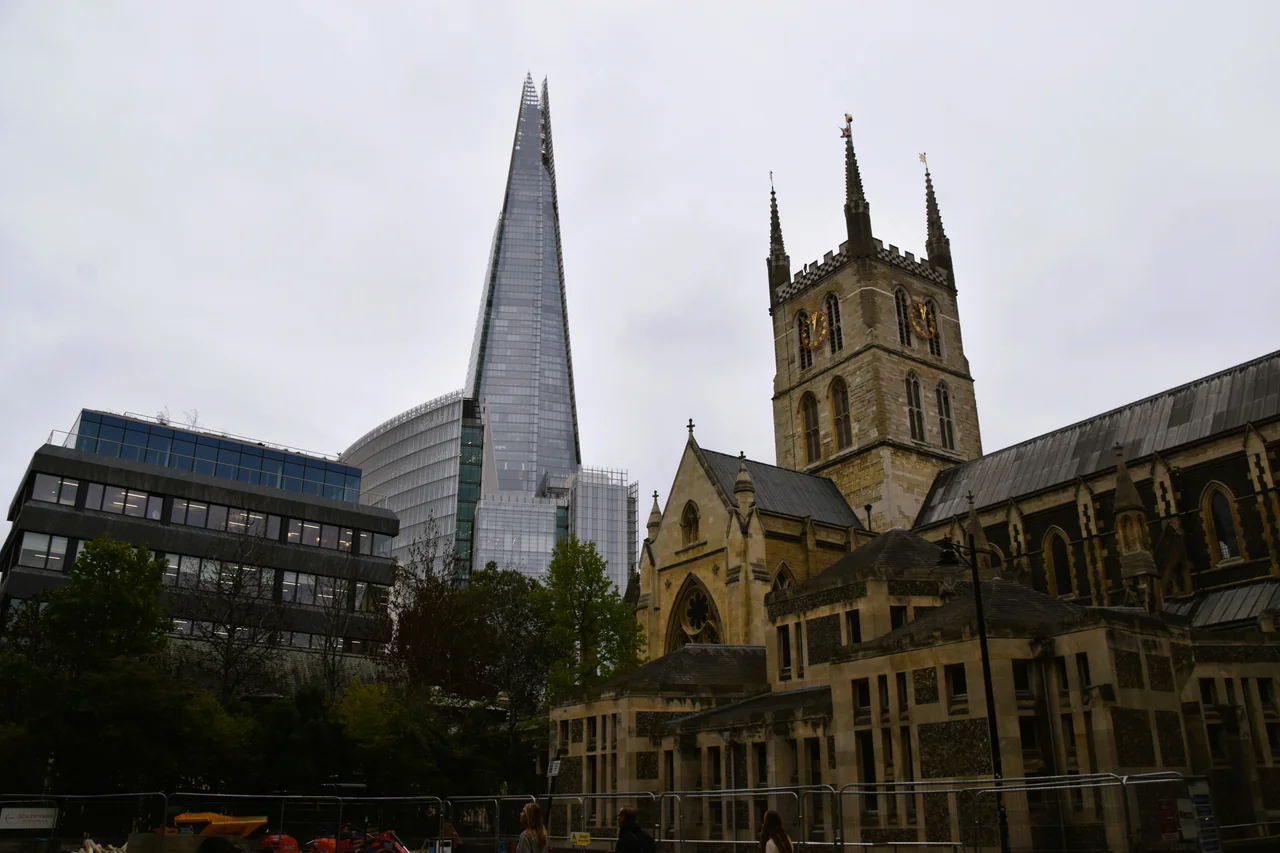
Southwark Cathedral
On 16 March 2018, a stray brown cat named Doorkins Magnificat met Queen Elizabeth II in the south aisle of Southwark Cathedral. Doorkins had been wandering in from the streets in 2008, looking for food and a warm radiator. She stayed. Dean Colin Slee named her in a joking nod to the atheist Richard Dawkins. By the time she retired in October 2019 she was a fixture, beloved enough that her death the following year was reported in the national press and that the cathedral held a memorial service for her, apparently the first such service ever held for a cat. The cathedral that took her in is one of the oldest places of Christian worship in London, the first Gothic church the city built, and the spiritual centre of the south bank of the Thames for more than a thousand years. The story is mostly older than her, but the cat fits.
A Ferry, A Priory, A Saint
The legend recorded by John Stow in the 16th century claimed the church was founded as a nunnery long before the Norman Conquest by a maiden named Mary, on the profits of a Thames ferry inherited from her parents. Later, the story went, it was converted into a college of priests by a noble lady called Swithen, and then refounded as an Augustinian priory in 1106. Some of that is sentimental, and historians today are sceptical that any minster on the site predates the conversion of Wessex in the 7th century. But the Domesday Book of 1086 records a minster of Southwark, and from 1106 the Priory of St Mary Overie ("over the river," to distinguish it from the many City churches dedicated to Mary) was active under the patronage of the Bishops of Winchester. The bishops built their London palace, Winchester Palace, immediately to the west; a fragment of the palace refectory wall, complete with a rose window, still stands on Clink Street.
London's First Gothic Church
The Great Fire of 1212 burned the church down, and the rebuilding that followed produced what is essentially the church standing today: a cruciform Gothic plan, built between roughly 1220 and 1420, the first Gothic church in London. Some 12th-century fragments survived. In the 1390s another fire damaged the building, and around 1420 Bishop Henry Beaufort assisted with the rebuilding of the south transept and the completion of the tower. The 14th-century poet John Gower lived in the priory precinct and is buried in the church; his tomb is unusual in that the original polychrome painting has been kept renewed across the centuries, so the colours look bright. There is also a recumbent wooden effigy of a knight, possibly 13th century, which would make it one of the oldest such memorials in England.
Heresy Trials and Burials
Like every monastic house in England, the priory was dissolved by Henry VIII, surrendered to the Crown in 1540 and re-dedicated to St Saviour. The parishioners leased the church from the Crown until they were able to buy it outright in 1614 for £800. During the reign of Mary I, six high-ranking clergymen including the former Bishop of Gloucester, John Hooper, were condemned to death in heresy trials held in the retrochoir of this church in January 1555. They were burned. As the parish church for Bankside, St Saviour's had close ties to the Elizabethan theatre community working at the nearby Globe and Rose. William Shakespeare's brother Edmund was buried here in 1607; his grave is unmarked but a commemorative stone was later placed in the choir. The dramatists John Fletcher and Philip Massinger are buried here. So is Lancelot Andrewes, Bishop of Winchester and one of the principal translators of the King James Bible, who died in 1626. From the tower of St Saviour's, in 1647, the Czech artist Wenceslas Hollar drew his Long View of London from Bankside, the panorama that became the definitive image of 17th-century London.
John Harvard and the Harvard Chapel
On 29 November 1607, a baby was baptised at the font in St Saviour's. His name was John Harvard. His father Robert, a Southwark butcher and inn-holder, was a business associate of Shakespeare's family and a parochial officer alongside the playwright's colleagues. Three decades later, having migrated to the Massachusetts Bay Colony, John Harvard left half his estate and his library to a new college being founded at Cambridge in the colony. The college took his name. Harvard University paid for the Harvard Chapel in the north transept of the cathedral, dedicated in 1907. The stained glass was designed by the American artist John La Farge and the US Ambassador Joseph Choate gave the window. The upper section shows the red shield of Harvard College with its motto Veritas next to the blue lion of Emmanuel College, Cambridge, where Harvard had taken his degrees in 1632 and 1635.
Bombs, Cathedral Status, the Future
St Saviour's was raised to cathedral status in 1905, becoming the mother church of the new Diocese of Southwark. Between October 1940 and June 1941, more than 1,600 high-explosive bombs and 20 parachute mines fell on the borough of Southwark; the cathedral was damaged in February 1941 and shrapnel scars are still visible on the outside walls. In 2001 Nelson Mandela came to open a new northern cloister built on the site of the old monastic one, with a refectory, education centre, and museum; the Millennium Buildings won architectural awards the following year. The cathedral has been an early and steady advocate for the inclusion of LGBT+ Christians, hosting a 1996 service for the Lesbian and Gay Christian Movement and now welcoming same-sex couples preparing for Civil Partnerships. The church has also confronted the darker side of its institutional history: at a 2015 trial of the facts, the lay clerk Hubert Chesshyre, by then living with dementia, was found to have sexually abused a teenage chorister during the 1990s. The cathedral continues to bear witness to that history alongside the celebration of its older one. A new cat, Hodge, a black-and-white tuxedo from a rescue, arrived in 2020. The mice did not appreciate it. The visitors did.
From the Air
Coordinates 51.5061 N, 0.0897 W on the south bank of the Thames, immediately south-east of London Bridge in Southwark. Recommended viewing altitude 800-1500 ft. From above, look for the cruciform Gothic plan with the central tower; the Shard rises immediately south-east of the cathedral and makes the location unmistakable. Borough Market sits just to the south. The London Bridge railway viaduct runs only 18 metres from the cathedral's south-east corner. Nearest airports: London City (EGLC) about 4 nm east, London Heathrow (EGLL) about 16 nm west. Class D airspace under London City CTR; transit clearance required. Best visibility on clear evenings when the cathedral is floodlit against the Shard's dark silhouette.
Nearby Stories
- Stevenage 5.7 km away
- Malling Abbey 5.7 km away
- 1952 Farnborough Airshow Crash 7.7 km away
- Ingatestone Hall 8.2 km away
- Hellfire Caves 9.1 km away
- The Carrington Event: The Solar Storm That Could Happen Again 9.8 km away
- Bletchley Park 16 km away
- Castle Hedingham 23 km away